PUBLISHER: Global Market Insights Inc. | PRODUCT CODE: 2019188

PUBLISHER: Global Market Insights Inc. | PRODUCT CODE: 2019188
Lotion Pump Market Opportunity, Growth Drivers, Industry Trend Analysis, and Forecast 2026 - 2035
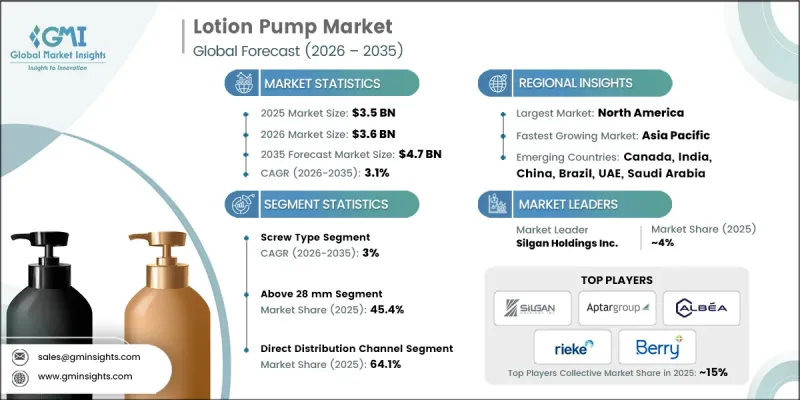
The Global Lotion Pump Market was valued at USD 3.5 billion in 2025 and is estimated to grow at a CAGR of 3.1% to reach USD 4.7 billion by 2035.
Growth in the lotion pump industry is driven by the increasing demand for personal care and skincare products, as consumers adopt more elaborate grooming routines and prioritize hygiene, convenience, and controlled dispensing. Lotion pumps have become an essential component across a wide range of liquid and semi-liquid formulations, supporting their widespread adoption in the broader beauty and personal care sector. Rapid urbanization, improving income levels, and rising awareness around personal grooming are further accelerating product consumption, particularly across developing regions. Additionally, the growing influence of digital platforms is shaping purchasing behavior and increasing demand for aesthetically appealing and functional packaging. Brands are placing strong emphasis on premium packaging designs that enhance usability and visual appeal, positioning dispensing systems as a key factor in product differentiation. Consumers increasingly associate high-quality pumps with superior performance and reliability, reinforcing their importance in modern packaging solutions.
| Market Scope | |
|---|---|
| Start Year | 2025 |
| Forecast Year | 2026-2035 |
| Start Value | $3.5 Billion |
| Forecast Value | $4.7 Billion |
| CAGR | 3.1% |
The screw-type segment generated USD 2 billion in 2025 and is expected to grow at a CAGR of 3% from 2026 to 2035. These pumps are designed to deliver controlled and precise dispensing, reducing product wastage while improving convenience and hygiene. Their durable construction supports compatibility with a variety of formulations, making them a preferred choice for manufacturers. As brands continue to prioritize user-friendly designs and product longevity, screw-type pumps are being integrated into advanced packaging solutions that enhance functionality and maintain product integrity.
The direct distribution channel held a 64.1% share in 2025 and is anticipated to grow at a CAGR of 3.2% through 2035. This approach allows manufacturers and buyers to engage directly, reducing dependency on intermediaries while improving supply chain efficiency and cost management. Direct sourcing also supports better quality control, faster turnaround times, and greater access to innovative packaging technologies. As demand grows for customized and sustainable pump solutions, companies are increasingly favoring direct partnerships to ensure consistency and responsiveness.
United States Lotion Pump Market captured USD 0.7 billion in 2025 and is expected to grow at a CAGR of 3% between 2026 and 2035. Strong consumer demand for premium skincare and beauty products is driving the need for high-performance dispensing systems. The market is further supported by a preference for advanced packaging that combines functionality with visual appeal. Continuous innovation in design, coupled with a focus on enhancing user experience, is contributing to sustained demand for high-quality lotion pumps in the region.
Key players operating in the Global Lotion Pump Market include Albea, APackaging Group, AptarGroup, Berry Global Group, BodyPak, Coster Group, Frapak Packaging, Lompak, OnePlus Packaging, Richmond Containers, Rieke, Silgan Holdings, Taixing K.K. Plastic, Taplast, and Yuyao WellPack Sprayer. Companies in the lotion pump market are focusing on innovation in design and functionality to enhance dispensing efficiency and user experience. They are investing in sustainable materials and eco-friendly manufacturing processes to meet regulatory standards and evolving consumer preferences. Strategic collaborations with personal care brands are helping companies expand their market reach and develop customized solutions. Firms are also strengthening direct distribution networks to improve supply chain efficiency and responsiveness. Additionally, product differentiation through premium finishes, durability, and compatibility with diverse formulations is enabling companies to maintain competitiveness while addressing the growing demand for high-quality and visually appealing packaging solutions.
Table of Contents
Chapter 1 Methodology & Scope
- 1.1 Market scope and definition
- 1.2 Research design
- 1.2.1 Research approach
- 1.2.2 Data collection methods
- 1.3 Data mining sources
- 1.3.1 Global
- 1.3.2 Regional/Country
- 1.4 Base estimates and calculations
- 1.4.1 Base year calculation
- 1.4.2 Key trends for market estimation
- 1.5 Primary research and validation
- 1.5.1 Primary sources
- 1.6 Forecast model
- 1.7 Research assumptions and limitations
Chapter 2 Executive Summary
- 2.1 Industry 360° synopsis
- 2.2 Key market trends
- 2.2.1 Regional
- 2.2.2 Type
- 2.2.3 Material Type
- 2.2.4 Category
- 2.2.5 Neck Size
- 2.2.6 Pump Output
- 2.2.7 Application
- 2.2.8 Distribution Channel
- 2.3 CXO perspectives: Strategic imperatives
- 2.3.1 Key decision points for industry executives
- 2.3.2 Critical success factors for market players
- 2.4 Future outlook and strategic recommendations
Chapter 3 Industry Insights
- 3.1 Industry ecosystem analysis
- 3.1.1 Supplier landscape
- 3.1.2 Profit margin
- 3.1.3 Value addition at each stage
- 3.1.4 Factor affecting the value chain
- 3.2 Industry impact forces
- 3.2.1 Growth drivers
- 3.2.1.1 Rising demand for personal care & skincare products
- 3.2.1.2 Shift toward premium & aesthetic packaging
- 3.2.1.3 Technological advancements in pump mechanisms
- 3.2.2 Industry pitfalls & challenges
- 3.2.2.1 Raw material price volatility
- 3.2.2.2 Rising demand for eco-friendly materials creates cost & manufacturing challenges
- 3.2.1 Growth drivers
- 3.3 Growth potential analysis
- 3.4 Future market trends
- 3.5 Technology and innovation landscape
- 3.5.1 Current technological trends
- 3.5.2 Emerging technologies
- 3.6 Price trends
- 3.6.1 By region
- 3.6.2 By type
- 3.7 Regulatory landscape
- 3.7.1 Standards and compliance requirements
- 3.7.2 Regional regulatory frameworks
- 3.7.3 Certification standards
- 3.8 Trade statistics
- 3.8.1 Major importing countries
- 3.8.2 Major exporting countries
- 3.9 Porter's analysis
- 3.10 PESTEL analysis
Chapter 4 Competitive Landscape, 2025
- 4.1 Introduction
- 4.2 Company market share analysis
- 4.2.1 By Region
- 4.2.1.1 North America
- 4.2.1.2 Europe
- 4.2.1.3 Asia Pacific
- 4.2.1.4 Latin America
- 4.2.1.5 Middle East & Africa
- 4.2.1 By Region
- 4.3 Company matrix analysis
- 4.4 Competitive analysis of major market players
- 4.5 Competitive positioning matrix
- 4.6 Key developments
- 4.6.1 Mergers & acquisitions
- 4.6.2 Partnerships & collaborations
- 4.6.3 New product launches
- 4.6.4 Expansion plans
Chapter 5 Market Estimates & Forecast, By Type, 2022 - 2035, (USD Billion) (Million Units)
- 5.1 Key trends
- 5.2 Screw type
- 5.3 On-Off type
Chapter 6 Market Estimates & Forecast, By Material Type, 2022 - 2035, (USD Billion) (Million Units)
- 6.1 Key trends
- 6.2 Plastic
- 6.2.1 Polypropylene (PP)
- 6.2.2 Polyethylene (PE)
- 6.2.3 Polystyrene (PS)
- 6.2.4 Acrylonitrile butadiene styrene (ABS)
- 6.3 Metal
- 6.3.1 Aluminum
- 6.3.2 Stainless steel
Chapter 7 Market Estimates & Forecast, By Category, 2022 - 2035, (USD Billion) (Million Units)
- 7.1 Key trends
- 7.2 Multi-material pumps
- 7.3 Mono-material pumps
Chapter 8 Market Estimates & Forecast, By Neck Size, 2022 - 2035, (USD Billion) (Million Units)
- 8.1 Key trends
- 8.2 Below 24 mm
- 8.3 24 mm - 28 mm
- 8.4 Above 28 mm
Chapter 9 Market Estimates & Forecast, By Pump Output, 2022 - 2035, (USD Billion) (Million Units)
- 9.1 Key trends
- 9.2 Up to 2 ml per stroke
- 9.3 2 - 4 ml per stroke
- 9.4 Above 4 ml per stroke
Chapter 10 Market Estimates & Forecast, By Application, 2022 - 2035, (USD Billion) (Million Units)
- 10.1 Key trends
- 10.2 Body Care
- 10.3 Hair Care
- 10.4 Skin Care
- 10.5 Baby Care
- 10.6 Others
Chapter 11 Market Estimates & Forecast, By Distribution Channel, 2022 - 2035, (USD Billion) (Million Units)
- 11.1 Key trends
- 11.2 Direct
- 11.3 Indirect
Chapter 12 Market Estimates & Forecast, By Region, 2022 - 2035, (USD Billion) (Million Units)
- 12.1 Key trends
- 12.2 North America
- 12.2.1 U.S.
- 12.2.2 Canada
- 12.3 Europe
- 12.3.1 Germany
- 12.3.2 UK
- 12.3.3 France
- 12.3.4 Italy
- 12.3.5 Spain
- 12.4 Asia Pacific
- 12.4.1 China
- 12.4.2 India
- 12.4.3 Japan
- 12.4.4 South Korea
- 12.4.5 Australia
- 12.4.6 Indonesia
- 12.4.7 Malaysia
- 12.5 Latin America
- 12.5.1 Brazil
- 12.5.2 Mexico
- 12.5.3 Argentina
- 12.6 MEA
- 12.6.1 Saudi Arabia
- 12.6.2 UAE
- 12.6.3 South Africa
Chapter 13 Company Profiles
- 13.1 Albea
- 13.2 APackaging Group
- 13.3 AptarGroup
- 13.4 Berry Global Group
- 13.5 BodyPak
- 13.6 Coster Group
- 13.7 Frapak Packaging
- 13.8 Lompak
- 13.9 OnePlus Packaging
- 13.10 Richmond Containers
- 13.11 Rieke
- 13.12 Silgan Holdings
- 13.13 Taixing K.K. Plastic
- 13.14 Taplast
- 13.15 Yuyao WellPack Sprayer

