
PUBLISHER: Global Market Insights Inc. | PRODUCT CODE: 2019190

PUBLISHER: Global Market Insights Inc. | PRODUCT CODE: 2019190
Modular Furniture Market Opportunity, Growth Drivers, Industry Trend Analysis, and Forecast 2026 - 2035
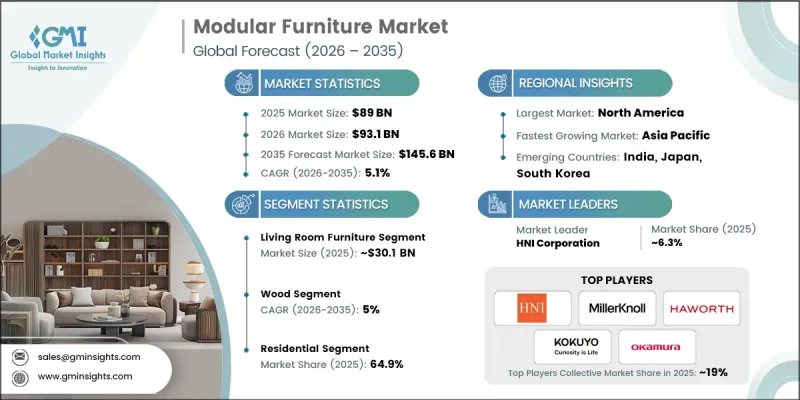
The Global Modular Furniture Market was valued at USD 89 billion in 2025 and is estimated to grow at a CAGR of 5.1% to reach USD 145.6 billion by 2035.
Market expansion is driven by rapid urbanization and the shrinking size of homes, which creates a need for furniture that maximizes space and functionality. Consumers increasingly prefer modular solutions that can be configured in multiple ways to suit changing needs, offering both storage efficiency and aesthetic appeal. Young professionals and small families are particularly drawn to designs that combine practicality with style, while retailers and manufacturers are responding by promoting compact, multi-functional pieces suitable for densely populated urban environments. Additionally, demand from commercial offices and co-working spaces is contributing to growth, as businesses seek flexible layouts that support collaboration and adaptability in modern workspaces. Modular furniture's versatility aligns with trends in contemporary design, sustainability, and ergonomic living.
| Market Scope | |
|---|---|
| Start Year | 2025 |
| Forecast Year | 2026-2035 |
| Start Value | $89 Billion |
| Forecast Value | $145.6 Billion |
| CAGR | 5.1% |
The living room furniture segment generated USD 30.1 billion in 2025 and is expected to grow at a CAGR of 5.6% from 2026 to 2035. Its popularity is attributed to its design adaptability, high utility, and capacity to enhance room aesthetics. Modular sofas, coffee tables, TV units, and shelving systems allow homeowners to configure spaces efficiently while reflecting personal style. Rising urbanization and apartment living further boost demand for versatile, space-saving furniture that suits compact interiors.
The wood segment held a 43.6% share in 2025 and is projected to grow at a CAGR of 5% through 2035. Its durability, aesthetic appeal, and versatility make it ideal for modular designs, including cabinets, tables, and seating systems. Wood can be customized for modern layouts while offering structural stability, with engineered and solid options appealing to diverse consumer preferences. Increasing awareness of sustainability and long-lasting furniture supports the adoption of wooden modular pieces.
U.S. Modular Furniture Market reached USD 24.3 billion in 2025 and is expected to grow at a CAGR of 5.1% from 2026 to 2035. Growth is driven by rising demand for flexible, space-efficient solutions across residential, commercial, and co-working sectors. Urbanization and smaller living spaces encourage the adoption of modular sofas, storage units, and office workstations. Businesses increasingly favor modular office setups that facilitate collaboration and easy reconfiguration. Integration of ergonomic designs and smart features further enhances appeal in modern workplaces.
Key players in the Global Modular Furniture Market include Haworth Inc., Vitra International, MillerKnoll, Inc., HNI Corporation, Flexsteel Industries, La-Z-Boy Incorporated, Wilkhahn GmbH, Hay A/S, Kinnarps AB, Okamura Corporation, Sedus Stoll AG, Teknion Corporation, Bene GmbH, Kokuyo Co., Ltd., and Senator Group. Companies in the Modular Furniture Market are strengthening their positions by focusing on product innovation, including ergonomic and multifunctional designs that appeal to urban consumers. They are expanding regional manufacturing and distribution networks to ensure timely delivery and cost efficiency. Strategic collaborations with real estate developers and co-working spaces help boost market penetration. Firms are investing in digital solutions, such as online configurators and AR visualization tools, to enhance the buying experience. Sustainability initiatives, including the use of eco-friendly materials and recyclable components, help brands capture environmentally conscious consumers. Additionally, targeted marketing campaigns and customization options allow companies to differentiate their products and reinforce brand loyalty.
Table of Contents
Chapter 1 Methodology & Scope
- 1.1 Market scope and definition
- 1.2 Research design
- 1.2.1 Research approach
- 1.2.2 Data collection methods
- 1.3 Data mining sources
- 1.3.1 Global
- 1.3.2 Regional/Country
- 1.4 Base estimates and calculations
- 1.4.1 Base year calculation
- 1.4.2 Key trends for market estimation
- 1.5 Primary research and validation
- 1.5.1 Primary sources
- 1.6 Forecast model
- 1.7 Research assumptions and limitations
Chapter 2 Executive Summary
- 2.1 Industry 360° synopsis
- 2.2 Key market trends
- 2.2.1 Regional
- 2.2.2 Product Type
- 2.2.3 Material
- 2.2.4 Price Range
- 2.2.5 Application
- 2.2.6 Distribution channel
Chapter 3 Industry Insights
- 3.1 Industry ecosystem analysis
- 3.1.1 Supplier landscape
- 3.1.2 Profit margin
- 3.1.3 Value addition at each stage
- 3.1.4 Factor affecting the value chain
- 3.2 Industry impact forces
- 3.2.1 Growth drivers
- 3.2.1.1 Rapid urbanization leading to smaller residential living spaces
- 3.2.1.2 Growing preference for customizable and flexible furniture solutions
- 3.2.1.3 Expansion of modern office environments and collaborative workspaces
- 3.2.2 Pitfalls & Challenges
- 3.2.2.1 Higher cost compared to traditional ready-made furniture in some segments
- 3.2.2.2 Durability concerns associated with frequent assembly and disassembly
- 3.2.3 Opportunities
- 3.2.3.1 Growing demand for sustainable and eco-friendly furniture materials
- 3.2.3.2 Integration of smart storage and multifunctional furniture designs
- 3.2.1 Growth drivers
- 3.3 Growth potential analysis
- 3.4 Future market trends
- 3.5 Technology and innovation landscape
- 3.5.1 Current technological trends
- 3.5.2 Emerging technologies
- 3.6 Regulatory landscape
- 3.6.1 Standards and compliance requirements
- 3.6.2 Regional regulatory frameworks
- 3.6.3 Certification standards
- 3.7 Porter's analysis
- 3.8 PESTEL analysis
- 3.9 Pricing analysis (driven by primary research)
- 3.9.1 Historical price trend analysis (driven by primary research) (2018-2024)
- 3.9.2 Pricing strategy by player type (premium / value / cost-plus) (driven by primary research)
- 3.9.3 Price sensitivity analysis by end-user segment
- 3.9.4 Regional price variations & factors
- 3.10 Trade data analysis (driven by paid database)
- 3.10.1 Import/export volume & value trends (driven by paid database) (2018-2024)
- 3.10.2 Key trade corridors & tariff impact (driven by paid database)
- 3.10.3 Major exporting & importing countries
- 3.10.4 Trade policy impact assessment
- 3.11 Distribution infrastructure & channel penetration landscape (driven by primary research)
- 3.11.1 Channel coverage by region & format (modern vs traditional trade) (driven by primary research)
- 3.11.2 Last-mile infrastructure gaps & emerging channel shifts (driven by primary research)
- 3.11.3 Omnichannel integration & digital transformation
- 3.11.4 Direct-to-consumer (D2C) model evolution
Chapter 4 Competitive Landscape, 2025
- 4.1 Introduction
- 4.2 Company market share analysis
- 4.2.1 By Region
- 4.2.1.1 North America
- 4.2.1.2 Europe
- 4.2.1.3 Asia Pacific
- 4.2.1.4 Latin America
- 4.2.1.5 Middle East & Africa
- 4.2.1 By Region
- 4.3 Company matrix analysis
- 4.4 Competitive analysis of major market players
- 4.5 Competitive positioning matrix
- 4.6 Key developments
- 4.6.1 Mergers & acquisitions
- 4.6.2 Partnerships & collaborations
- 4.6.3 New product launches
- 4.6.4 Expansion plans
Chapter 5 Market Estimates & Forecast, By Product Type, 2022 - 2035, (USD Billion) (Thousand Units)
- 5.1 Key trends
- 5.2 Living Room Furniture
- 5.2.1 Modular tables
- 5.2.2 Shelving units
- 5.2.3 Modular chairs
- 5.2.4 Others
- 5.3 Outdoor Furniture
- 5.3.1 Modular patio
- 5.3.2 Sun Lounges
- 5.3.3 Others
- 5.4 Bedroom Furniture
- 5.4.1 Beds
- 5.4.2 Wardrobes
- 5.4.3 Others
- 5.5 Kitchen furniture
- 5.5.1 Modular kitchen cabinets
- 5.5.2 Others
- 5.6 Others
Chapter 6 Market Estimates & Forecast, By Material, 2022 - 2035, (USD Billion) (Thousand Units)
- 6.1 Key trends
- 6.2 Wood
- 6.3 Metal
- 6.4 Plastic
- 6.5 Glass
- 6.6 Others
Chapter 7 Market Estimates & Forecast, By Price Range, 2022 - 2035, (USD Billion) (Thousand Units)
- 7.1 Key trends
- 7.2 Low
- 7.3 Medium
- 7.4 High
Chapter 8 Market Estimates & Forecast, By Application, 2022 - 2035, (USD Billion) (Thousand Units)
- 8.1 Key trends
- 8.2 Residential
- 8.3 Commercial
- 8.4 Industrial
Chapter 9 Market Estimates & Forecast, By Distribution Channel, 2022 - 2035, (USD Billion) (Thousand Units)
- 9.1 Key trends
- 9.2 Online
- 9.2.1 E-commerce
- 9.2.2 Company websites
- 9.3 Offline
- 9.3.1 Specialty stores
- 9.3.2 Supermarkets & hypermarkets
- 9.3.3 Department stores
Chapter 10 Market Estimates & Forecast, By Region, 2022 - 2035, (USD Billion) (Thousand Units)
- 10.1 Key trends
- 10.2 North America
- 10.2.1 U.S.
- 10.2.2 Canada
- 10.3 Europe
- 10.3.1 Germany
- 10.3.2 UK
- 10.3.3 France
- 10.3.4 Italy
- 10.3.5 Spain
- 10.4 Asia Pacific
- 10.4.1 China
- 10.4.2 India
- 10.4.3 Japan
- 10.4.4 South Korea
- 10.4.5 Australia
- 10.5 Latin America
- 10.5.1 Brazil
- 10.5.2 Mexico
- 10.5.3 Argentina
- 10.6 MEA
- 10.6.1 Saudi Arabia
- 10.6.2 UAE
- 10.6.3 South Africa
Chapter 11 Company Profiles
- 11.1 Bene GmbH
- 11.2 Flexsteel Industries
- 11.3 Haworth Inc.
- 11.4 Hay A/S
- 11.5 HNI Corporation
- 11.6 Kinnarps AB
- 11.7 Kokuyo Co., Ltd.
- 11.8 La-Z-Boy Incorporated
- 11.9 MillerKnoll, Inc.
- 11.10 Okamura Corporation
- 11.11 Sedus Stoll AG
- 11.12 Senator Group
- 11.13 Teknion Corporation
- 11.14 Vitra International
- 11.15 Wilkhahn GmbH

