
PUBLISHER: Global Market Insights Inc. | PRODUCT CODE: 2019200

PUBLISHER: Global Market Insights Inc. | PRODUCT CODE: 2019200
Food Flavor Market Opportunity, Growth Drivers, Industry Trend Analysis, and Forecast 2026 - 2035
The Global Food Flavor Market was valued at USD 12.5 billion in 2025 and is estimated to grow at a CAGR of 4.3% to reach USD 19 billion by 2035.
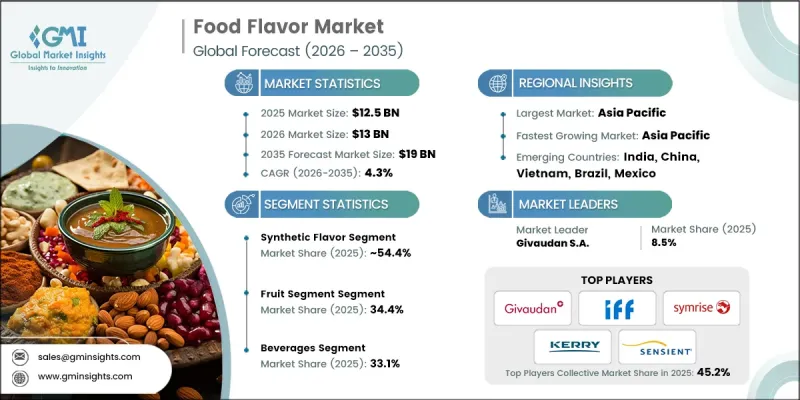
The market continues to evolve steadily as shifting consumer preferences place greater emphasis on natural ingredients, transparency, and enhanced taste experiences. Food flavors, which include both naturally derived and synthetically developed variants, are gaining importance across diverse food and beverage formulations as manufacturers aim to deliver consistent and appealing sensory profiles. The industry is witnessing a clear transition toward clean-label solutions, supported by rising awareness around ingredient sourcing and product authenticity. Increasing focus on health-oriented consumption patterns and product innovation is further encouraging the development of advanced flavor systems. In beverage formulations, flavors play a vital role in defining product identity and improving consumer acceptance, particularly as companies work to balance taste with reduced sugar content and functional benefits. The growing inclination toward unique taste profiles and evolving culinary preferences is also contributing to broader flavor experimentation, reinforcing long-term market expansion across multiple application areas.
| Market Scope | |
|---|---|
| Start Year | 2025 |
| Forecast Year | 2026-2035 |
| Start Value | $12.5 Billion |
| Forecast Value | $19 Billion |
| CAGR | 4.3% |
The synthetic flavor segment accounted for 54.4% share in 2025 and is anticipated to grow at a CAGR of 4% through 2035. This segment continues to maintain a strong presence due to its ability to deliver consistent quality, cost efficiency, and extended shelf stability. Synthetic flavors are engineered to replicate naturally occurring taste profiles, making them suitable for large-scale production across processed foods and beverages. Their availability throughout the year without dependency on seasonal raw materials enhances their appeal among manufacturers. In addition, these flavors allow precise formulation control, ensuring uniformity in taste across production batches. Despite these advantages, increasing demand for clean-label products is gradually influencing the segment, encouraging companies to develop hybrid solutions that combine performance efficiency with improved consumer perception and regulatory compliance.
The fruit flavor segment held a significant share of 34.4% in 2025 and is expected to grow at a CAGR of 3.9% by 2035. This segment continues to lead due to its broad acceptance and adaptability across various food and beverage categories. Fruit-based flavors are widely incorporated into multiple product formulations because they provide natural sweetness and appealing taste characteristics that align with evolving consumer preferences. Their association with health-conscious consumption further strengthens their market position, as consumers increasingly gravitate toward products perceived as natural and beneficial. The expansion of global taste preferences and demand for diverse flavor experiences is also supporting the development of new fruit-inspired formulations, contributing to steady growth across the segment.
North America Food Flavor Market accounted for a 29.6% share in 2025. The region benefits from a well-established food and beverage sector that actively embraces innovation and product differentiation. Rising consumer awareness regarding health, wellness, and ingredient transparency is encouraging manufacturers to shift toward natural and sustainable flavor solutions. In addition, the demand for functional food products and nutritionally enhanced offerings is driving the adoption of sophisticated flavor technologies that improve both taste and product positioning. Evolving consumer preferences, combined with the expansion of diverse culinary influences, are further supporting market growth. Strong distribution networks, advanced processing capabilities, and continuous product development initiatives are reinforcing the region's position in the global market.
Key players operating in the Global Food Flavor Market include Givaudan S.A., Symrise AG, Kerry Group plc, International Flavors and Fragrances (IFF), Sensient Technologies, Firmenich SA, Dohler, MANE Flavor & Fragrance Manufacturer, McCormick & Company, Inc., Frutarom (part of IFF), Gold Coast Ingredients, BioSun Flavors & Food Ingredients, Flavaroma, Natures Flavors, Inc., and Synergy Flavors. Companies in the food flavor market are strengthening their competitive position by investing in research and development to create advanced flavor formulations that align with evolving consumer preferences. They are focusing on expanding portfolios with natural and clean-label ingredients while improving sourcing transparency and sustainability practices. Strategic collaborations with food and beverage manufacturers are enabling tailored flavor solutions and long-term partnerships. Businesses are also enhancing production capabilities and adopting innovative technologies to ensure consistency, scalability, and efficiency. Geographic expansion into emerging markets, combined with the introduction of differentiated and customized flavor profiles, is further helping companies build stronger market presence and maintain long-term growth potential.
Table of Contents
Chapter 1 Methodology & Scope
- 1.1 Market scope and definition
- 1.2 Research design
- 1.2.1 Research approach
- 1.2.2 Data collection methods
- 1.3 Data mining sources
- 1.3.1 Global
- 1.3.2 Regional/Country
- 1.4 Base estimates and calculations
- 1.4.1 Base year calculation
- 1.4.2 Key trends for market estimation
- 1.5 Primary research and validation
- 1.5.1 Primary sources
- 1.6 Forecast model
- 1.7 Research assumptions and limitations
Chapter 2 Executive Summary
- 2.1 Industry 360° synopsis
- 2.2 Key market trends
- 2.2.1 Type
- 2.2.2 Flavor
- 2.2.3 Application
- 2.2.4 Regional
- 2.3 TAM Analysis, 2026-2035
- 2.4 CXO perspectives: Strategic imperatives
Chapter 3 Industry Insights
- 3.1 Industry ecosystem analysis
- 3.1.1 Supplier landscape
- 3.1.2 Profit margin
- 3.1.3 Value addition at each stage
- 3.1.4 Factor affecting the value chain
- 3.1.5 Disruptions
- 3.2 Industry impact forces
- 3.2.1 Growth drivers
- 3.2.2 Industry pitfalls and challenges
- 3.2.3 Market opportunities
- 3.3 Growth potential analysis
- 3.4 Regulatory landscape
- 3.4.1 North America
- 3.4.2 Europe
- 3.4.3 Asia Pacific
- 3.4.4 Latin America
- 3.4.5 Middle East & Africa
- 3.5 Porter's analysis
- 3.6 PESTEL analysis
- 3.7 Price trends
- 3.7.1 By region
- 3.7.2 By type
- 3.8 Future market trends
- 3.9 Technology and Innovation landscape
- 3.9.1 Current technological trends
- 3.9.2 Emerging technologies
- 3.10 Patent Landscape
- 3.11 Trade statistics (HS code)
- 3.11.1 Major importing countries
- 3.11.2 Major exporting countries
- 3.12 Sustainability and environmental aspects
- 3.12.1 Sustainable practices
- 3.12.2 Waste reduction strategies
- 3.12.3 Energy efficiency in production
- 3.12.4 Eco-friendly initiatives
- 3.13 Carbon footprint consideration
Chapter 4 Competitive Landscape, 2025
- 4.1 Introduction
- 4.2 Company market share analysis
- 4.2.1 By region
- 4.2.1.1 North America
- 4.2.1.2 Europe
- 4.2.1.3 Asia Pacific
- 4.2.1.4 LATAM
- 4.2.1.5 MEA
- 4.2.1 By region
- 4.3 Competitive analysis of major market players
- 4.4 Competitive positioning matrix
- 4.5 Key developments
- 4.5.1 Mergers & acquisitions
- 4.5.2 Partnerships & collaborations
- 4.5.3 New Product Launches
- 4.5.4 Expansion Plans
Chapter 5 Market Estimates and Forecast, By Type, 2022-2035 (USD Billion) (Kilo Tons)
- 5.1 Key trends
- 5.2 Natural flavor
- 5.3 Synthetic flavor
Chapter 6 Market Estimates and Forecast, By Flavor, 2022-2035 (USD Billion) (Kilo Tons)
- 6.1 Key trends
- 6.2 Fruit
- 6.2.1 Citrus
- 6.2.2 Berries
- 6.2.3 Stone fruits
- 6.2.4 Tropical & exotic
- 6.2.5 Apple & pear
- 6.2.6 Melon
- 6.2.7 Others
- 6.3 Chocolate
- 6.3.1 Dark chocolate
- 6.3.2 Milk chocolate
- 6.3.3 White chocolate
- 6.3.4 Ruby chocolate
- 6.3.5 Others
- 6.4 Vanilla
- 6.5 Nut
- 6.5.1 Almond
- 6.5.2 Hazelnut
- 6.5.3 Walnut
- 6.5.4 Pistachio
- 6.5.5 Cashew
- 6.5.6 Pecan
- 6.5.7 Macadamia
- 6.5.8 Others
- 6.6 Caramel
- 6.7 Other
Chapter 7 Market Estimates and Forecast, By Application, 2022-2035 (USD Billion) (Kilo Tons)
- 7.1 Key trends
- 7.2 Beverages
- 7.2.1 Non-alcoholic
- 7.2.2 Alcoholic
- 7.3 Dairy products
- 7.3.1 Frozen dairy
- 7.3.2 Cultured dairy
- 7.3.3 Cheese
- 7.3.4 Milk drinks
- 7.3.5 Dairy alternatives
- 7.3.6 Other dairy
- 7.4 Bakery and confectionery
- 7.4.1 Bakery
- 7.4.2 Confectionery
- 7.5 Savory and snacks
- 7.6 Other
Chapter 8 Market Estimates and Forecast, By Region, 2022-2035 (USD Billion) (Kilo Tons)
- 8.1 Key trends
- 8.2 North America
- 8.2.1 U.S.
- 8.2.2 Canada
- 8.3 Europe
- 8.3.1 Germany
- 8.3.2 UK
- 8.3.3 France
- 8.3.4 Spain
- 8.3.5 Italy
- 8.3.6 Rest of Europe
- 8.4 Asia Pacific
- 8.4.1 China
- 8.4.2 India
- 8.4.3 Japan
- 8.4.4 Australia
- 8.4.5 South Korea
- 8.4.6 Rest of Asia Pacific
- 8.5 Latin America
- 8.5.1 Brazil
- 8.5.2 Mexico
- 8.5.3 Argentina
- 8.5.4 Rest of Latin America
- 8.6 Middle East and Africa
- 8.6.1 Saudi Arabia
- 8.6.2 South Africa
- 8.6.3 UAE
- 8.6.4 Rest of Middle East and Africa
Chapter 9 Company Profiles
- 9.1 Givaudan S.A.
- 9.2 International Flavors and Fragrances (IFF)
- 9.3 Symrise AG
- 9.4 Kerry Group plc
- 9.5 Sensient Technologies
- 9.6 BioSun Flavors & Food Ingredients
- 9.7 Dohler
- 9.8 Firmenich SA
- 9.9 Flavaroma
- 9.10 Frutarom (part of IFF)
- 9.11 Gold Coast Ingredients
- 9.12 MANE Flavor & Fragrance Manufacturer
- 9.13 McCormick & Company, Inc.
- 9.14 Natures Flavors, Inc.
- 9.15 Synergy Flavors

