PUBLISHER: Global Market Insights Inc. | PRODUCT CODE: 2019205

PUBLISHER: Global Market Insights Inc. | PRODUCT CODE: 2019205
Military Satellite Market Opportunity, Growth Drivers, Industry Trend Analysis, and Forecast 2026 - 2035
The Global Military Satellite Market was valued at USD 40.8 billion in 2025 and is estimated to grow at a CAGR of 16.4% to reach USD 190.4 billion by 2035.
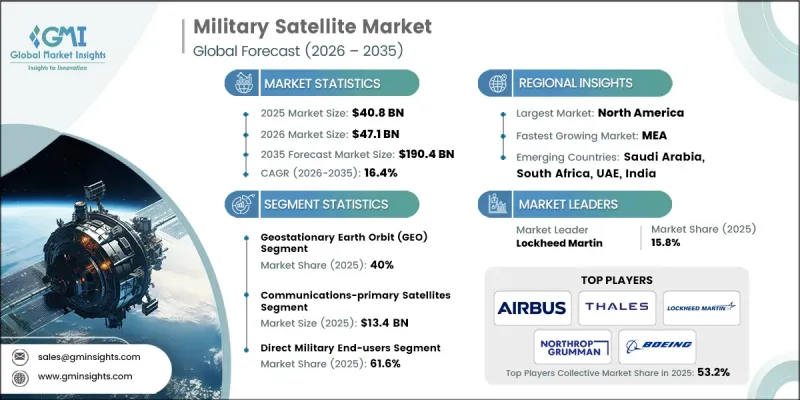
The market's rapid growth is fueled by increasing geopolitical tensions and the rising demand for secure, resilient, and technologically advanced space-based systems. Military organizations are prioritizing satellites for intelligence, surveillance, reconnaissance (ISR), missile warning and detection, secure communications, and integrated command-and-control operations. Modern defense strategies are increasingly integrating satellites into multi-domain operations to ensure interoperability across land, air, sea, cyber, and space. Governments are investing in small satellite constellations, advanced launch technologies, and resilient communication networks to support real-time military operations, strategic situational awareness, and rapid threat response. The rising importance of space domain awareness, satellite survivability, and orbital congestion management also drives investment, making space-based assets a cornerstone of national security and strategic defense capabilities worldwide.
| Market Scope | |
|---|---|
| Start Year | 2025 |
| Forecast Year | 2026-2035 |
| Start Value | $40.8 Billion |
| Forecast Value | $190.4 Billion |
| CAGR | 16.4% |
The geostationary earth orbit (GEO) segment accounted for 40% share in 2025, leading the sector due to its ability to provide persistent global coverage across communications, navigation, ISR, and missile warning functions. GEO satellites maintain fixed orbital positions, delivering enduring support for surveillance, military command, and strategic operations. They are preferred for applications requiring long-term observation and uninterrupted communication links.
The missile warning-primary satellites segment is expected to grow at a CAGR of 18.7% during 2026-2035. Growth is driven by increasing investments in early warning systems, global missile detection networks, and strategic defense initiatives. The sector benefits from advancements in high-resolution infrared sensors, low-latency data transmission, and real-time threat monitoring, enabling militaries to rapidly detect and respond to missile threats and potential security breaches.
North America Military Satellite Market held 42.2% share in 2025. The region's growth is supported by elevated military spending, ongoing geopolitical tensions, and the need for secure, resilient, space-based communication systems. Investments in low Earth orbit (LEO) constellations, space situational awareness, and secure communications platforms contribute to market expansion. The region also benefits from advanced aerospace infrastructure, skilled workforce, and strong defense research and development capabilities.
Prominent players operating in the Global Military Satellite Market include Airbus, Boeing, Lockheed Martin, BAE Systems, Northrop Grumman, Thales, General Dynamics Mission Systems, Inc., Elbit Systems, Viasat, Israel Aerospace Industries, China Aerospace Science and Technology Corporation, and SpaceX. Key strategies employed by companies in the military satellite market focus on technological innovation, strategic partnerships, and portfolio diversification. Firms are investing heavily in next-generation satellites, high-resolution sensors, and secure communication payloads to meet evolving defense needs. Companies form alliances with governments, defense contractors, and launch service providers to secure contracts and expand market reach. Emphasis on research and development enables the creation of modular, multi-mission satellite platforms capable of ISR, communications, and missile defense. Additionally, companies pursue geographic expansion, cost optimization, and after-sales service networks to enhance operational efficiency and strengthen long-term market presence. Competitive differentiation is achieved through proprietary technologies, space situational awareness capabilities, and enhanced satellite survivability in contested orbital environments.
Table of Contents
Chapter 1 Methodology and Scope
- 1.1 Market scope and definition
- 1.2 Research design
- 1.2.1 Research approach
- 1.2.2 Data collection methods
- 1.3 Data mining sources
- 1.3.1 Global
- 1.3.2 Regional/Country
- 1.4 Base estimates and calculations
- 1.4.1 Base year calculation
- 1.4.2 Key trends for market estimation
- 1.5 Primary research and validation
- 1.5.1 Primary sources
- 1.6 Forecast model
- 1.7 Research assumptions and limitations
Chapter 2 Executive Summary
- 2.1 Industry 360° synopsis, 2022 - 2035
- 2.2 Key market trends
- 2.2.1 Orbital Classification trends
- 2.2.2 Primary mission trends
- 2.2.3 End-user trends
- 2.2.4 Regional trends
- 2.3 TAM Analysis, 2026-2035
- 2.4 CXO perspectives: Strategic imperatives
Chapter 3 Industry Insights
- 3.1 Industry ecosystem analysis
- 3.1.1 Supplier Landscape
- 3.1.2 Profit Margin
- 3.1.3 Cost structure
- 3.1.4 Value addition at each stage
- 3.1.5 Factor affecting the value chain
- 3.1.6 Disruptions
- 3.2 Industry impact forces
- 3.2.1 Growth drivers
- 3.2.1.1 Rising geopolitical tensions driving secure military satellite communications
- 3.2.1.2 Expansion of space-based missile warning and detection capabilities
- 3.2.1.3 Advancements in small satellites and reusable launch technologies
- 3.2.1.4 Integration of satellites into multi-domain military operations
- 3.2.1.5 Growing reliance on satellite-based intelligence surveillance and reconnaissance
- 3.2.2 Industry pitfalls and challenges
- 3.2.2.1 High costs for satellite development launch and maintenance
- 3.2.2.2 Threats from cyberattacks, jamming and anti-satellite weapons
- 3.2.3 Market opportunities
- 3.2.3.1 Rising adoption of low Earth orbit defense constellations
- 3.2.3.2 Growing public-private partnerships in military satellite programs
- 3.2.1 Growth drivers
- 3.3 Growth potential analysis
- 3.4 Regulatory landscape
- 3.4.1 North America
- 3.4.2 Europe
- 3.4.3 Asia Pacific
- 3.4.4 Latin America
- 3.4.5 Middle East & Africa
- 3.5 Porter's analysis
- 3.6 PESTEL analysis
- 3.7 Technology and Innovation landscape
- 3.7.1 Current technological trends
- 3.7.2 Emerging technologies
- 3.8 Defense Budget Analysis
- 3.9 Global Defense Spending Trends
- 3.10 Regional Defense Budget Allocation
- 3.10.1 North America
- 3.10.2 Europe
- 3.10.3 Asia Pacific
- 3.10.4 Middle East and Africa
- 3.10.5 Latin America
- 3.11 Key Defense Modernization Programs
- 3.12 Budget Forecast (2026-2035)
- 3.12.1 Impact on Industry Growth
- 3.12.2 Defense Budgets by Country
- 3.13 Mergers, Acquisitions, and Strategic Partnerships Landscape
- 3.14 Risk Assessment and Management
- 3.15 Major Contract Awards (2022-2025)
- 3.16 Geopolitical and trade dynamics
Chapter 4 Competitive Landscape, 2025
- 4.1 Introduction
- 4.2 Company market share analysis
- 4.2.1 By region
- 4.2.1.1 North America
- 4.2.1.2 Europe
- 4.2.1.3 Asia Pacific
- 4.2.1.4 Latin America
- 4.2.1.5 Middle East & Africa
- 4.2.2 Market concentration analysis
- 4.2.1 By region
- 4.3 Competitive benchmarking of key players
- 4.3.1 Financial performance comparison
- 4.3.1.1 Revenue
- 4.3.1.2 Profit margin
- 4.3.1.3 R&D
- 4.3.2 Product portfolio comparison
- 4.3.2.1 Product range breadth
- 4.3.2.2 Technology
- 4.3.2.3 Innovation
- 4.3.3 Geographic presence comparison
- 4.3.3.1 Global footprint analysis
- 4.3.3.2 Service network coverage
- 4.3.3.3 Market penetration by region
- 4.3.4 Competitive positioning matrix
- 4.3.4.1 Leaders
- 4.3.4.2 Challengers
- 4.3.4.3 Followers
- 4.3.4.4 Niche players
- 4.3.5 Strategic outlook matrix
- 4.3.1 Financial performance comparison
- 4.4 Key developments
- 4.4.1 Mergers and acquisitions
- 4.4.2 Partnerships and collaborations
- 4.4.3 Technological advancements
- 4.4.4 Expansion and investment strategies
- 4.4.5 Digital transformation initiatives
- 4.5 Emerging/ startup competitors landscape
Chapter 5 Market Estimates and Forecast, By Orbital Classification, 2022 - 2035 (USD Million)
- 5.1 Key trends
- 5.2 Low earth orbit (LEO)
- 5.3 Medium earth orbit (MEO)
- 5.4 Geostationary earth orbit (GEO)
- 5.5 Highly elliptical orbit (HEO)
Chapter 6 Market Estimates and Forecast, By Primary Mission, 2022 - 2035 (USD Million)
- 6.1 Key trends
- 6.2 Communications-primary satellites
- 6.3 Intelligence & surveillance-primary satellites
- 6.4 Navigation & timing-primary satellites
- 6.5 Missile warning-primary satellites
- 6.6 Space situational awareness-primary satellites
- 6.7 Multi-mission satellites
Chapter 7 Market Estimates and Forecast, By End-User, 2022 - 2035 (USD Million)
- 7.1 Key trends
- 7.2 Direct military end-users
- 7.3 Intelligence & security agencies
- 7.4 International military organizations
- 7.5 Others
Chapter 8 Market Estimates and Forecast, By Region, 2022 - 2035 (USD Million)
- 8.1 Key trends
- 8.2 North America
- 8.2.1 U.S.
- 8.2.2 Canada
- 8.3 Europe
- 8.3.1 Germany
- 8.3.2 UK
- 8.3.3 France
- 8.3.4 Spain
- 8.3.5 Italy
- 8.3.6 Russia
- 8.4 Asia Pacific
- 8.4.1 China
- 8.4.2 India
- 8.4.3 Japan
- 8.4.4 Australia
- 8.4.5 South Korea
- 8.5 Latin America
- 8.5.1 Brazil
- 8.5.2 Mexico
- 8.5.3 Argentina
- 8.6 Middle East and Africa
- 8.6.1 South Africa
- 8.6.2 Saudi Arabia
- 8.6.3 UAE
Chapter 9 Company Profiles
- 9.1 Global Key Players
- 9.1.1 Airbus
- 9.1.2 Boeing
- 9.2 Regional key players
- 9.2.1 North America
- 9.2.1.1 Lockheed Martin
- 9.2.1.2 Northrop Grumman
- 9.2.1.3 SpaceX
- 9.2.2 Asia Pacific
- 9.2.2.1 China Aerospace Science and Technology Corporation
- 9.2.2.2 General Dynamics Mission Systems, Inc.
- 9.2.2.3 Viasat
- 9.2.3 Europe
- 9.2.3.1 BAE Systems
- 9.2.3.2 Elbit Systems
- 9.2.3.3 Thales
- 9.2.1 North America
- 9.3 Niche Players/Disruptors
- 9.3.1 Israel Aerospace Industries

