
PUBLISHER: Global Market Insights Inc. | PRODUCT CODE: 2019211

PUBLISHER: Global Market Insights Inc. | PRODUCT CODE: 2019211
Apple Seed Oil Market Opportunity, Growth Drivers, Industry Trend Analysis, and Forecast 2026 - 2035
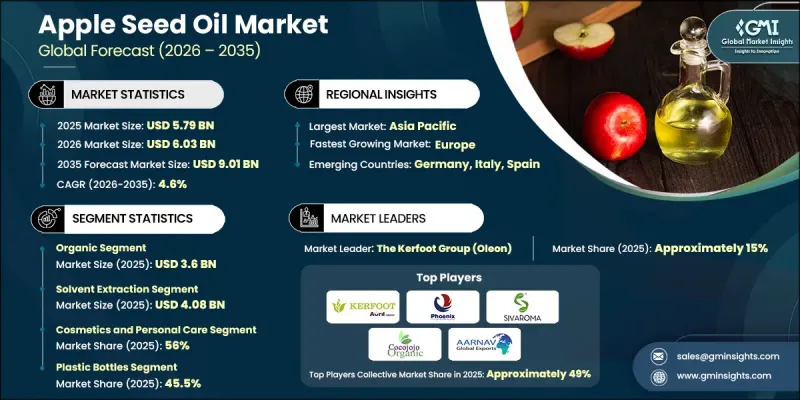
The Global Apple Seed Oil Market was valued at USD 5.79 billion in 2025 and is estimated to grow at a CAGR of 4.6% to reach USD 9.01 billion by 2035.
Market growth is driven by the rising focus on utilizing fruit processing by-products and reducing waste. Apple seeds, which were once discarded during juice and cider production, are now recognized as a valuable source for oil extraction due to their rich content of fatty acids and bioactive compounds. Cold-pressing and mechanical extraction methods are widely used to preserve these nutritional and functional properties, positioning apple seed oil as a premium ingredient rather than a conventional cooking oil. The cosmetics and personal care sector is a major driver, with demand stemming from formulations for skin, hair, and anti-aging products. Its lightweight texture, emollient qualities, and plant-based origin meet the growing consumer preference for clean-label and sustainable products. Limited applications in the food industry focus on gourmet uses and nutritional blends, highlighting the product's niche positioning. The market's dynamics depend on the availability of apple seed by-products and the ability of manufacturers to integrate sustainable sourcing practices into their operations, ensuring consistent quality and supply for industrial-scale production.
| Market Scope | |
|---|---|
| Start Year | 2025 |
| Forecast Year | 2026-2035 |
| Start Value | $5.79 Billion |
| Forecast Value | $9.01 Billion |
| CAGR | 4.6% |
In 2025, the organic apple seed oil segment was valued at USD 3.6 billion and is expected to grow at a CAGR of 4.4% through 2035. The organic segment is expanding steadily as consumers increasingly prioritize ingredient integrity, clean sourcing, and controlled cultivation practices. Organic apple seed oil is favored in formulations where product quality and natural positioning are critical, including high-end personal care, nutraceutical, and wellness products. Growth is supported by alignment with sustainability and ethical sourcing goals, as well as premium product strategies. However, higher production complexity and selective cultivation limit its aggressive expansion, making the segment more quality-driven than volume-driven. Consumer awareness around organic certifications and environmental impact continues to shape demand, emphasizing long-term trust and credibility over short-term adoption.
The solvent extraction segment reached USD 4.08 billion in 2025 and is projected to grow at a CAGR of 4.4% from 2026 to 2035. Solvent extraction is widely adopted due to its ability to achieve higher oil recovery and consistent output, making it suitable for large-scale production. Manufacturers rely on this method when process scalability, yield efficiency, and standardized oil characteristics are prioritized. Its continued adoption is supported by operational familiarity and cost efficiency, ensuring a stable supply for commercial applications. While sustainability concerns may influence brand choices, the method remains critical for maintaining consistent quality and meeting demand in high-volume production lines, especially where uniform composition and blending compatibility are essential for personal care and specialty formulations.
North America Apple Seed Oil Market accounted for USD 1.88 billion in 2025. Rising preference for natural, plant-based ingredients in personal care and wellness products is driving demand in this region. The United States leads adoption due to established apple processing industries, a strong focus on sustainability, and high demand for cosmetic and nutraceutical formulations incorporating apple seed oil. Canada also contributes to regional growth, supported by its fruit processing infrastructure and increasing emphasis on clean-label and plant-based ingredients. Growth is reinforced by manufacturers integrating eco-friendly sourcing practices, ensuring traceability and quality, which aligns with consumer expectations for transparency and premium positioning.
Major players operating in the Global Apple Seed Oil Market include The Kerfoot Group (Oleon), CocoJoJo, Organic Pure Oil, K.K Enterprisers, Aarnav Global Exports, Sivaroma Naturals, Phoenix Group, Sri Venkatesh Aromas, FruitSmart Inc., AU Natural Organics, IMCD N.V., and other regional suppliers, all contributing to innovation, sustainable sourcing, and niche application development in both personal care and specialty food sectors. Key strategies employed by companies in the apple seed oil market focus on product differentiation, sustainability, and supply chain optimization. Firms invest in advanced extraction technologies such as cold-pressing and mechanical processing to preserve bioactive compounds and enhance oil quality. Strategic partnerships with fruit processing units and juice producers ensure a consistent seed supply and reduce operational costs. Companies focus on organic certification, eco-labeling, and ethical sourcing to appeal to environmentally conscious consumers. Diversifying applications into cosmetics, hair care, nutraceuticals, and gourmet foods helps broaden market reach. Investment in research and development enables formulation improvements, blending with other plant-based oils, and expanding stability and oxidative resistance.
Table of Contents
Chapter 1 Methodology
- 1.1 Market scope and definition
- 1.2 Research design
- 1.2.1 Research approach
- 1.2.2 Data collection methods
- 1.3 Data mining sources
- 1.3.1 Global
- 1.3.2 Regional/Country
- 1.4 Base estimates and calculations
- 1.4.1 Base year calculation
- 1.4.2 Key trends for market estimation
- 1.5 Primary research and validation
- 1.5.1 Primary sources
- 1.6 Forecast model
- 1.7 Research assumptions and limitations
Chapter 2 Executive Summary
- 2.1 Industry 360° synopsis
- 2.2 Key market trends
- 2.2.1 Regional
- 2.2.2 Nature
- 2.2.3 Extraction Process
- 2.2.4 End Use
- 2.2.5 Packaging
- 2.2.6 Distribution Channel
- 2.3 TAM Analysis, 2026-2035
- 2.4 CXO perspectives: Strategic imperatives
Chapter 3 Industry Insights
- 3.1 Industry ecosystem analysis
- 3.1.1 Supplier Landscape
- 3.1.2 Profit Margin
- 3.1.3 Value addition at each stage
- 3.1.4 Factor affecting the value chain
- 3.1.5 Disruptions
- 3.2 Industry impact forces
- 3.2.1 Growth drivers
- 3.2.2 Industry pitfalls and challenges
- 3.2.3 Market opportunities
- 3.3 Growth potential analysis
- 3.4 Regulatory landscape
- 3.4.1 North America
- 3.4.2 Europe
- 3.4.3 Asia Pacific
- 3.4.4 Latin America
- 3.4.5 Middle East & Africa
- 3.5 Porter's analysis
- 3.6 PESTEL analysis
- 3.7 Price trends
- 3.7.1 By region
- 3.7.2 By product
- 3.8 Future market trends
- 3.9 Technology and Innovation landscape
- 3.9.1 Current technological trends
- 3.9.2 Emerging technologies
- 3.10 Patent Landscape
- 3.11 Trade statistics
- 3.11.1 Major importing countries
- 3.11.2 Major exporting countries
- 3.12 Sustainability and Environmental Aspects
- 3.12.1 Sustainable Practices
- 3.12.2 Waste Reduction Strategies
- 3.12.3 Energy Efficiency in Production
- 3.12.4 Eco-friendly Initiatives
- 3.13 Carbon Footprint Considerations
Chapter 4 Competitive Landscape, 2025
- 4.1 Introduction
- 4.2 Company market share analysis
- 4.2.1 By region
- 4.2.1.1 North America
- 4.2.1.2 Europe
- 4.2.1.3 Asia Pacific
- 4.2.1.4 LATAM
- 4.2.1.5 MEA
- 4.2.1 By region
- 4.3 Company matrix analysis
- 4.4 Competitive analysis of major market players
- 4.5 Competitive positioning matrix
- 4.6 Key developments
- 4.6.1 Mergers & acquisitions
- 4.6.2 Partnerships & collaborations
- 4.6.3 New Product Launches
- 4.6.4 Expansion Plans
Chapter 5 Market Estimates and Forecast, By Nature, 2022- 2035 (USD Billion, Kilo Tons)
- 5.1 Key trends
- 5.2 Organic
- 5.3 Conventional
Chapter 6 Market Estimates and Forecast, By Extraction Process, 2022- 2035 (USD Billion, Kilo Tons)
- 6.1 Key trends
- 6.2 Solvent extraction
- 6.3 Cold-pressed
Chapter 7 Market Estimates and Forecast, By End Use, 2022 - 2035 (USD Billion, Kilo Tons)
- 7.1 Key trends
- 7.2 Cosmetics and Personal Care
- 7.3 Food and Beverages
- 7.4 Pharmaceuticals
- 7.5 Others (Aromatherapy, etc.)
Chapter 8 Market Estimates and Forecast, By Packaging, 2022 - 2035 (USD Billion, Kilo Tons)
- 8.1 Key trends
- 8.2 Plastic Bottles
- 8.3 Glass bottles
- 8.4 Other (Plastic pouch, Can)
Chapter 9 Market Estimates and Forecast, By Distribution channel, 2022 - 2035 (USD Billion, Kilo Tons)
- 9.1 Key trends
- 9.2 Direct Sales
- 9.3 Retail Stores
- 9.4 Online Retail
- 9.5 Other (Pharmacies and Health Stores)
Chapter 10 Market Estimates and Forecast, By Region, 2022 - 2035 (USD Billion, Kilo Tons)
- 10.1 Key trends
- 10.2 North America
- 10.2.1 U.S.
- 10.2.2 Canada
- 10.3 Europe
- 10.3.1 Germany
- 10.3.2 UK
- 10.3.3 France
- 10.3.4 Italy
- 10.3.5 Spain
- 10.3.6 Rest of Europe
- 10.4 Asia Pacific
- 10.4.1 China
- 10.4.2 India
- 10.4.3 Japan
- 10.4.4 Australia
- 10.4.5 South Korea
- 10.4.6 Rest of Asia Pacific
- 10.5 Latin America
- 10.5.1 Brazil
- 10.5.2 Mexico
- 10.5.3 Argentina
- 10.5.4 Rest of Latin America
- 10.6 Middle East & Africa
- 10.6.1 Saudi Arabia
- 10.6.2 South Africa
- 10.6.3 UAE
- 10.6.4 Rest of Middle East & Africa
Chapter 11 Company Profiles
- 11.1 The Kerfoot Group (Oleon)
- 11.2 CocoJoJo
- 11.3 Organic Pure Oil
- 11.4 K.K Enterprisers
- 11.5 Aarnav Global Exports
- 11.6 Sivaroma Naturals
- 11.7 Phoenix Group
- 11.8 Sri Venkatesh Aromas
- 11.9 FruitSmart Inc.
- 11.10 AU Natural Organics
- 11.11 IMCD N.V.

