PUBLISHER: Global Market Insights Inc. | PRODUCT CODE: 2019223

PUBLISHER: Global Market Insights Inc. | PRODUCT CODE: 2019223
Arterial Cannula Market Opportunity, Growth Drivers, Industry Trend Analysis, and Forecast 2026 - 2035
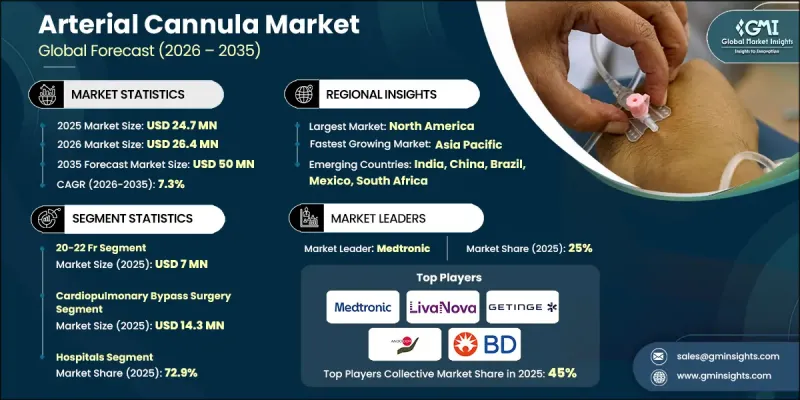
The Global Arterial Cannula Market was valued at USD 24.7 million in 2025 and is estimated to grow at a CAGR of 7.3% to reach USD 50 million by 2035.
The arterial cannula market is witnessing steady expansion as healthcare systems increasingly prioritize advanced cardiac and critical care interventions. The growing incidence of cardiovascular conditions, combined with higher utilization of life-support technologies, continues to elevate demand for precise and reliable vascular access solutions. Arterial cannulas play a crucial role in enabling controlled blood flow and maintaining hemodynamic stability during complex procedures. Technological advancements in cannula design, including improved materials, enhanced flexibility, and optimized flow dynamics, are further strengthening adoption. In addition, broader insurance coverage and supportive reimbursement frameworks are making advanced procedures more accessible, which supports overall market growth. The rising elderly population, along with increasing prevalence of lifestyle-related risk factors, continues to intensify the need for surgical and critical care interventions. As healthcare providers focus on improving patient outcomes and procedural efficiency, the arterial cannula market is expected to maintain strong growth momentum across developed and emerging regions.
| Market Scope | |
|---|---|
| Start Year | 2025 |
| Forecast Year | 2026-2035 |
| Start Value | $24.7 Million |
| Forecast Value | $50 Million |
| CAGR | 7.3% |
Favorable reimbursement structures and expanding insurance coverage for critical care procedures are significantly supporting the growth of the arterial cannula market. Healthcare systems across multiple regions are increasingly covering advanced interventions, which reduces cost pressures on both patients and medical institutions. This financial support encourages wider adoption of procedures requiring arterial cannulation. As hospitals continue to invest in advanced surgical capabilities and intensive care infrastructure, the consistent need for efficient and high-performance cannulation devices further strengthens market demand and long-term adoption trends.
The 20-22 Fr segment generated USD 7 million in 2025, maintaining a strong position within the arterial cannula market. This segment continues to gain preference due to its compatibility with adult anatomical requirements and its ability to deliver effective perfusion with reduced procedural complexity. Its balanced design supports optimal flow rates while minimizing risks associated with vascular damage and complications. The segment's alignment with minimally invasive surgical approaches further enhances its adoption, as healthcare providers increasingly prioritize patient safety, faster recovery, and improved procedural outcomes.
The cardiopulmonary bypass surgery segment reached USD 14.3 million in 2025, reflecting its critical importance in complex cardiac procedures. Arterial cannulas remain essential in maintaining circulation and oxygenation during surgical interventions that require temporary cardiac arrest. Continuous advancements in cannula design are improving performance efficiency, enabling smoother insertion and enhanced compatibility with evolving surgical techniques. The consistent volume of high-risk cardiac procedures ensures sustained demand for arterial cannulation devices, reinforcing this segment's strong contribution to overall market growth.
North America Arterial Cannula Market accounted for 42.5% share in 2025, supported by a high burden of cardiovascular conditions and strong healthcare infrastructure. The region continues to experience rising demand for advanced cardiac procedures, driven by the increasing prevalence of chronic conditions and lifestyle-related health risks. Hospitals and specialized care centers play a central role in adopting advanced medical technologies, including arterial cannulas, to improve clinical outcomes. Ongoing investments in healthcare innovation, coupled with growing awareness of early diagnosis and treatment, are expected to further strengthen regional market expansion over the forecast period.
Prominent players in the Global Arterial Cannula Market include Andocor, B. Braun, Becton, Dickinson and Company, Edward Lifesciences, Freelife Medical, Fresenius Medical Care, Getinge, LivaNova, Medtronic, Nipro Corporation, Polymedicure, Terumo Corporation, and Eurosets. Key strategies adopted by companies in the Global Arterial Cannula Market focus on continuous product innovation, strategic collaborations, and expansion of manufacturing capabilities to enhance their competitive positioning. Companies are investing in advanced materials and design improvements to deliver better flow performance, safety, and ease of use. Partnerships with healthcare providers and research institutions are helping accelerate product development and clinical validation. Market players are also strengthening their global footprint through mergers, acquisitions, and distribution network expansion. Additionally, emphasis on regulatory compliance, quality certifications, and customized product offerings tailored to specific clinical needs is enabling companies to build strong customer trust and long-term market presence.
Table of Contents
Chapter 1 Research Methodology
- 1.1 Research approach
- 1.2 Quality commitments
- 1.2.1 GMI AI policy & data integrity commitment
- 1.2.1.1 Source consistency protocol
- 1.2.1 GMI AI policy & data integrity commitment
- 1.3 Research trail & confidence scoring
- 1.3.1 Research trail components
- 1.3.2 Scoring components
- 1.4 Data collection
- 1.4.1 Partial list of primary sources
- 1.5 Data mining sources
- 1.5.1 Paid sources
- 1.5.1.1 Sources, by region
- 1.5.1 Paid sources
- 1.6 Base estimates and calculations
- 1.6.1 Base year calculation for any one approach
- 1.7 Forecast model
- 1.7.1 Quantified market impact analysis
- 1.7.1.1 Mathematical impact of growth parameters on forecast
- 1.7.1 Quantified market impact analysis
- 1.8 Research transparency addendum
- 1.8.1 Source attribution framework
- 1.8.2 Quality assurance metrics
- 1.8.3 Our commitment to trust
Chapter 2 Executive Summary
- 2.1 Industry 360° synopsis
- 2.2 Key market trends
- 2.2.1 Size trends
- 2.2.2 Application trends
- 2.2.3 End Use trends
- 2.2.4 Regional trends
- 2.3 CXO perspectives: Strategic imperatives
Chapter 3 Industry Insights
- 3.1 Industry ecosystem analysis
- 3.2 Industry impact forces
- 3.2.1 Growth drivers
- 3.2.1.1 Increasing prevalence of cardiovascular disorders
- 3.2.1.2 Growing use of respiratory and cardiac support in critical care settings
- 3.2.1.3 Advancements in cannula design
- 3.2.1.4 Availability of reimbursements and coverage for cardiac and critical care procedures
- 3.2.2 Industry pitfalls and challenges
- 3.2.2.1 Stringent regulatory requirements
- 3.2.2.2 Complexity associated with ECMO and cardiopulmonary procedures
- 3.2.3 Market opportunities
- 3.2.3.1 Demand for pediatric and neonatal specialized cannulas
- 3.2.1 Growth drivers
- 3.3 Growth potential analysis
- 3.4 Regulatory landscape (Driven by primary research)
- 3.4.1 North America
- 3.4.2 Europe
- 3.4.3 Asia Pacific
- 3.5 Technology landscape
- 3.5.1 Current technological trends
- 3.5.2 Emerging technologies
- 3.6 Future market trends (Driven by primary research)
- 3.7 Porter's analysis
- 3.8 Impact of AI and generative AI on the market
- 3.9 PESTEL analysis
Chapter 4 Competitive Landscape, 2025
- 4.1 Introduction
- 4.2 Company market share analysis
- 4.3 Company matrix analysis
- 4.4 Competitive analysis of major market players
- 4.5 Competitive positioning matrix
- 4.6 Key developments
- 4.6.1 Mergers and acquisitions
- 4.6.2 Partnerships and collaborations
- 4.6.3 New product launches
- 4.6.4 Expansion plans
Chapter 5 Market Estimates and Forecast, By Size, 2022 - 2035 ($ Mn)
- 5.1 Key trends
- 5.2 14-16 Fr
- 5.3 17-19 Fr
- 5.4 20-22 Fr
- 5.5 23-25 Fr
- 5.6 26-28 Fr
- 5.7 29-31 Fr
- 5.8 32-34 Fr
- 5.9 35-36 Fr
Chapter 6 Market Estimates and Forecast, By Application, 2022 - 2035 ($ Mn)
- 6.1 Key trends
- 6.2 Cardiopulmonary bypass surgery
- 6.3 Extracorporeal membrane oxygenation
- 6.4 Other applications
Chapter 7 Market Estimates and Forecast, By End Use, 2022 - 2035 ($ Mn)
- 7.1 Key trends
- 7.2 Hospitals
- 7.3 Ambulatory surgical centers
- 7.4 Other end users
Chapter 8 Market Estimates and Forecast, By Region, 2022 - 2035 ($ Mn)
- 8.1 Key trends
- 8.2 North America
- 8.2.1 U.S.
- 8.2.2 Canada
- 8.3 Europe
- 8.3.1 Germany
- 8.3.2 UK
- 8.3.3 France
- 8.3.4 Spain
- 8.3.5 Italy
- 8.3.6 Netherlands
- 8.4 Asia Pacific
- 8.4.1 China
- 8.4.2 Japan
- 8.4.3 India
- 8.4.4 Australia
- 8.4.5 South Korea
- 8.5 Latin America
- 8.5.1 Brazil
- 8.5.2 Mexico
- 8.5.3 Argentina
- 8.6 Middle East and Africa
- 8.6.1 South Africa
- 8.6.2 Saudi Arabia
- 8.6.3 UAE
Chapter 9 Company Profiles
- 9.1 Andocor
- 9.2 B. Braun
- 9.3 Becton, Dickinson and Company
- 9.4 Edward Lifesciences
- 9.5 Freelife Medical
- 9.6 Fresenius Medical Care
- 9.7 Getinge
- 9.8 LivaNova
- 9.9 Medtronic
- 9.10 Nipro Corporation
- 9.11 Polymedicure
- 9.12 Terumo Corporation
- 9.13 Eurosets

