
PUBLISHER: Global Market Insights Inc. | PRODUCT CODE: 2019224

PUBLISHER: Global Market Insights Inc. | PRODUCT CODE: 2019224
Cane Chopper Market Opportunity, Growth Drivers, Industry Trend Analysis, and Forecast 2026 - 2035
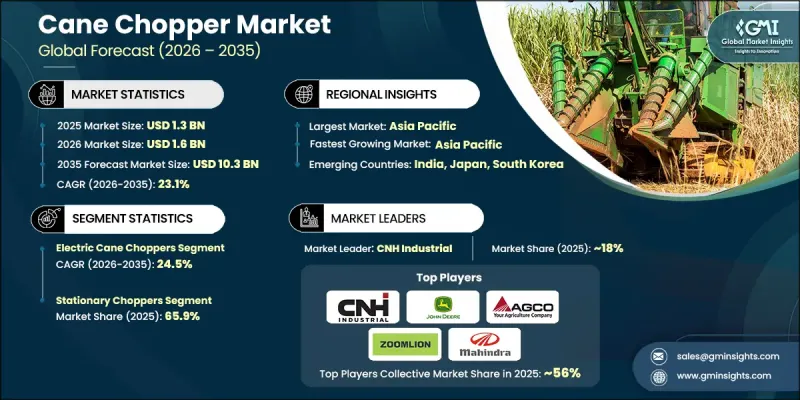
The Global Cane Chopper Market was valued at USD 1.3 billion in 2025 and is estimated to grow at a CAGR of 23.1% to reach USD 10.3 billion by 2035.
Farmers are transitioning from labor-intensive manual methods to mechanized choppers to boost efficiency, reduce workforce dependency, and accelerate the harvesting process. Cane choppers enable faster, uniform cutting, supporting both small farms and large-scale commercial operations. Agricultural contractors seek machines that offer consistent performance and minimize field losses. Rising labor costs, worker shortages, and government incentives for farm mechanization are further driving adoption. Modern choppers are engineered to handle varying crop densities and field conditions while ensuring durability and easy maintenance. The growth of sugar production and processing industries also fuels demand, as mills require a timely, high-quality cane supply to maintain sugar recovery and production continuity.
| Market Scope | |
|---|---|
| Start Year | 2025 |
| Forecast Year | 2026-2035 |
| Start Value | $1.3 Billion |
| Forecast Value | $10.3 Billion |
| CAGR | 23.1% |
The electric cane choppers segment generated USD 633.2 million in 2025 and is expected to grow at a CAGR of 24.5% through 2035. These machines lead the market due to their operational efficiency, uniform cutting, low noise, minimal emissions, and low maintenance needs. They are particularly popular among juice vendors, small processing units, and food service outlets seeking hygienic and reliable equipment.
The stationary choppers segment held 65.9% share in 2025 and is projected to grow at a CAGR of 5% through 2035. Their fixed design offers superior stability, control, safety, and consistent output, making them ideal for commercial juice shops and processing facilities. The robust construction allows for long-term operation with minimal vibration, supporting high-volume requirements.
China Cane Chopper Market reached USD 125 million in 2025 and is expected to grow at a CAGR of 24.8% from 2026 to 2035. Mechanization is increasing in southern provinces with dense sugarcane cultivation. Farmers favor high-capacity, tractor-mounted, and self-propelled choppers capable of handling tall, heavy cane. Manufacturers focus on durability, corrosion resistance, and modular designs to adapt to varying farm sizes and tropical conditions.
Key players in the Global Cane Chopper Market include AGCO Corporation, BMA Group, CNH Industrial, Crystal Engineers, Jacto, John Deere, Mahindra & Mahindra, Pratco, Rachitech Pvt. Ltd., Saisidha Sugar Equipment, Tata Agrico, Three Star Engineering, Trimurti Project Engineers, Ulka Industries, and Zoomlion. Leading companies in the Global Cane Chopper Market are reinforcing their positions by investing in R&D to enhance blade efficiency, durability, and energy consumption. They are introducing modular and customizable designs to cater to diverse farm sizes and crop conditions. Partnerships with local distributors and service providers improve after-sales support and market penetration. Firms are also focusing on developing electric and hybrid models to meet sustainability standards while offering low-maintenance solutions. Marketing campaigns highlighting productivity gains, reduced labor dependency, and operational reliability help strengthen brand recognition. Additionally, expanding production capacities and entering emerging regions further solidify their competitive presence globally.
Table of Contents
Chapter 1 Methodology & Scope
- 1.1 Market scope and definition
- 1.2 Research design
- 1.2.1 Research approach
- 1.2.2 Data collection methods
- 1.3 Data mining sources
- 1.3.1 Global
- 1.3.2 Regional/Country
- 1.4 Base estimates and calculations
- 1.4.1 Base year calculation
- 1.4.2 Key trends for market estimation
- 1.5 Primary research and validation
- 1.5.1 Primary sources
- 1.6 Forecast model
- 1.7 Research assumptions and limitations
Chapter 2 Executive Summary
- 2.1 Industry 360° synopsis
- 2.2 Key market trends
- 2.2.1 Regional
- 2.2.2 Product Type
- 2.2.3 Design
- 2.2.4 Capacity
- 2.2.5 End-User
- 2.2.6 Distribution channel
Chapter 3 Industry Insights
- 3.1 Industry ecosystem analysis
- 3.1.1 Supplier landscape
- 3.1.2 Profit margin
- 3.1.3 Value addition at each stage
- 3.1.4 Factor affecting the value chain
- 3.2 Industry impact forces
- 3.2.1 Growth drivers
- 3.2.1.1 Increasing mechanization in sugarcane harvesting operations
- 3.2.1.2 Expansion of sugar production and processing industries
- 3.2.1.3 Growing adoption of integrated sugarcane harvesting machines
- 3.2.2 Pitfalls & Challenges
- 3.2.2.1 High capital cost of mechanized cane chopping equipment
- 3.2.2.2 Maintenance and operational complexity of harvesting machinery
- 3.2.3 Opportunities
- 3.2.3.1 Development of compact and cost-effective cane choppers for small farms
- 3.2.3.2 Increasing demand for fuel-efficient and low-emission agricultural machinery
- 3.2.1 Growth drivers
- 3.3 Growth potential analysis
- 3.4 Future market trends
- 3.5 Technology and innovation landscape
- 3.5.1 Current technological trends
- 3.5.2 Emerging technologies
- 3.6 Regulatory landscape
- 3.6.1 Standards and compliance requirements
- 3.6.2 Regional regulatory frameworks
- 3.6.3 Certification standards
- 3.7 Porter's analysis
- 3.8 PESTEL analysis
- 3.9 Pricing analysis (driven by primary research)
- 3.9.1 Historical price trend analysis (driven by primary research) (2019-2024)
- 3.9.2 Pricing strategy by player type (premium/value/cost-plus) (driven by primary research)
- 3.9.3 Regional price variations & drivers
- 3.9.4 Impact of raw material costs on equipment pricing
- 3.9.5 Price elasticity of demand by farm size
- 3.10 Trade data analysis (driven by paid database)
- 3.10.1 Import/export volume & value trends (driven by paid database) (2019-2024)
- 3.10.2 Key trade corridors & tariff impact (driven by paid database)
- 3.10.3 Major exporting countries
- 3.10.4 Major importing countries
- 3.10.5 Trade policy impact on market dynamics
- 3.11 Capacity & production landscape (driven by primary research)
- 3.11.1 Installed manufacturing capacity by region & key producer (driven by primary research)
- 3.11.2 Capacity utilization rates & expansion pipelines (driven by primary research)
Chapter 4 Competitive Landscape, 2025
- 4.1 Introduction
- 4.2 Company market share analysis
- 4.2.1 By Region
- 4.2.1.1 North America
- 4.2.1.2 Europe
- 4.2.1.3 Asia Pacific
- 4.2.1.4 Latin America
- 4.2.1.5 Middle East & Africa
- 4.2.1 By Region
- 4.3 Company matrix analysis
- 4.4 Competitive analysis of major market players
- 4.5 Competitive positioning matrix
- 4.6 Key developments
- 4.6.1 Mergers & acquisitions
- 4.6.2 Partnerships & collaborations
- 4.6.3 New product launches
- 4.6.4 Expansion plans
Chapter 5 Market Estimates & Forecast, By Product Type, 2022 - 2035, (USD Billion) (Thousand Units)
- 5.1 Key trends
- 5.2 Manual Cane Choppers
- 5.3 Electric Cane Choppers
- 5.4 Tractor-Mounted Cane Choppers
Chapter 6 Market Estimates & Forecast, By Design, 2022 - 2035, (USD Billion) (Thousand Units)
- 6.1 Key trends
- 6.2 Handheld Choppers
- 6.3 Stationary Choppers
Chapter 7 Market Estimates & Forecast, By Capacity, 2022 - 2035, (USD Billion) (Thousand Units)
- 7.1 Key trends
- 7.2 Small Capacity (Under 5 tons/hour)
- 7.3 Medium Capacity (5-10 tons/hour)
- 7.4 Large Capacity (10-20 tons/hour)
- 7.5 Heavy-Duty Capacity (Over 20 tons/hour)
Chapter 8 Market Estimates & Forecast, By End-User, 2022 - 2035, (USD Billion) (Thousand Units)
- 8.1 Key trends
- 8.2 Sugar Mills
- 8.3 Agricultural Cooperatives
- 8.4 Large Commercial Farms
- 8.5 Small to Medium Farming Enterprises
- 8.6 Others
Chapter 9 Market Estimates & Forecast, By Distribution Channel, 2022 - 2035, (USD Billion) (Thousand Units)
- 9.1 Key trends
- 9.2 Direct
- 9.3 Indirect
Chapter 10 Market Estimates & Forecast, By Region, 2022 - 2035, (USD Billion) (Thousand Units)
- 10.1 Key trends
- 10.2 North America
- 10.2.1 U.S.
- 10.2.2 Canada
- 10.3 Europe
- 10.3.1 Germany
- 10.3.2 UK
- 10.3.3 France
- 10.3.4 Italy
- 10.3.5 Spain
- 10.4 Asia Pacific
- 10.4.1 China
- 10.4.2 India
- 10.4.3 Japan
- 10.4.4 South Korea
- 10.4.5 Australia
- 10.5 Latin America
- 10.5.1 Brazil
- 10.5.2 Mexico
- 10.5.3 Argentina
- 10.6 MEA
- 10.6.1 Saudi Arabia
- 10.6.2 UAE
- 10.6.3 South Africa
Chapter 11 Company Profiles
- 11.1 AGCO Corporation
- 11.2 BMA Group
- 11.3 CNH Industrial
- 11.4 Crystal Engineers
- 11.5 Jacto
- 11.6 John Deere
- 11.7 Mahindra & Mahindra
- 11.8 Pratco
- 11.9 Rachitech Pvt. Ltd.
- 11.10 Saisidha Sugar Equipment
- 11.11 Tata Agrico
- 11.12 Three Star Engineering
- 11.13 Trimurti Project Engineers
- 11.14 Ulka Industries
- 11.15 Zoomlion

