
PUBLISHER: Global Market Insights Inc. | PRODUCT CODE: 2019233

PUBLISHER: Global Market Insights Inc. | PRODUCT CODE: 2019233
Pharmaceutical Blister Packaging Market Opportunity, Growth Drivers, Industry Trend Analysis, and Forecast 2026 - 2035
The Global Pharmaceutical Blister Packaging Market was valued at USD 23.3 billion in 2025 and is estimated to grow at a CAGR of 7.7% to reach USD 48.6 billion in 2035.
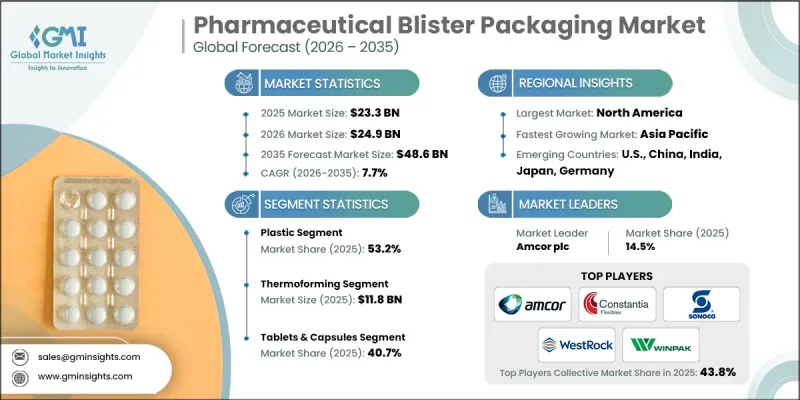
Market growth is fueled by stringent regulatory mandates requiring tamper-evident and traceable packaging, coupled with heightened adoption of high-barrier materials to protect moisture- and oxygen-sensitive drugs. Expanding pharmaceutical production in developed and emerging regions, driven by the rising incidence of chronic diseases, aging populations, and enhanced healthcare access, is further boosting demand. Pharmaceutical manufacturers are increasingly leveraging unit-dose packaging to enhance patient safety while complying with anti-counterfeiting regulations, including enhanced traceability and secure identification requirements. These trends are accelerating the adoption of blister packaging solutions that improve product protection, operational efficiency, and supply chain integrity across the pharmaceutical sector.
| Market Scope | |
|---|---|
| Start Year | 2025 |
| Forecast Year | 2026-2035 |
| Start Value | $23.3 Billion |
| Forecast Value | $48.6 Billion |
| CAGR | 7.7% |
The thermoforming segment reached USD 11.8 billion in 2025, due to its efficiency in producing transparent blister cavities suitable for tablets and capsules. Thermoforming technology ensures visibility, high throughput, and seamless integration with automated packaging systems, supporting widespread adoption across pharmaceutical production facilities.
The pharmaceutical blister packaging segment accounted for 53.2% share in 2025, reflecting the widespread reliance on plastics such as PVC and PET. These materials are highly favored due to their excellent formability, allowing precise cavity shaping to hold tablets and capsules. Their superior clarity ensures that the contents are clearly visible, which is important for both quality inspection and patient assurance. PVC and PET also offer cost-effective solutions for large-scale production, enabling manufacturers to maintain high throughput while minimizing material expenses.
North America Pharmaceutical Blister Packaging Market accounted for 34.7% share in 2025. The region's growth is supported by its large pharmaceutical manufacturing base, strict regulatory standards, and increasing demand for unit-dose packaging in hospitals and retail pharmacies. Pharmaceutical companies and packaging suppliers are investing in advanced automation and sustainable blister packaging solutions to enhance operational efficiency, maintain regulatory compliance, and address environmental concerns.
Key players operating in the Global Pharmaceutical Blister Packaging Market include ACG, Amcor plc, AptarGroup, Inc., Borealis AG, Carcano Antonio S.p.A., Caprihans India Limited, Constantia Flexibles, Dow, Honeywell International Inc., Huhtamaki, RENOLIT SE, Rohrer Corporation, Romaco Group, Sonoco Products Company, SUDPACK, Syensqo, Tekni-Plex, Inc., Tjoapack LLC, VinylPlus, WestRock Company, and Winpak Control Group. Companies in the Global Pharmaceutical Blister Packaging Market are strengthening their presence through strategic innovation and operational enhancements. They are investing in R&D to develop high-barrier, eco-friendly, and sustainable materials that meet evolving regulatory requirements and consumer expectations. Collaborations with pharmaceutical manufacturers and technology providers enable tailored packaging solutions and seamless integration into automated production lines. Expansion into emerging markets and regional manufacturing facilities ensures improved supply chain access and cost efficiency. Additionally, players focus on process automation, digital tracking, and serialization technologies to enhance product security, optimize operational throughput, and maintain competitive advantage in the global pharmaceutical packaging landscape.
Table of Contents
Chapter 1 Methodology and Scope
- 1.1 Market scope and definition
- 1.2 Research design
- 1.2.1 Research approach
- 1.2.2 Data collection methods
- 1.3 Data mining sources
- 1.3.1 Global
- 1.3.2 Regional/Country
- 1.4 Base estimates and calculations
- 1.4.1 Base year calculation
- 1.4.2 Key trends for market estimation
- 1.5 Primary research and validation
- 1.5.1 Primary sources
- 1.6 Forecast model
- 1.7 Research assumptions and limitations
Chapter 2 Executive Summary
- 2.1 Industry 360° synopsis, 2022 - 2035
- 2.2 Key market trends
- 2.2.1 Material trends
- 2.2.2 Technology trends
- 2.2.3 End-use trends
- 2.2.4 Regional trends
- 2.3 TAM Analysis, 2026-2035
- 2.4 CXO perspectives: Strategic imperatives
Chapter 3 Industry Insights
- 3.1 Industry ecosystem analysis
- 3.1.1 Supplier Landscape
- 3.1.2 Profit Margin
- 3.1.3 Cost structure
- 3.1.4 Value addition at each stage
- 3.1.5 Factor affecting the value chain
- 3.1.6 Disruptions
- 3.2 Industry impact forces
- 3.2.1 Growth drivers
- 3.2.1.1 Rising global pharmaceutical consumption rates
- 3.2.1.2 Increasing demand for unit-dose patient safety packaging
- 3.2.1.3 Regulatory mandates for tamper-evidence and traceability
- 3.2.1.4 Adoption of high-speed automated packaging lines
- 3.2.1.5 Need for moisture/oxygen barrier protection for drugs
- 3.2.2 Industry pitfalls and challenges
- 3.2.2.1 Rigid regulatory compliance burden
- 3.2.2.2 Difficult recyclability of multilayer packs
- 3.2.3 Market opportunities
- 3.2.3.1 Shift to recyclable mono-material blisters
- 3.2.3.2 Smart/serialized packaging innovation
- 3.2.1 Growth drivers
- 3.3 Growth potential analysis
- 3.4 Regulatory landscape
- 3.4.1 North America
- 3.4.2 Europe
- 3.4.3 Asia Pacific
- 3.4.4 Latin America
- 3.4.5 Middle East & Africa
- 3.5 Porter's analysis
- 3.6 PESTEL analysis
- 3.7 Technology and Innovation landscape
- 3.7.1 Current technological trends
- 3.7.2 Emerging technologies
- 3.8 Price trends
- 3.8.1 By region
- 3.8.2 By product
- 3.9 Pricing Strategies
- 3.10 Emerging Business Models
- 3.11 Compliance Requirements
- 3.12 Patent and IP analysis
Chapter 4 Competitive Landscape, 2025
- 4.1 Introduction
- 4.2 Company market share analysis
- 4.2.1 By region
- 4.2.1.1 North America
- 4.2.1.2 Europe
- 4.2.1.3 Asia Pacific
- 4.2.1.4 Latin America
- 4.2.1.5 Middle East & Africa
- 4.2.2 Market concentration analysis
- 4.2.1 By region
- 4.3 Competitive benchmarking of key players
- 4.3.1 Financial performance comparison
- 4.3.1.1 Revenue
- 4.3.1.2 Profit margin
- 4.3.1.3 R&D
- 4.3.2 Product portfolio comparison
- 4.3.2.1 Product range breadth
- 4.3.2.2 Technology
- 4.3.2.3 Innovation
- 4.3.3 Geographic presence comparison
- 4.3.3.1 Global footprint analysis
- 4.3.3.2 Service network coverage
- 4.3.3.3 Market penetration by region
- 4.3.4 Competitive positioning matrix
- 4.3.4.1 Leaders
- 4.3.4.2 Challengers
- 4.3.4.3 Followers
- 4.3.4.4 Niche players
- 4.3.5 Strategic outlook matrix
- 4.3.1 Financial performance comparison
- 4.4 Key developments
- 4.4.1 Mergers and acquisitions
- 4.4.2 Partnerships and collaborations
- 4.4.3 Technological advancements
- 4.4.4 Expansion and investment strategies
- 4.4.5 Digital transformation initiatives
- 4.5 Emerging/ startup competitors landscape
Chapter 5 Market Estimates and Forecast, By Material, 2022 - 2035 (USD Million)
- 5.1 Key trends
- 5.2 Plastic
- 5.3 Aluminum Foil
- 5.4 Paper
Chapter 6 Market Estimates and Forecast, By Technology, 2022 - 2035 (USD Million)
- 6.1 Key trends
- 6.2 Cold Forming
- 6.3 Thermoforming
- 6.4 Heat Seal
Chapter 7 Market Estimates and Forecast, By End-Use, 2022 - 2035 (USD Million)
- 7.1 Key trends
- 7.2 Tablets & Capsules
- 7.3 Medical Devices
- 7.4 Injectables
- 7.5 Others
Chapter 8 Market Estimates and Forecast, By Region, 2022 - 2035 (USD Million)
- 8.1 Key trends
- 8.2 North America
- 8.2.1 U.S.
- 8.2.2 Canada
- 8.3 Europe
- 8.3.1 Germany
- 8.3.2 UK
- 8.3.3 France
- 8.3.4 Spain
- 8.3.5 Italy
- 8.3.6 Netherlands
- 8.4 Asia Pacific
- 8.4.1 China
- 8.4.2 India
- 8.4.3 Japan
- 8.4.4 Australia
- 8.4.5 South Korea
- 8.5 Latin America
- 8.5.1 Brazil
- 8.5.2 Mexico
- 8.5.3 Argentina
- 8.6 Middle East and Africa
- 8.6.1 South Africa
- 8.6.2 Saudi Arabia
- 8.6.3 UAE
Chapter 9 Company Profiles
- 9.1 Global Key Players
- 9.1.1 Amcor plc
- 9.1.2 Constantia Flexibles
- 9.1.3 Sonoco Products Company
- 9.1.4 WestRock Company
- 9.1.5 Winpak Control Group
- 9.2 Regional key players
- 9.2.1 North America
- 9.2.1.1 AptarGroup, Inc.
- 9.2.1.2 Rohrer Corporation
- 9.2.1.3 Tekni-Plex, Inc.
- 9.2.1.4 Dow
- 9.2.2 Asia Pacific
- 9.2.2.1 ACG
- 9.2.2.2 Caprihans India Limited
- 9.2.2.3 Huhtamaki
- 9.2.3 Europe
- 9.2.3.1 Borealis AG
- 9.2.3.2 Carcano Antonio S.p.A.
- 9.2.3.3 RENOLIT SE
- 9.2.3.4 SUDPACK
- 9.2.1 North America
- 9.3 Niche Players/Disruptors
- 9.3.1 Honeywell International Inc.
- 9.3.2 Romaco Group
- 9.3.3 Syensqo
- 9.3.4 Tjoapack LLC
- 9.3.5 VinylPlus

