PUBLISHER: Global Market Insights Inc. | PRODUCT CODE: 2019236

PUBLISHER: Global Market Insights Inc. | PRODUCT CODE: 2019236
Controlled Environment Agriculture (CEA) Market Opportunity, Growth Drivers, Industry Trend Analysis, and Forecast 2026 - 2035
The Global Controlled Environment Agriculture (CEA) Market was valued at USD 33.7 billion in 2025 and is estimated to grow at a CAGR of 8.4% to reach USD 75.8 billion by 2035.
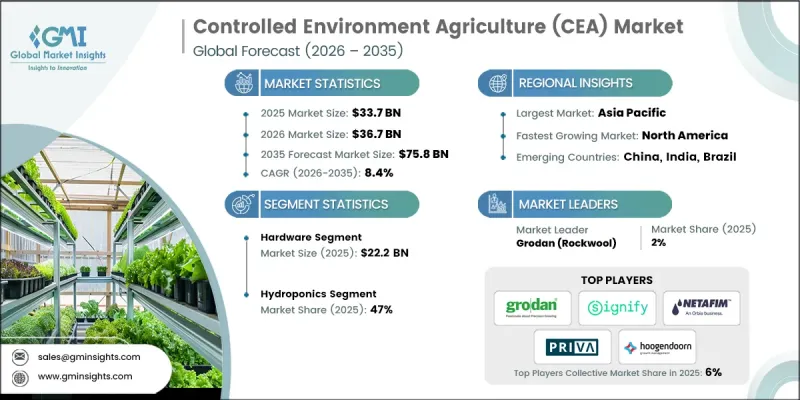
The industry is undergoing a transformation where traditional farming methods reliant on weather, soil, and seasonal conditions are being replaced with fully controlled and sustainable production environments. CEA enables growers to produce consistent, high-quality crops year-round while reducing dependence on natural factors. Key drivers of this shift include the declining availability of farmland, rising consumer demand for traceable and fresh produce, and a focus on reducing resource use and chemical inputs. Growers are experimenting with greenhouses, vertical farms, and hybrid facilities to optimize production efficiency, balancing technology investments, operating costs, and crop-specific needs. Retailers and food companies are partnering with CEA providers to secure dependable, locally sourced produce, while new entrants are introducing energy-efficient lighting, automation systems, and innovative labor-saving technologies to improve productivity and sustainability. Although high capital investments and skilled labor shortages remain challenges, the market continues to mature steadily.
| Market Scope | |
|---|---|
| Start Year | 2025 |
| Forecast Year | 2026-2035 |
| Start Value | $33.7 Billion |
| Forecast Value | $75.8 Billion |
| CAGR | 8.4% |
The hardware segment accounted for USD 22.2 billion in 2025. Hardware forms the backbone of modern indoor farming systems, controlling light, temperature, humidity, airflow, and nutrient delivery. Reliable hardware is essential to maintain stable growing conditions, making it indispensable for continuous crop production across greenhouses, vertical farms, and plant factories. Without dependable hardware, growers cannot achieve consistent yields or maintain optimal crop quality, highlighting its critical role in CEA operations.
The hydroponics segment held a 47% share in 2025. Hydroponic systems provide a soil-free, highly controlled environment, supplying plants with water, nutrients, and oxygen directly. This method maximizes resource efficiency while mitigating common agricultural challenges such as soil-borne diseases, pests, and weather variability. Controlled input delivery ensures stable yields in both quantity and quality, making hydroponics the preferred choice for growers aiming for reliable, year-round production. Hydroponics also optimizes space and light usage, enabling higher productivity per square meter compared to traditional farming methods.
U.S. Controlled Environment Agriculture (CEA) Market held 78% share, generating USD 6 billion in 2025. Demand for locally grown, pesticide-free produce drives growth, as retailers and food service providers seek reliable, high-quality crops. Expansion in greenhouse and vertical farm capacities supports this demand, while the presence of experienced growers, technology providers, and automation experts helps new projects scale quickly. North America's strong infrastructure, skilled workforce, and mature supply chain facilitate rapid adoption and deployment of advanced CEA solutions, enhancing market growth and stability in the region.
Key players operating in the Global Controlled Environment Agriculture (CEA) Market include Heliospectra, Netafim, Freight Farms, iFarm, Koidra, Urban Crop Solutions, Agritecture, Priva, Signify, Fluence, Grodan, OSRAM, Hoogendoorn, Argus Controls, and Ridder. Companies in the Controlled Environment Agriculture (CEA) Market are adopting multiple strategies to strengthen their presence and expand market foothold. They are investing heavily in research and development to improve energy-efficient lighting, climate control systems, and automation technologies, enhancing crop yield and consistency. Strategic collaborations with retailers, foodservice operators, and technology partners help integrate innovative solutions into commercial operations. Geographic expansion into high-demand regions and targeting urban areas enables better access to end consumers. Firms are also emphasizing sustainability by optimizing water, nutrient, and energy usage while adopting eco-friendly materials.
Table of Contents
Chapter 1 Research Methodology
- 1.1 Research approach
- 1.2 Quality Commitments
- 1.2.1 GMI AI policy & data integrity commitment
- 1.2.1.1 Source consistency protocol
- 1.2.1 GMI AI policy & data integrity commitment
- 1.3 Research Trail & Confidence Scoring
- 1.3.1 Research Trail Components
- 1.3.2 Scoring Components
- 1.4 Data Collection
- 1.4.1 Partial list of primary sources
- 1.5 Data mining sources
- 1.5.1 Paid sources
- 1.5.1.1 Sources, by region
- 1.5.1 Paid sources
- 1.6 Base estimates and calculations
- 1.6.1 Base year calculation for any one approach
- 1.7 Forecast model
- 1.7.1 Quantified market impact analysis
- 1.7.1.1 Mathematical impact of growth parameters on forecast
- 1.7.1 Quantified market impact analysis
- 1.8 Research transparency addendum
- 1.8.1 Source attribution framework
- 1.8.2 Quality assurance metrics
- 1.8.3 Our commitment to trust
Chapter 2 Executive Summary
- 2.1 Industry 360° synopsis, 2022 - 2035
- 2.2 Key market trends
- 2.2.1 Country
- 2.2.2 Component
- 2.2.3 Facility Type
- 2.2.4 Technology
- 2.2.5 Crop
- 2.2.6 End use
Chapter 3 Industry Insights
- 3.1 Industry ecosystem analysis
- 3.1.1 Raw material suppliers
- 3.1.2 Component manufacturers
- 3.1.3 Technology providers
- 3.1.4 System integrators
- 3.1.5 Consulting & engineering firms
- 3.1.6 Distributors & retailers
- 3.1.7 End users
- 3.1.8 Value addition by stage
- 3.2 Industry impact forces
- 3.2.1 Growth drivers
- 3.2.1.1 Rising Demand for Clean and Traceable Produce
- 3.2.1.2 Declining Availability of Arable Land and Unpredictable Climate
- 3.2.1.3 Advancements in Indoor Farming Technologies
- 3.2.2 Industry pitfalls & challenges
- 3.2.2.1 High Initial Investment and Operating Costs
- 3.2.2.2 Need for Skilled Technical Expertise
- 3.2.3 Opportunities
- 3.2.3.1 Expansion of Urban and On-Site Food Production
- 3.2.3.2 Integration of Renewable Energy and Smart Automation
- 3.2.1 Growth drivers
- 3.3 Growth potential analysis
- 3.4 Future market trends
- 3.5 Technology and innovation landscape
- 3.5.1 LED lighting technology evolution
- 3.5.2 Climate control system advancements [solution core]
- 3.5.2.1 Precision temperature & humidity control requirements
- 3.5.2.2 Energy efficiency standards & benchmarks (kW per sq ft)
- 3.5.2.3 CO2 enrichment & management systems
- 3.5.2.4 Integration with IoT & building automation platforms
- 3.5.2.5 HVAC system sizing & specification by facility type
- 3.5.2.6 Competitive landscape for CEA climate control suppliers
- 3.5.3 Automation & robotics integration
- 3.5.4 IoT & sensor technology
- 3.5.5 Nutrient delivery system innovations
- 3.5.6 Water management technologies
- 3.6 Patent landscape (driven by primary research)
- 3.6.1 Patent filing trends (2018-2024)
- 3.6.2 Key technology areas (lighting, climate control, automation)
- 3.6.3 Geographic patent distribution
- 3.6.4 Top patent assignees
- 3.6.5 Emerging innovation clusters
- 3.7 Pricing analysis (driven by primary research)
- 3.7.1 Historical price trend analysis (driven by primary research)
- 3.7.2 Pricing strategy by player type (premium / value / cost-plus) (driven by primary research)
- 3.7.3 Regional price variations
- 3.7.4 Component cost structure
- 3.7.5 Price elasticity analysis
- 3.8 Regulatory landscape
- 3.8.1 Standards and compliance requirements
- 3.8.2 Regional regulatory frameworks
- 3.8.3 Certification standards
- 3.9 Trade data analysis (driven by primary research)
- 3.9.1 Import / export volume & value trends (driven by primary research)
- 3.9.2 Key trade corridors & tariff impact (driven by primary research)
- 3.9.3 Equipment trade flows by region
- 3.9.4 Regulatory barriers to trade
- 3.10 Impact of ai & generative ai on the market
- 3.10.1 AI-driven disruption of existing business models
- 3.10.2 Genai use cases & adoption roadmap by segment
- 3.10.3 Risks, limitations & regulatory considerations
- 3.11 Porter's analysis
- 3.12 PESTEL analysis
- 3.13 Capacity & production landscape (Driven by Primary Research)
- 3.13.1 Installed capacity by region & key producer (Driven by Primary Research)
- 3.13.2 Capacity utilization rates & expansion pipelines (Driven by Primary Research)
Chapter 4 Competitive Landscape, 2025
- 4.1 Introduction
- 4.2 Company market share analysis
- 4.2.1 North America
- 4.2.2 Europe
- 4.2.3 Asia Pacific
- 4.2.4 Latin America
- 4.2.5 Middle East and Africa
- 4.3 Company matrix analysis
- 4.4 Competitive analysis of major market players
- 4.4.1 Product portfolio comparison
- 4.4.2 Geographic footprint analysis
- 4.4.3 Financial performance benchmarking
- 4.4.4 Technology partnerships & component suppliers
- 4.5 Competitive positioning matrix
- 4.6 Key developments
- 4.6.1 Mergers & acquisitions
- 4.6.2 Partnerships & collaborations
- 4.6.3 New product launches
- 4.6.4 Expansion plans
Chapter 5 Market Estimates & Forecast, By Component, 2022-2035 ($Bn)
- 5.1 Key trends
- 5.2 Hardware
- 5.2.1 Lighting
- 5.2.2 Climate control systems
- 5.2.2.1 HVAC Systems
- 5.2.2.2 Humidity Control
- 5.2.2.3 CO2 Management
- 5.2.3 Sensors
- 5.2.4 Irrigation systems
- 5.2.5 Research & Institutional
- 5.3 Software
- 5.3.1 Farm management software
- 5.3.2 Data analytics
- 5.3.3 Remote monitoring
- 5.3.4 Others
- 5.4 Service
- 5.4.1 Installation
- 5.4.2 Maintenance
- 5.4.3 Consulting
Chapter 6 Market Estimates & Forecast, By Facility Type, 2022-2035 ($Bn)
- 6.1 Key trends
- 6.2 Green House
- 6.3 Vertical Farms
- 6.4 Others
Chapter 7 Market Estimates & Forecast, By Technology, 2022-2035 ($Bn)
- 7.1 Key trends
- 7.2 Hydroponics
- 7.3 Aeroponics
- 7.4 Soil-Based Under Cover
Chapter 8 Market Estimates & Forecast, By Crop, 2022-2035 ($Bn)
- 8.1 Key trends
- 8.2 Vegetables
- 8.3 Fruits
- 8.4 Soil-Based Under Cover
Chapter 9 Market Estimates & Forecast, By End use, 2022-2035 ($Bn)
- 9.1 Key trends
- 9.2 Commercial
- 9.2.1 Large-scale commercial (>50,000 sq ft)
- 9.2.2 Small-scale commercial (<50,000 sq ft)
- 9.3 Residential
- 9.4 Others
Chapter 10 Market Estimates & Forecast, By Region, 2022-2035 ($Bn)
- 10.1 Key trends
- 10.2 North America
- 10.2.1 U.S.
- 10.2.2 Canada
- 10.3 Europe
- 10.3.1 UK
- 10.3.2 Germany
- 10.3.3 France
- 10.3.4 Italy
- 10.3.5 Spain
- 10.3.6 Russia
- 10.3.7 Netherlands
- 10.3.8 Rest of Europe
- 10.4 Asia Pacific
- 10.4.1 China
- 10.4.2 India
- 10.4.3 Japan
- 10.4.4 South Korea
- 10.4.5 Australia
- 10.4.6 Rest of Asia Pacific
- 10.5 Latin America
- 10.5.1 Brazil
- 10.5.2 Mexico
- 10.5.3 Argentina
- 10.5.4 Rest of Latin America
- 10.6 MEA
- 10.6.1 South Africa
- 10.6.2 Saudi Arabia
- 10.6.3 UAE
- 10.6.4 Rest of MEA
Chapter 11 Company Profiles
- 11.1 Heliospectra
- 11.2 Netafim
- 11.3 Freight Farms
- 11.4 iFarm
- 11.5 Koidra
- 11.6 Urban Crop Solutions
- 11.7 Agritecture
- 11.8 Priva
- 11.9 Signify
- 11.10 Fluence
- 11.11 Grodan
- 11.12 OSRAM
- 11.13 Hoogendoorn
- 11.14 Argus Controls
- 11.15 Ridder

