
PUBLISHER: Global Market Insights Inc. | PRODUCT CODE: 2019237

PUBLISHER: Global Market Insights Inc. | PRODUCT CODE: 2019237
Synthetic Turf Market Opportunity, Growth Drivers, Industry Trend Analysis, and Forecast 2026 - 2035
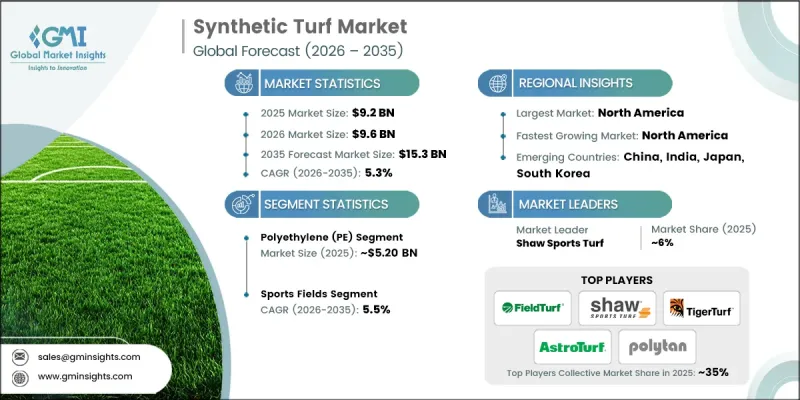
The Global Synthetic Turf Market was valued at USD 9.2 billion in 2025 and is estimated to grow at a CAGR of 5.3% to reach USD 15.3 billion by 2035.
Governments and private organizations are increasingly funding stadiums, training grounds, and community sports facilities to encourage physical activity and sports participation. Synthetic turf is favored in professional leagues, schools, and universities for its durability, reliability, and low-maintenance advantages. Environmental factors such as water scarcity and climate change are accelerating adoption, as synthetic surfaces reduce water usage and maintenance efforts. Its versatility for multiple sports, combined with advancements in materials enhancing player safety, comfort, and performance, has broadened its appeal. Additionally, growing interest in residential and commercial landscaping is creating new market opportunities, as synthetic turf offers a visually appealing, maintenance-free alternative for urban spaces and small outdoor areas.
| Market Scope | |
|---|---|
| Start Year | 2025 |
| Forecast Year | 2026-2035 |
| Start Value | $9.2 Billion |
| Forecast Value | $15.3 Billion |
| CAGR | 5.3% |
The polyethylene segment generated USD 5.20 billion in 2025 and is expected to grow at a CAGR of 5.5% through 2035. Its soft texture, durability, and grass-like appearance make polyethylene ideal for sports fields, recreational zones, and residential applications. UV resistance, color retention, and resilience under heavy use reinforce its popularity, ensuring long-lasting performance.
The sports fields segment accounted for 59% share in 2025, with a projected CAGR of 5.5% from 2026 to 2035. High demand from professional teams, schools, and municipal recreation facilities drives adoption, as synthetic turf ensures consistent surfaces, extended play seasons, and reduced maintenance requirements.
U.S. Synthetic Turf Market reached USD 2.71 billion in 2025, with a forecasted CAGR of 5.7% through 2035. Demand stems from sports organizations, educational institutions, residential customers, and commercial properties. Synthetic turf adoption supports athletic programs, water-efficient landscaping, and aesthetic enhancements in commercial and residential spaces, while specialty applications like pet turf, playground surfaces, and rooftop installations expand growth potential.
Key players in the Global Synthetic Turf Market include FieldTurf, SYNLawn, ForeverLawn, AstroTurf, Sprinturf, CCGrass, K9Grass, Tarkett Sports, EasyTurf, Shaw Sports Turf, Polytan, Synthetic Turf International, TigerTurf, Global Syn-Turf, and Hellas Construction. Companies in the Global Synthetic Turf Market strengthen their foothold through continuous product innovation, developing high-performance, durable, and visually appealing turf systems for diverse applications. Strategic partnerships with sports organizations, educational institutions, and landscaping contractors enhance distribution and brand visibility. Investment in R&D to improve UV resistance, player safety, and environmental sustainability drives competitive advantage. Expanding presence in emerging markets, offering customizable solutions, and providing installation and maintenance services reinforce customer loyalty. Additionally, digital marketing campaigns, direct-to-consumer sales channels, and collaborations with residential and commercial developers further consolidate market position and stimulate adoption.
Table of Contents
Chapter 1 Methodology & Scope
- 1.1 Market scope and definition
- 1.2 Research design
- 1.2.1 Research approach
- 1.2.2 Data collection methods
- 1.3 Data mining sources
- 1.3.1 Global
- 1.3.2 Regional/Country
- 1.4 Base estimates and calculations
- 1.4.1 Base year calculation
- 1.4.2 Key trends for market estimation
- 1.5 Primary research and validation
- 1.5.1 Primary sources
- 1.6 Forecast model
- 1.7 Research assumptions and limitations
Chapter 2 Executive Summary
- 2.1 Industry 360° synopsis
- 2.2 Key market trends
- 2.2.1 Regional
- 2.2.2 Material
- 2.2.3 Infill Type
- 2.2.4 Application
- 2.2.5 Distribution Channel
- 2.3 CXO perspectives: Strategic imperatives
- 2.3.1 Key decision points for industry executives
- 2.3.2 Critical success factors for market players
- 2.4 Future outlook and strategic recommendations
Chapter 3 Industry Insights
- 3.1 Industry ecosystem analysis
- 3.1.1 Supplier landscape
- 3.1.2 Profit margin
- 3.1.3 Value addition at each stage
- 3.1.4 Factor affecting the value chain
- 3.2 Industry impact forces
- 3.2.1 Growth drivers
- 3.2.1.1 Growing investment in sports infrastructure and recreational facilities
- 3.2.1.2 Rising water scarcity and environmental sustainability concerns
- 3.2.1.3 Expansion of residential and commercial landscaping applications
- 3.2.2 Pitfalls & Challenges
- 3.2.2.1 High initial installation costs
- 3.2.2.2 Environmental concerns related to microplastic shedding and disposal
- 3.2.3 Opportunities
- 3.2.3.1 Development of eco-friendly and recyclable synthetic turf materials
- 3.2.3.2 Growing demand for pet-friendly and specialty turf applications
- 3.2.1 Growth drivers
- 3.3 Growth potential analysis
- 3.4 Future market trends
- 3.5 Technology and innovation landscape
- 3.5.1 Current technological trends
- 3.5.2 Emerging technologies
- 3.6 Price trends Pricing Analysis (Driven by Primary Research)
- 3.6.1 Pricing Analysis (Driven by Primary Research)
- 3.6.2 Historical Price Trend Analysis (Driven by Primary Research)
- 3.6.3 Pricing Strategy by Player Type (Premium / Value / Cost-plus) (Driven by Primary Research)
- 3.6.4 Price Variation by Material Type & Application
- 3.7 Regulatory landscape
- 3.7.1 Standards and compliance requirements
- 3.7.2 Regional regulatory frameworks
- 3.7.3 Certification standards
- 3.8 Porter's analysis
- 3.9 PESTEL analysis
- 3.10 Trade Data Analysis (Driven by Primary Research)
- 3.10.1 Import/Export Volume & Value Trends (Driven by Primary Research)
- 3.10.2 Key Trade Corridors & Tariff Impact (Driven by Primary Research)
- 3.10.3 Regional Trade Dynamics & Cross-border Flow
- 3.11 Impact of AI & Generative AI on the Market
- 3.11.1 AI-Driven Disruption of Manufacturing Processes
- 3.11.2 GenAI Use Cases (Design Optimization, Predictive Maintenance)
- 3.11.3 Risks, Limitations & Regulatory Considerations
- 3.12 Capacity & Production Landscape (Driven by Primary Research)
- 3.12.1 Installed Capacity by Region & Key Producer (Driven by Primary Research)
- 3.12.2 Capacity Utilization Rates & Expansion Pipelines (Driven by Primary Research)
Chapter 4 Competitive Landscape, 2025
- 4.1 Introduction
- 4.2 Company market share analysis
- 4.2.1 By Region
- 4.2.1.1 North America
- 4.2.1.2 Europe
- 4.2.1.3 Asia Pacific
- 4.2.1.4 Latin America
- 4.2.1.5 Middle East & Africa
- 4.2.1 By Region
- 4.3 Company matrix analysis
- 4.4 Competitive analysis of major market players
- 4.5 Competitive positioning matrix
- 4.6 Key developments
- 4.6.1 Mergers & acquisitions
- 4.6.2 Partnerships & collaborations
- 4.6.3 New product launches
- 4.6.4 Expansion plans
Chapter 5 Market Estimates & Forecast, By Material, 2022 - 2035, (USD Billion) (Billions Square Feet)
- 5.1 Key trends
- 5.2 Polyethylene (PE)
- 5.3 Polypropylene (PP)
- 5.4 Nylon
Chapter 6 Market Estimates & Forecast, By Infill Type, 2022 - 2035, (USD Billion) (Billions Square Feet)
- 6.1 Key trends
- 6.2 Crumb Rubber
- 6.3 Coated Sand
- 6.4 Organic Infill
- 6.5 Thermoplastic Elastomer (TPE)
- 6.6 Infill-Free Systems
Chapter 7 Market Estimates & Forecast, By Application, 2022 - 2035, (USD Billion) (Billions Square Feet)
- 7.1 Key trends
- 7.2 Sports Fields
- 7.2.1 Soccer/Football
- 7.2.2 Baseball
- 7.2.3 Golf (putting greens, tee lines)
- 7.2.4 Others (Hockey, Rugby, Etc)
- 7.3 Residential Landscaping
- 7.4 Commercial Landscaping
- 7.5 Others (Rooftop Gardens, Pet Turf, Etc)
Chapter 8 Market Estimates & Forecast, By Distribution Channel, 2022 - 2035, (USD Billion) (Billions Square Feet)
- 8.1 Key trends
- 8.2 Online
- 8.3 Offline
Chapter 9 Market Estimates & Forecast, By Region, 2022 - 2035, (USD Billion) (Billions Square Feet)
- 9.1 Key trends
- 9.2 North America
- 9.2.1 U.S.
- 9.2.2 Canada
- 9.3 Europe
- 9.3.1 Germany
- 9.3.2 UK
- 9.3.3 France
- 9.3.4 Italy
- 9.3.5 Spain
- 9.4 Asia Pacific
- 9.4.1 China
- 9.4.2 India
- 9.4.3 Japan
- 9.4.4 South Korea
- 9.4.5 Australia
- 9.5 Latin America
- 9.5.1 Brazil
- 9.5.2 Mexico
- 9.5.3 Argentina
- 9.6 MEA
- 9.6.1 Saudi Arabia
- 9.6.2 UAE
- 9.6.3 South Africa
Chapter 10 Company Profiles
- 10.1 AstroTurf
- 10.2 CCGrass
- 10.3 EasyTurf
- 10.4 FieldTurf
- 10.5 ForeverLawn
- 10.6 Global Syn-Turf
- 10.7 Hellas Construction
- 10.8 K9Grass
- 10.9 Polytan
- 10.10 Shaw Sports Turf
- 10.11 Sprinturf
- 10.12 SYNLawn
- 10.13 Synthetic Turf International
- 10.14 Tarkett Sports
- 10.15 TigerTurf

