PUBLISHER: Global Market Insights Inc. | PRODUCT CODE: 2019240

PUBLISHER: Global Market Insights Inc. | PRODUCT CODE: 2019240
Automotive Power Distribution Modules Market Opportunity, Growth Drivers, Industry Trend Analysis, and Forecast 2026 - 2035
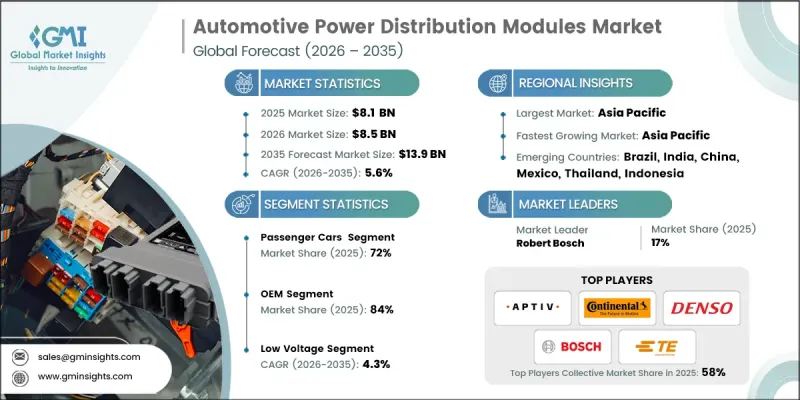
The Global Automotive Power Distribution Modules Market was valued at USD 8.1 billion in 2025 and is estimated to grow at a CAGR of 5.6% to reach USD 13.9 billion by 2035.
The market is fueled by the increasing complexity of vehicle electrical systems and the rising adoption of electrified powertrains in both passenger and commercial vehicles. PDMs play a critical role in managing power flow between the battery, alternator, and multiple electrical components, ensuring stable and efficient operation under varying loads. The transition from conventional relay-fused boxes to smart, lightweight modules with integrated diagnostics, communication protocols, and thermal management is driving the demand for intelligent solutions. Regulatory standards for vehicle safety, emissions, and electrification, coupled with growth in connected car technologies, ADAS, and infotainment systems, are accelerating market expansion. The rise in vehicle production, particularly for hybrid and battery electric vehicles, along with aftermarket replacements and upgrades, further contributes to the sustained growth of the automotive PDM sector.
| Market Scope | |
|---|---|
| Start Year | 2025 |
| Forecast Year | 2026-2035 |
| Start Value | $8.1 Billion |
| Forecast Value | $13.9 Billion |
| CAGR | 5.6% |
The passenger car segment accounted for 72% share in 2025 and is expected to grow at a CAGR of 5.1% from 2026 to 2035. Passenger cars dominate due to high global production volumes and increasing integration of hybrid and electric vehicles, which require efficient power management. Modern passenger vehicles demand intelligent PDMs to support advanced electronics, ADAS, connectivity systems, and infotainment platforms, ensuring optimized energy distribution and enhanced system reliability. The growing consumer preference for technologically sophisticated vehicles continues to drive the adoption of advanced power distribution modules in this segment.
The OEM channel held an 84% share in 2025, with an expected CAGR of 5.8% during 2026-2035. Automotive manufacturers rely on OEM-supplied modules tailored to specific electrical architectures, performance standards, and safety requirements. These modules are integrated into passenger vehicles, commercial vehicles, and electric vehicles at the production stage. The OEM channel emphasizes long-term contracts, compliance with IATF 16949 certification, and strict quality validation, which ensures the reliability and safety of automotive electronics. Rising hybrid and battery electric vehicle adoption is further reinforcing OEM demand for advanced PDM solutions to support complex electrical and high-voltage systems.
China Automotive Power Distribution Modules Market will grow at a CAGR of 5.1% from 2026 to 2035. The country's vast automotive manufacturing base, combined with a strong electronics supply chain, fuels robust demand for sophisticated power distribution systems. China produces over 30 million vehicles annually, including passenger, commercial, and electric vehicles, creating a significant requirement for intelligent PDMs that support electronic systems, digital cockpits, ADAS, and connected vehicle technologies. This dominance positions China as a key driver for innovation and adoption in the Asia Pacific automotive PDM sector.
Key players operating in the Global Automotive Power Distribution Modules Market include Aptiv, Robert Bosch, Continental, Denso, TE Connectivity, Lear, Eaton, Hitachi Astemo, Yazaki, and Valeo. Companies in the Automotive Power Distribution Modules Market are focusing on technological innovation to strengthen their market position by developing smart, compact, and lightweight modules that support electrified vehicles and high-voltage architectures. They are forming strategic partnerships with OEMs and Tier 1 suppliers to secure long-term contracts and expand their global footprint. Investment in R&D for integrated diagnostics, advanced thermal management, and reliable communication protocols is a key strategy to differentiate products. Companies are also enhancing aftermarket support, offering modular and customizable solutions to meet diverse vehicle architectures. Expansion into emerging markets, especially in Asia Pacific, and collaboration with EV manufacturers are being leveraged to increase market share, improve brand visibility, and capture the growing demand for intelligent power distribution solutions.
Table of Contents
Chapter 1 Methodology
- 1.1 Research approach
- 1.2 Quality commitments
- 1.3 Research trail and confidence scoring
- 1.3.1 Research trail components
- 1.3.2 Scoring components
- 1.4 Data collection
- 1.4.1 Partial list of primary sources
- 1.5 Data mining sources
- 1.5.1 Paid sources
- 1.6 Best estimates and calculations
- 1.6.1 Base year calculation for any one approach
- 1.7 Forecast model
- 1.8 Research transparency addendum
Chapter 2 Executive Summary
- 2.1 Industry 360° synopsis, 2022 - 2035
- 2.2 Key market trends
- 2.2.1 Regional
- 2.2.2 Component
- 2.2.3 Module
- 2.2.4 Vehicle
- 2.2.5 Sales Channel
- 2.2.6 Application
- 2.3 TAM Analysis, 2026-2035
- 2.4 CXO perspectives: Strategic imperatives
Chapter 3 Industry Insights
- 3.1 Industry ecosystem analysis
- 3.1.1 Supplier landscape
- 3.1.2 Profit margin analysis
- 3.1.3 Cost structure
- 3.1.4 Value addition at each stage
- 3.1.5 Factor affecting the value chain
- 3.1.6 Disruptions
- 3.2 Industry impact forces
- 3.2.1 Growth drivers
- 3.2.1.1 Rapid electrification of vehicle fleets and transition to EVs/HEVs
- 3.2.1.2 Increasing electronic content in modern vehicles (ADAS, infotainment, connectivity)
- 3.2.1.3 Adoption of zone architecture and smart power distribution solutions
- 3.2.1.4 Stringent emission regulations driving high-voltage system integration
- 3.2.1.5 Consumer demand for advanced safety and comfort features
- 3.2.2 Industry pitfalls and challenges
- 3.2.2.1 High cost of advanced power distribution modules
- 3.2.2.2 Complexity in design & integration of multi-voltage systems
- 3.2.2.3 Semiconductor supply chain disruptions & component shortages
- 3.2.2.4 Thermal management challenges in compact vehicle spaces
- 3.2.3 Market opportunities
- 3.2.3.1 Expansion of 48V mild hybrid systems in passenger vehicles
- 3.2.3.2 Retrofitting aftermarket smart PDM solutions
- 3.2.3.3 Emerging markets automotive production growth
- 3.2.3.4 Integration with vehicle-to-grid (V2G) infrastructure
- 3.2.3.5 Development of modular & scalable PDM platforms
- 3.2.1 Growth drivers
- 3.3 Growth potential analysis
- 3.4 Regulatory landscape
- 3.4.1 North America
- 3.4.1.1 US- EPA GHG phase 3 & CAFE standards
- 3.4.1.2 Canada - Emissions-based regulatory framework
- 3.4.2 Europe
- 3.4.2.1 Germany- Euro 7 Emission Standards
- 3.4.2.2 UK- Post-brexit vehicle type approval
- 3.4.2.3 France- Decarbonization roadmap
- 3.4.2.4 Italy- Low-Emission zone compliance
- 3.4.3 Asia Pacific
- 3.4.3.1 China- China VI-b & Emerging China VII standards
- 3.4.3.2 India- BS-VI Stage II & bharat stage VII transition
- 3.4.3.3 Japan- Fuel efficiency standards (2030 Targets)
- 3.4.3.4 Australia- Fuel quality & ADR 79/05 standards
- 3.4.4 LATAM
- 3.4.4.1 Mexico- NOM-194-SE-2021 & USMCA rules of origin
- 3.4.4.2 Argentina- Law 24.449 & environmental amendments
- 3.4.5 MEA
- 3.4.5.1 South Africa- National road traffic act (1996)
- 3.4.5.2 Saudi Arabia- Traffic law & vision 2030 transport initiatives
- 3.4.1 North America
- 3.5 Porter's analysis
- 3.6 PESTEL analysis
- 3.7 Technology and innovation landscape
- 3.7.1 Current technological trends
- 3.7.2 Emerging technologies
- 3.8 Patent landscape (driven by primary research)
- 3.9 Pricing analysis (Driven by Primary Research)
- 3.9.1 Historical price trend analysis
- 3.9.2 Pricing strategy by player type (premium / value / cost-plus)
- 3.9.3 Total cost of ownership (TCO) analysis
- 3.10 Trade data analysis (driven by paid database)
- 3.10.1 Import/export volume & value trends
- 3.10.2 Key trade corridors & tariff impact
- 3.11 Use cases & success stories
- 3.12 Impact of AI & generative AI on the market
- 3.12.1 AI-driven disruption of existing business models
- 3.12.2 GenAI use cases & adoption roadmap by segment
- 3.12.3 Risks, limitations & regulatory considerations
- 3.13 Capacity & production landscape (driven by primary research)
- 3.13.1 Installed capacity by region & key producer
- 3.13.2 Capacity utilization rates & expansion pipelines
- 3.14 Sustainability and environmental aspects
- 3.14.1 Sustainable practices
- 3.14.2 Waste reduction strategies
- 3.14.3 Energy efficiency in production
- 3.14.4 Eco-friendly Initiatives
- 3.14.5 Carbon footprint considerations
- 3.15 Forecast assumptions & scenario analysis (Driven by primary research)
- 3.15.1 Base Case - key macro & industry variables driving CAGR
- 3.15.2 Optimistic Scenarios - Favorable macro and industry tailwinds
- 3.15.3 Pessimistic Scenario - Macroeconomic slowdown or industry headwinds
Chapter 4 Competitive Landscape, 2025
- 4.1 Introduction
- 4.2 Company market share analysis
- 4.2.1 North America
- 4.2.2 Europe
- 4.2.3 Asia Pacific
- 4.2.4 LATAM
- 4.2.5 MEA
- 4.3 Competitive analysis of major market players
- 4.4 Competitive positioning matrix
- 4.5 Company Tier Benchmarking
- 4.5.1 Tier Classification Criteria & Qualifying Thresholds
- 4.5.2 Tier Positioning Matrix by Revenue, Geography & Innovation
- 4.6 Key developments
- 4.6.1 Mergers & acquisitions
- 4.6.2 Partnerships & collaborations
- 4.6.3 New product launches
- 4.6.4 Expansion plans and funding
Chapter 5 Market Estimates & Forecast, By Component, 2022 - 2035 ($Bn, Units)
- 5.1 Key trends
- 5.2 Power modules
- 5.3 Fuses and circuit breakers
- 5.4 Connectors and terminals
- 5.5 Relays
- 5.6 Voltage regulators
- 5.7 Others
Chapter 6 Market Estimates & Forecast, By Module, 2022 - 2035 ($Bn, Units)
- 6.1 Key trends
- 6.2 Low voltage
- 6.3 Medium voltage
- 6.4 High voltage
Chapter 7 Market Estimates & Forecast, By Vehicle, 2022 - 2035 ($Bn, Units)
- 7.1 Key trends
- 7.2 Passenger cars
- 7.2.1 Hatchback
- 7.2.2 Sedan
- 7.2.3 SUV
- 7.3 Commercial vehicles
- 7.3.1 Light commercial vehicles (LCVs)
- 7.3.2 Medium commercial vehicles (MCVs)
- 7.3.3 Heavy commercial vehicles (HCVs)
Chapter 8 Market Estimates & Forecast, By Sales Channel, 2022 - 2035 ($Bn, Units)
- 8.1 Key trends
- 8.2 OEM
- 8.3 Aftermarket
Chapter 9 Market Estimates & Forecast, By Application, 2022 - 2035 ($Bn, Units)
- 9.1 Key trends
- 9.2 Lighting systems
- 9.3 Infotainment systems
- 9.4 HVAC systems
- 9.5 Safety and driver assistance systems
- 9.6 Powertrain systems
- 9.7 Battery management systems
- 9.8 Others
Chapter 10 Market Estimates & Forecast, By Region, 2022 - 2035 ($Bn, Units)
- 10.1 Key trends
- 10.2 North America
- 10.2.1 US
- 10.2.2 Canada
- 10.3 Europe
- 10.3.1 Germany
- 10.3.2 UK
- 10.3.3 France
- 10.3.4 Italy
- 10.3.5 Spain
- 10.3.6 Russia
- 10.3.7 Netherlands
- 10.3.8 Sweden
- 10.3.9 Denmark
- 10.3.10 Poland
- 10.4 Asia Pacific
- 10.4.1 China
- 10.4.2 India
- 10.4.3 Japan
- 10.4.4 Australia
- 10.4.5 South Korea
- 10.4.6 Singapore
- 10.4.7 Thailand
- 10.4.8 Indonesia
- 10.4.9 Vietnam
- 10.5 Latin America
- 10.5.1 Brazil
- 10.5.2 Mexico
- 10.5.3 Argentina
- 10.5.4 Colombia
- 10.6 MEA
- 10.6.1 South Africa
- 10.6.2 Saudi Arabia
- 10.6.3 UAE
- 10.6.4 Israel
Chapter 11 Company Profiles
- 11.1 Global Players
- 11.1.1 Aptiv
- 11.1.2 Continental
- 11.1.3 Denso
- 11.1.4 Eaton
- 11.1.5 Hitachi Astemo
- 11.1.6 Lear
- 11.1.7 Mitsubishi Electric
- 11.1.8 Robert Bosch
- 11.1.9 TE Connectivity
- 11.1.10 Valeo
- 11.2 Regional Players
- 11.2.1 DRAXLMAIER
- 11.2.2 Furukawa Electric
- 11.2.3 Leoni
- 11.2.4 Panasonic Automotive Systems
- 11.2.5 Sumitomo Electric Industries
- 11.2.6 Yazaki
- 11.3 Emerging Players
- 11.3.1 Infineon Technologies
- 11.3.2 NXP Semiconductors
- 11.3.3 onsemi (ON Semiconductor)
- 11.3.4 STMicroelectronics

