PUBLISHER: Global Market Insights Inc. | PRODUCT CODE: 2019242

PUBLISHER: Global Market Insights Inc. | PRODUCT CODE: 2019242
Aircraft Lighting Market Opportunity, Growth Drivers, Industry Trend Analysis, and Forecast 2026 - 2035
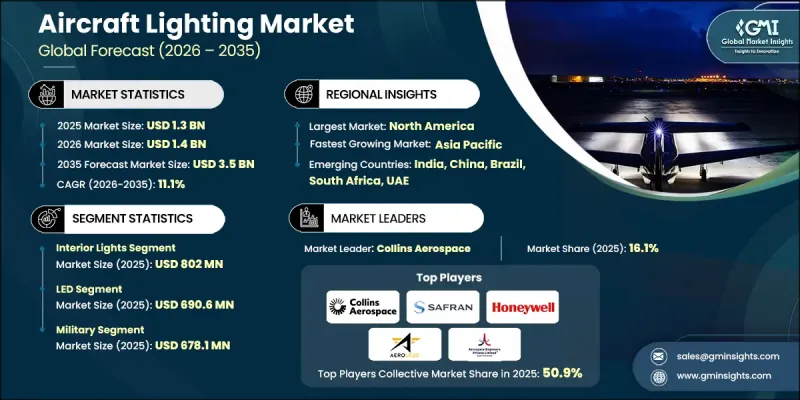
The Global Aircraft Lighting Market was valued at USD 1.3 billion in 2025 and is estimated to grow at a CAGR of 11.1% to reach USD 3.5 billion by 2035.
Airlines and aircraft operators are increasingly adopting LED and smart lighting systems, focusing on energy efficiency, passenger comfort, and cabin experience. Fleet modernization and retrofit initiatives, coupled with rising demand for lightweight and sustainable lighting solutions, are propelling market growth. As older aircraft are upgraded with advanced exterior and interior lighting systems, the demand for navigation, anti-collision, runway, and cabin lighting increases. The trend toward human-centric, mood-based cabin illumination, along with programmable and smart lighting solutions, supports operational efficiency while enhancing passenger well-being. Governments' focus on fuel efficiency and sustainability further accelerates the adoption of next-generation lighting systems across commercial, regional, and defense aviation.
| Market Scope | |
|---|---|
| Start Year | 2025 |
| Forecast Year | 2026-2035 |
| Start Value | $1.3 Billion |
| Forecast Value | $3.5 Billion |
| CAGR | 11.1% |
The interior lighting segment generated USD 802 million in 2025. Passenger comfort and enhanced cabin experience are driving demand, with airlines installing mood, dynamic, and programmable LED lighting to reduce jet lag and improve overall satisfaction. Aircraft modernization programs boost interior lighting installations, as retrofitting older fleets with energy-efficient LED systems becomes a priority. Manufacturers are focusing on modular, retrofit-friendly solutions and collaborating with airlines and MRO providers to capture recurring aftermarket revenue and ensure long-term adoption.
The LED segment accounted for USD 690.6 million in 2025, leading the market due to energy efficiency, longer service life, and reduced maintenance costs. LED systems enable advanced cabin illumination, programmable lighting, and integration with smart aircraft management systems, supporting both new aircraft and retrofit programs. Scalable, modular LED solutions designed for low maintenance and high reliability are a key focus for manufacturers targeting fleet upgrades and modernization.
North America Aircraft Lighting Market held a 35% share in 2025, driven by the adoption of energy-efficient LED and smart lighting solutions across commercial and defense fleets. The region's mature aerospace ecosystem, robust airline modernization programs, and retrofit demand sustain growth. Operators in North America prioritize passenger experience and operational efficiency, while extensive MRO infrastructure supports recurring upgrades. Regulatory and safety standards further encourage advanced lighting integration across airports and aircraft platforms. Manufacturers are leveraging partnerships with airlines and MRO providers to develop LED retrofit modules and smart lighting solutions aligned with fleet renewal cycles, optimizing aftermarket revenue.
Key players in the Global Aircraft Lighting Market include Astronics Corporation, Honeywell International Inc., Collins Aerospace, AeroLEDs, Safran S.A., Prizm Lighting, Aircraft Lighting International, Bruce Aerospace, Whelen Aerospace Technologies, Lumitex LLC., Oxley Group, Diehl Stiftung & Co. KG, Luminator Aerospace, Aero Dynamix, and American Bright. Companies in the Global Aircraft Lighting Market are implementing strategies to strengthen their market presence and capture a greater share. They are focusing on product innovation, such as energy-efficient LED modules, smart lighting systems, and modular, retrofit-friendly designs, to meet airline and MRO requirements. Strategic partnerships with aircraft manufacturers and maintenance providers ensure integration with fleet renewal programs. Companies are also investing in R&D for advanced human-centric cabin illumination and programmable exterior lighting to differentiate offerings. Expanding after-sales services, including maintenance, support, and upgrade packages, helps build recurring revenue streams.
Table of Contents
Chapter 1 Methodology and Scope
- 1.1 Market scope and definition
- 1.2 Research design
- 1.2.1 Research approach
- 1.2.2 Data collection methods
- 1.3 Data mining sources
- 1.3.1 Global
- 1.3.2 Regional/Country
- 1.4 Base estimates and calculations
- 1.4.1 Base year calculation
- 1.4.2 Key trends for market estimation
- 1.5 Primary research and validation
- 1.5.1 Primary sources
- 1.6 Forecast model
- 1.7 Research assumptions and limitations
Chapter 2 Executive Summary
- 2.1 Industry 360° synopsis
- 2.2 Key market trends
- 2.2.1 Type trends
- 2.2.2 Light source trends
- 2.2.3 Aircraft type trends
- 2.2.4 Point of sales trends
- 2.2.5 Regional trends
- 2.3 TAM Analysis, 2026 - 2035 (USD Million)
- 2.4 CXO perspectives: Strategic imperatives
- 2.4.1 Executive decision points
- 2.4.2 Critical success factors
- 2.5 Future outlook and strategic recommendations
Chapter 3 Industry Insights
- 3.1 Industry ecosystem analysis
- 3.1.1 Supplier landscape
- 3.1.2 Profit margin
- 3.1.3 Cost structure
- 3.1.4 Value addition at each stage
- 3.1.5 Factor affecting the value chain
- 3.1.6 Disruptions
- 3.2 Industry impact forces
- 3.2.1 Growth drivers
- 3.2.1.1 Increasing global aircraft fleet expansion
- 3.2.1.2 Rising air passenger traffic and new aircraft deliveries
- 3.2.1.3 Growing adoption of LED and smart lighting systems
- 3.2.1.4 Increasing aircraft modernization and retrofit programs
- 3.2.1.5 Rising focus on passenger comfort and cabin experience
- 3.2.2 Pitfalls and challenges
- 3.2.2.1 High installation and certification costs
- 3.2.2.2 Complex integration with aircraft electrical systems
- 3.2.1 Growth drivers
- 3.3 Growth potential analysis
- 3.4 Regulatory landscape
- 3.4.1 North America
- 3.4.2 Europe
- 3.4.3 Asia Pacific
- 3.4.4 Latin America
- 3.4.5 Middle East & Africa
- 3.5 Porter's analysis
- 3.6 PESTEL analysis
- 3.7 Technology and Innovation landscape
- 3.7.1 Current technological trends
- 3.7.2 Emerging technologies
- 3.8 Emerging Business Models
- 3.9 Compliance Requirements
- 3.10 Supply Chain Resilience
- 3.11 Defense Budget Analysis
- 3.12 Global Defense Spending Trends
- 3.13 Regional Defense Budget Allocation
- 3.13.1 North America
- 3.13.2 Europe
- 3.13.3 Asia Pacific
- 3.13.4 Middle East and Africa
- 3.13.5 Latin America
- 3.14 Key Defense Modernization Programs
- 3.15 Budget Forecast (2025-2034)
- 3.15.1 Impact on Industry Growth
- 3.15.2 Defense Budgets by Country
- 3.15.3 Defense Budget Allocation by Segment
- 3.15.3.1 Personnel
- 3.15.3.2 Operations and Maintenance
- 3.15.3.3 Procurement
- 3.15.3.4 Research, Development, Test and Evaluation
- 3.15.3.5 Infrastructure and Construction
- 3.15.3.6 Technology and Innovation
- 3.16 Sustainability Initiatives
- 3.17 Supply Chain Resilience
- 3.18 Geopolitical Analysis
- 3.19 Workforce Analysis
- 3.20 Digital Transformation
- 3.21 Mergers, Acquisitions, and Strategic Partnerships Landscape
- 3.22 Risk Assessment and Management
- 3.23 Major Contract Awards (2022-2025)
Chapter 4 Competitive Landscape, 2025
- 4.1 Introduction
- 4.2 Company market share analysis
- 4.2.1 By region
- 4.2.1.1 North America
- 4.2.1.2 Europe
- 4.2.1.3 Asia Pacific
- 4.2.1.4 Latin America
- 4.2.1.5 Middle East & Africa
- 4.2.2 Market concentration analysis
- 4.2.1 By region
- 4.3 Competitive benchmarking of key players
- 4.3.1 Product portfolio comparison
- 4.3.1.1 Product range breadth
- 4.3.1.2 Technology
- 4.3.1.3 Innovation
- 4.3.2 Geographic presence comparison
- 4.3.2.1 Global footprint analysis
- 4.3.2.2 Service network coverage
- 4.3.2.3 Market penetration by region
- 4.3.3 Competitive positioning matrix
- 4.3.3.1 Leaders
- 4.3.3.2 Challengers
- 4.3.3.3 Followers
- 4.3.3.4 Niche players
- 4.3.4 Strategic outlook matrix
- 4.3.1 Product portfolio comparison
- 4.4 Key developments, 2022-2025
- 4.4.1 Mergers and acquisitions
- 4.4.2 Partnerships and collaborations
- 4.4.3 Technological advancements
- 4.4.4 Expansion and investment strategies
- 4.4.5 Sustainability initiatives
- 4.4.6 Digital transformation initiatives
- 4.5 Emerging/ startup competitors landscape
Chapter 5 Market Estimates and Forecast, By Type, 2022 - 2035 (USD Million)
- 5.1 Key trends
- 5.2 Interior Lights
- 5.3 Exterior Lights
Chapter 6 Market Estimates and Forecast, By Light Source, 2022 - 2035 (USD Million)
- 6.1 Key trends
- 6.2 LED
- 6.3 Fluorescent
Chapter 7 Market Estimates and Forecast, By Aircraft Type, 2022 - 2035 (USD Million)
- 7.1 Key Trends
- 7.2 Commercial
- 7.2.1 Narrow-Body
- 7.2.2 Wide-Body
- 7.2.3 Business Jets
- 7.2.4 Turboprop
- 7.3 Military
Chapter 8 Market Estimates and Forecast, By Point of Sales, 2022 - 2035 (USD Million)
- 8.1 Key trends
- 8.2 OEM
- 8.3 Aftermarket
Chapter 9 Market Estimates and Forecast, By Region, 2022 - 2035 (USD Million)
- 9.1 Key trends
- 9.2 North America
- 9.2.1 U.S.
- 9.2.2 Canada
- 9.3 Europe
- 9.3.1 Germany
- 9.3.2 UK
- 9.3.3 France
- 9.3.4 Spain
- 9.3.5 Italy
- 9.3.6 Netherlands
- 9.4 Asia Pacific
- 9.4.1 China
- 9.4.2 India
- 9.4.3 Japan
- 9.4.4 Australia
- 9.4.5 South Korea
- 9.5 Latin America
- 9.5.1 Brazil
- 9.5.2 Mexico
- 9.5.3 Argentina
- 9.6 Middle East and Africa
- 9.6.1 Saudi Arabia
- 9.6.2 South Africa
- 9.6.3 UAE
Chapter 10 Company Profiles
- 10.1 Global Key Players
- 10.1.1 Collins Aerospace
- 10.1.2 Honeywell International Inc.
- 10.1.3 Safran S.A.
- 10.1.4 Astronics Corporation
- 10.1.5 Diehl Stiftung & Co. KG
- 10.2 Regional Key Players
- 10.2.1 North America
- 10.2.1.1 Bruce Aerospace
- 10.2.1.2 Whelen Aerospace Technologies
- 10.2.1.3 Luminator Aerospace
- 10.2.1.4 PWI Inc.
- 10.2.2 Europe
- 10.2.2.1 Oxley Group
- 10.2.2.2 SELA GmbH
- 10.2.2.3 Cobalt Aerospace Group Limited
- 10.2.3 Asia Pacific
- 10.2.3.1 Aerospace Limited
- 10.2.3.2 Aircraft Lighting International
- 10.2.3.3 American Bright
- 10.2.1 North America
- 10.3 Niche / Disruptors
- 10.3.1 AeroLEDs
- 10.3.2 Aero Dynamix
- 10.3.3 Lumitex, LLC.
- 10.3.4 Prizm Lighting

