
PUBLISHER: Global Market Insights Inc. | PRODUCT CODE: 2019248

PUBLISHER: Global Market Insights Inc. | PRODUCT CODE: 2019248
Oyster and Clam Market Opportunity, Growth Drivers, Industry Trend Analysis, and Forecast 2026 - 2035
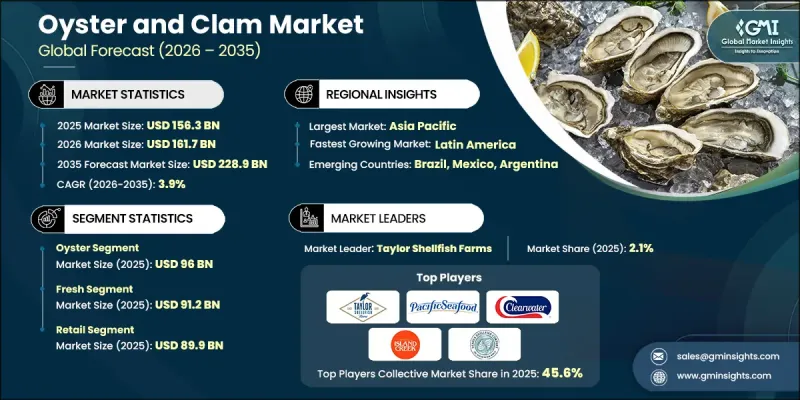
The Global Oyster and Clam Market was valued at USD 156.3 billion in 2025 and is estimated to grow at a CAGR of 3.9% to reach USD 228.9 billion by 2035.
Oysters and clams, classified as bivalve mollusks, are defined by their two-shell structure that safeguards their internal organs. Oysters attach to surfaces in marine and brackish waters, while clams prefer burrowing into sandy or muddy areas along coastlines and freshwater bodies. Both species act as natural filter feeders, enhancing water quality by capturing plankton and nutrients. Oysters hold additional market significance due to pearl production, while clams are prized for their versatile culinary applications. These shellfish contribute essential ecological benefits: oyster reefs provide habitats for marine life and improve water conditions, while clam burrowing aerates soil and recycles nutrients, supporting benthic ecosystems. Their presence is a reliable indicator of balanced and healthy aquatic environments, underscoring their ecological and economic value. Increasing demand for seafood, sustainable aquaculture, and awareness of environmental benefits are driving global market growth.
| Market Scope | |
|---|---|
| Start Year | 2025 |
| Forecast Year | 2026-2035 |
| Start Value | $156.3 Billion |
| Forecast Value | $228.9 Billion |
| CAGR | 3.9% |
The oyster segment reached USD 96 billion in 2025, leading the industry due to its distinct flavor and texture. Their supply is maintained through both wild harvesting and aquaculture, ensuring year-round availability. Clams, with their mild taste, are widely used in soups, pastas, ready-to-eat meals, and other culinary applications, making them a staple in both commercial and household kitchens. The versatility of clams in multiple dishes drives consistent demand alongside oysters.
The retail segment accounted for USD 89.9 billion in 2025, emerging as the primary sales channel for oysters and clams. Supermarkets, seafood stores, and online platforms provide consumers with access to diverse product selections and packaging formats. Retailers focus on storage, labeling, and display methods to maintain product quality and ensure freshness, catering to urban and inland buyers who seek convenient, high-quality shellfish options.
U.S. Oyster and Clam Market reached USD 33.3 billion in 2025, driven by rising seafood consumption and growing awareness of sustainable fishing and aquaculture practices. Producers are focusing on consistent product availability to meet demand from restaurants, retailers, and local markets. Sustainable farming methods are critical to ensuring a steady supply while maintaining quality standards. Collaboration between farmers and distributors helps expand reach, improve product consistency, and reinforce consumer trust in fresh, responsibly sourced oysters and clams.
Key players in the Global Oyster and Clam Market include Pacific Seafood, Clearwater Seafoods, Colville Bay Oyster Co. Ltd, Taylor Shellfish Farms, Ward Oyster Company, Five Star Shellfish Inc, Pangea Shellfish Company, Island Creek Oysters, Woodstown Bay Shellfish Ltd, and Royal Hawaiian Seafood. Companies in the Global Oyster and Clam Market are adopting a variety of strategies to strengthen their market position and expand their reach. Key initiatives include investing in sustainable aquaculture methods and modernized farming technology to improve yield and quality while minimizing environmental impact. Firms are also expanding distribution networks to reach urban, regional, and international markets efficiently. Packaging innovation, including convenient and eco-friendly formats, enhances consumer appeal and product shelf life. Strategic partnerships, acquisitions, and collaborations help companies scale operations, diversify product portfolios, and access new markets. Emphasis on branding, traceability, and compliance with environmental regulations fosters consumer trust, while marketing campaigns highlight product quality, freshness, and sustainability to capture loyal customer bases and enhance competitive positioning globally.
Table of Contents
Chapter 1 Methodology & Scope
- 1.1 Market scope and definition
- 1.2 Research design
- 1.2.1 Research approach
- 1.2.2 Data collection methods
- 1.3 Data mining sources
- 1.3.1 Global
- 1.3.2 Regional/Country
- 1.4 Base estimates and calculations
- 1.4.1 Base year calculation
- 1.4.2 Key trends for market estimation
- 1.5 Primary research and validation
- 1.5.1 Primary sources
- 1.6 Forecast model
- 1.7 Research assumptions and limitations
Chapter 2 Executive Summary
- 2.1 Industry 360° synopsis
- 2.2 Key market trends
- 2.2.1 Type
- 2.2.2 Form
- 2.2.3 Distribution Channel
- 2.2.4 Regional
- 2.3 TAM Analysis, 2026-2035
- 2.4 CXO perspectives: Strategic imperatives
- 2.5 Future outlook and strategic recommendations
Chapter 3 Industry Insights
- 3.1 Industry ecosystem analysis
- 3.1.1 Supplier landscape
- 3.1.2 Profit margin
- 3.1.3 Value addition at each stage
- 3.1.4 Factor affecting the value chain
- 3.1.5 Disruptions
- 3.2 Industry impact forces
- 3.2.1 Growth drivers
- 3.2.1.1 Rising demand for seafood boosts oyster and clam consumption
- 3.2.1.2 Modern aquaculture improves growth and disease resistance
- 3.2.1.3 Sustainable farming supports long-term production
- 3.2.2 Pitfalls/challenge
- 3.2.2.1 Water pollution harms shellfish health
- 3.2.2.2 Overharvesting reduces wild populations
- 3.2.3 Opportunities
- 3.2.3.1 Eco-tourism and shellfish festivals
- 3.2.3.2 Biotechnology enhances yield and quality
- 3.2.1 Growth drivers
- 3.3 Growth potential analysis
- 3.4 Regulatory landscape
- 3.4.1 North America
- 3.4.2 Europe
- 3.4.3 Asia Pacific
- 3.4.4 Latin America
- 3.4.5 Middle East & Africa
- 3.5 Porter's analysis
- 3.6 PESTEL analysis
- 3.7 Technology and innovation landscape
- 3.7.1 Current technological trends
- 3.7.2 Emerging technologies
- 3.8 Price trends
- 3.8.1 By region
- 3.8.2 By type
- 3.9 Future market trends
- 3.10 Patent landscape
- 3.11 Trade statistics (HS code)
- 3.11.1 Major importing countries
- 3.11.2 Major exporting countries
- 3.12 Sustainability and environmental aspects
- 3.12.1 Sustainable practices
- 3.12.2 Waste reduction strategies
- 3.12.3 Energy efficiency in production
- 3.12.4 Eco-friendly initiatives
- 3.13 Carbon footprint consideration
Chapter 4 Competitive Landscape, 2025
- 4.1 Introduction
- 4.2 Company market share analysis
- 4.2.1 By region
- 4.2.1.1 North America
- 4.2.1.2 Europe
- 4.2.1.3 Asia Pacific
- 4.2.1.4 LATAM
- 4.2.1.5 MEA
- 4.2.1 By region
- 4.3 Company matrix analysis
- 4.4 Competitive analysis of major market players
- 4.5 Competitive positioning matrix
- 4.6 Key developments
- 4.6.1 Mergers & acquisitions
- 4.6.2 Partnerships & collaborations
- 4.6.3 New product launches
- 4.6.4 Expansion plans
Chapter 5 Market Estimates and Forecast, By Type, 2022-2035 (USD Billion) (Kilo Tons)
- 5.1 Key trends
- 5.2 Oyster
- 5.3 Clam
Chapter 6 Market Estimates and Forecast, By Form, 2022-2035 (USD Billion) (Kilo Tons)
- 6.1 Key trends
- 6.2 Fresh
- 6.3 Frozen
- 6.4 Canned
Chapter 7 Market Estimates and Forecast, By Distribution Channel, 2022-2035 (USD Billion) (Kilo Tons)
- 7.1 Key trends
- 7.2 Retail
- 7.3 Foodservice
- 7.4 Other
Chapter 8 Market Estimates and Forecast, By Region, 2022-2035 (USD Billion) (Kilo Tons)
- 8.1 Key trends
- 8.2 North America
- 8.2.1 U.S.
- 8.2.2 Canada
- 8.3 Europe
- 8.3.1 Germany
- 8.3.2 UK
- 8.3.3 France
- 8.3.4 Spain
- 8.3.5 Italy
- 8.3.6 Rest of Europe
- 8.4 Asia Pacific
- 8.4.1 China
- 8.4.2 India
- 8.4.3 Japan
- 8.4.4 Australia
- 8.4.5 South Korea
- 8.4.6 Rest of Asia Pacific
- 8.5 Latin America
- 8.5.1 Brazil
- 8.5.2 Mexico
- 8.5.3 Argentina
- 8.5.4 Rest of Latin America
- 8.6 Middle East and Africa
- 8.6.1 Saudi Arabia
- 8.6.2 South Africa
- 8.6.3 UAE
- 8.6.4 Rest of Middle East and Africa
Chapter 9 Company Profiles
- 9.1 Clearwater Seafoods
- 9.2 Colville Bay Oyster Co. Ltd
- 9.3 Five Star Shellfish Inc
- 9.4 Island Creek Oysters
- 9.5 Pacific Seafood
- 9.6 Pangea Shellfish Company
- 9.7 Royal Hawaiian Seafood
- 9.8 Taylor Shellfish Farms
- 9.9 Ward Oyster Company
- 9.10 Woodstown Bay Shellfish Ltd

