PUBLISHER: Global Market Insights Inc. | PRODUCT CODE: 2019249

PUBLISHER: Global Market Insights Inc. | PRODUCT CODE: 2019249
North America Underfloor Heating Market Opportunity, Growth Drivers, Industry Trend Analysis, and Forecast 2026 - 2035
North America Underfloor Heating Market was valued at USD 2 billion in 2025 and is estimated to grow at a CAGR of 5.2% to reach USD 3.3 billion by 2035.
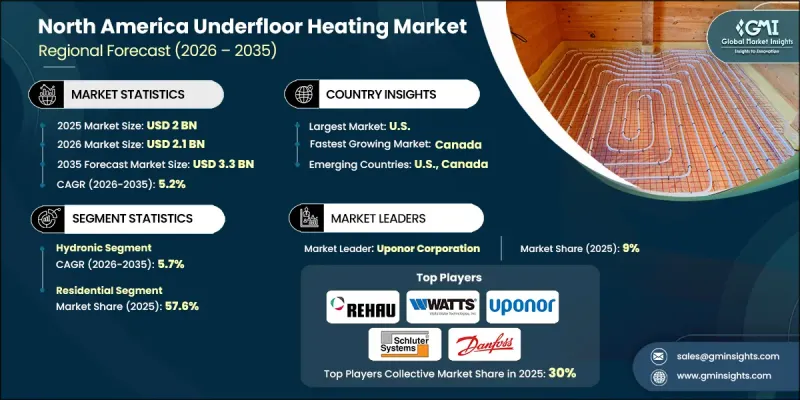
Market expansion is driven by rising demand for energy-efficient heating systems, propelled by governmental policies aimed at reducing carbon emissions and improving building performance. The rapid development of residential and commercial infrastructure, combined with a shift toward sustainable and technologically advanced heating solutions, is further shaping market dynamics. Consumers increasingly favor underfloor heating systems that deliver uniform warmth while reducing utility costs, and heightened awareness of energy conservation continues to fuel adoption. Hydronic and electric radiant systems are becoming central to smart building initiatives, while extreme weather events highlight the need for reliable, high-performance heating solutions. Incentives, mandates, and international electrification programs are encouraging investment in low-energy heating technologies, making underfloor systems a preferred choice in both new construction and retrofit projects across the region.
| Market Scope | |
|---|---|
| Start Year | 2025 |
| Forecast Year | 2026-2035 |
| Start Value | $2 Billion |
| Forecast Value | $3.3 Billion |
| CAGR | 5.2% |
The hydronic underfloor heating segment held a 66.4% share and is expected to grow at a CAGR of 5.7% through 2035. The segment's growth is supported by the rising adoption of advanced and energy-efficient heating solutions, driven by initiatives promoting sustainable and clean building designs. Increasing residential and commercial construction, particularly in smart city developments, further boosts the demand for hydronic systems, which are valued for their efficiency, adaptability, and long-term operational cost savings. This technology is also preferred for large-scale installations where consistent heating and integration with renewable energy sources are critical.
The residential segment accounted for 57.6% share in 2025, with an anticipated CAGR of 5.2% from 2026 to 2035. Expanding urbanization, population growth, and a rising focus on green buildings are key factors propelling the adoption of underfloor heating in homes. Homeowners are increasingly prioritizing energy-efficient and clean heating solutions that reduce emissions and support sustainable lifestyles. Collaborative initiatives between governments and private stakeholders to deliver effective heating in cold climates are also supporting market growth. Continuous innovation in space heating systems and the integration of smart control technologies further enhance the appeal of residential underfloor heating solutions.
U.S. Underfloor Heating Market held 77.8% share, generating USD 1.5 billion in 2025. Market growth in the U.S. is fueled by heightened demand for advanced heating systems, stricter energy efficiency regulations, and financial incentives encouraging the use of low-emission, high-efficiency technologies. Policies promoting the modernization of residential and commercial buildings, along with incentives for energy-efficient retrofits, are driving the adoption of underfloor heating solutions. Increasing awareness of operational cost savings, coupled with the need for consistent and uniform heating, positions the U.S. as the primary growth driver in North America.
Key players in the North America Underfloor Heating Market include Danfoss, Gold Heat, Arkon Heating, FloorHeat, Infloor Heating Systems, REHAU, STEP HEAT, Nuheat, ThermaRay, ProLux Materials, Schluter Systems, Warmboard, Warmup, Ouellet, SunTouch, Emerson Electric, MAPEI, MP Global Products, and Watts. These companies drive innovation, focus on sustainability, and leverage strategic collaborations to expand their presence in the competitive underfloor heating landscape. Companies operating in the North America Underfloor Heating Market are employing strategies such as technological innovation, strategic partnerships, and customer-focused solutions to strengthen their market position. Firms are investing in advanced electric and hydronic systems with smart controls and automation capabilities to improve energy efficiency and user convenience. Strategic alliances with construction firms, architects, and distributors help expand market reach and integrate products into new residential and commercial projects. Companies are also focusing on after-sales service, installation support, and turnkey solutions to enhance customer loyalty.
Table of Contents
Chapter 1 Methodology & Scope
- 1.1 Research design
- 1.2 Quality commitment
- 1.2.1 GMI AI policy & data integrity commitment
- 1.2.1.1 Source consistency protocol
- 1.2.1 GMI AI policy & data integrity commitment
- 1.3 Research Trail & Confidence Scoring
- 1.3.1 Research Trail Components
- 1.3.2 Scoring components
- 1.4 Data Collection
- 1.4.1 Partial list of primary sources
- 1.5 Data mining sources
- 1.5.1 Paid Sources
- 1.5.1.1 Sources, by country
- 1.5.1 Paid Sources
- 1.6 Base estimates and calculations
- 1.6.1 Base year calculation for any one approach
- 1.7 Forecast model
- 1.8 Research transparency addendum
- 1.8.1 Source attribution framework
- 1.8.2 Quality assurance metrics
- 1.8.3 Our commitment to trust
- 1.9 Market definitions
Chapter 2 Executive Summary
- 2.1 Industry synopsis, 2022 - 2035
- 2.2 Business trends
- 2.3 Technology trends
- 2.4 Facility trends
- 2.5 Application trends
- 2.6 Country trends
Chapter 3 Industry Insights
- 3.1 Industry ecosystem analysis
- 3.1.1 Raw material availability & sourcing analysis
- 3.1.2 Key factors affecting the value chain
- 3.1.3 Disruptions
- 3.2 Industry impact forces
- 3.2.1 Growth drivers
- 3.2.2 Industry pitfalls & challenges
- 3.3 Growth potential analysis
- 3.4 Regulatory landscape
- 3.5 Porter's analysis
- 3.5.1 Bargaining power of suppliers
- 3.5.2 Bargaining power of buyers
- 3.5.3 Threat of new entrants
- 3.5.4 Threat of substitutes
- 3.6 PESTEL analysis
- 3.6.1 Political factors
- 3.6.2 Economic factors
- 3.6.3 Social factors
- 3.6.4 Technological factors
- 3.6.5 Legal factors
- 3.6.6 Environmental factors
- 3.7 Cost structure analysis of underfloor heating systems
- 3.8 Emerging opportunities & trends
- 3.8.1 Digital transformation with IoT technologies
- 3.8.2 Emerging market penetration
- 3.9 Investment analysis & future outlook
Chapter 4 Competitive Landscape, 2026
- 4.1 Introduction
- 4.2 Company market share analysis, by country, 2025
- 4.2.1 U.S.
- 4.2.2 Canada
- 4.3 Competitive positioning matrix
- 4.4 Key developments
- 4.4.1 Mergers & acquisitions
- 4.4.2 Partnerships & collaborations
- 4.4.3 New product launches
- 4.4.4 Expansion plans and funding
Chapter 5 Market Size and Forecast, By Technology, 2022 - 2035 (USD Million)
- 5.1 Key trends
- 5.2 Electric
- 5.3 Hydronic
Chapter 6 Market Size and Forecast, By Facility, 2022 - 2035 (USD Million)
- 6.1 Key trends
- 6.2 New buildings
- 6.3 Retrofit
Chapter 7 Market Size and Forecast, By Application, 2022 - 2035 (USD Million)
- 7.1 Key trends
- 7.2 Residential
- 7.2.1 Single family
- 7.2.2 Multi family
- 7.3 Commercial
- 7.3.1 Education
- 7.3.2 Healthcare
- 7.3.3 Retail
- 7.3.4 Logistics & transportation
- 7.3.5 Offices
- 7.3.6 Hospitality
- 7.3.7 Others
- 7.4 Industrial
Chapter 8 Market Size and Forecast, By Country, 2022 - 2035, (USD Million)
- 8.1 Key trends
- 8.2 U.S.
- 8.3 Canada
Chapter 9 Company Profiles
- 9.1 Arkon Heating
- 9.2 Danfoss
- 9.3 Emerson Electric
- 9.4 FloorHeat
- 9.5 Gold Heat
- 9.6 Infloor Heating Systems
- 9.7 MAPEI
- 9.8 MP Global Products
- 9.9 Nuheat
- 9.10 Ouellet
- 9.11 ProLux Materials
- 9.12 REHAU
- 9.13 Schluter Systems
- 9.14 STEP HEAT
- 9.15 SunTouch
- 9.16 ThermaRay
- 9.17 Uponor Corporation
- 9.18 Warmboard
- 9.19 Warmup
- 9.20 Watts

