PUBLISHER: Global Market Insights Inc. | PRODUCT CODE: 2019250

PUBLISHER: Global Market Insights Inc. | PRODUCT CODE: 2019250
Perfume Market Opportunity, Growth Drivers, Industry Trend Analysis, and Forecast 2026 - 2035
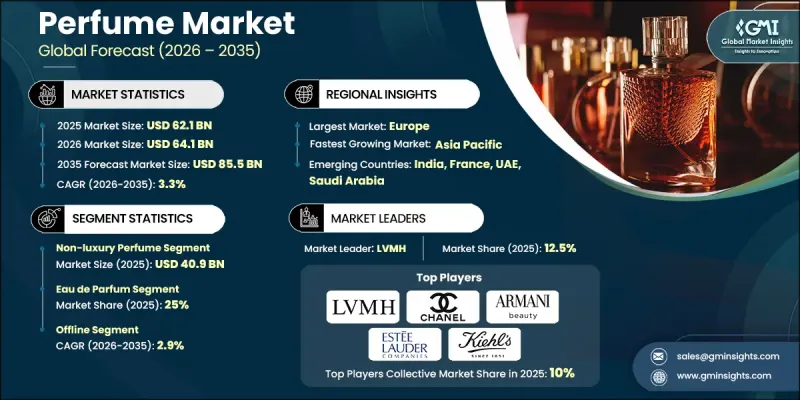
The Global Perfume Market was valued at USD 62.1 billion in 2025 and is estimated to grow at a CAGR of 3.3% to reach USD 85.5 billion by 2035.
Market expansion is fueled by rising consumer interest in specialized perfumes made from natural ingredients and the increasing reach of e-commerce platforms, which have made fragrances more accessible worldwide. The growing popularity of personal grooming services and the influence of social media platforms are driving consumer engagement with perfumes. Advanced formulation technologies and the inclusion of natural and organic components are attracting environmentally conscious buyers. Additionally, the growing trend of unisex fragrances is broadening the consumer base, while shifting preferences among younger consumers, particularly Gen-Z, are influencing new fragrance launches. Floral-inspired scents, especially innovative variations of rose, are making a notable comeback, reflecting evolving consumer tastes. Collectively, changing consumer behavior, technological innovations, and regulatory frameworks are reshaping the perfume industry and driving consistent market growth.
| Market Scope | |
|---|---|
| Start Year | 2025 |
| Forecast Year | 2026-2035 |
| Start Value | $62.1 Billion |
| Forecast Value | $85.5 Billion |
| CAGR | 3.3% |
In 2025, the non-luxury perfume segment reached USD 40.9 billion and is expected to grow at a CAGR of 2.9% through 2035. The segment's growth is supported by product affordability and the rising demand for daily-use fragrances. Consumers increasingly seek diverse options within accessible price ranges, which encourages steady expansion. The growth of online retail channels has further amplified accessibility, allowing customers to explore a wide variety of non-luxury perfumes conveniently. As a result, the segment continues to maintain a strong foothold in the market while supporting the adoption of mid-range fragrance products.
The eau de parfum (EDP) segment held a 25% share in 2025 and is projected to grow at a CAGR of 3.8% from 2026 to 2035. EDP offers a balanced concentration of fragrance oils, making it longer-lasting yet more affordable than parfum. Its affordability, combined with the availability of multiple scent options, has made EDP particularly popular among middle-income consumers. Rising awareness of personal grooming and the growing trend of self-expression through fragrances are further driving the segment's expansion. The segment benefits from ongoing innovations in scent composition and targeted marketing, attracting a broad audience globally.
United States Perfume Market held an 80% share, generating USD 14.7 billion in 2025, driven by shifting consumer preferences toward niche and personalized perfumes, along with growing interest in eco-friendly and sustainable fragrance options. Social media platforms and celebrity endorsements continue to elevate brand visibility and influence purchasing decisions. The East Coast, with key hubs for fragrance innovation and distribution, plays a critical role in shaping trends and supporting market expansion. The combination of affluent consumers, innovative marketing strategies, and high adoption of e-commerce channels ensures that the U.S. remains a leading market globally.
Prominent players operating in the Global Perfume Market include Chanel, Dior, Gucci, Tom Ford, Burberry, Victoria's Secret, Armani Beauty, Hermes, LVMH, Michael Kors, Estee Lauder, Bvlgari, Kiehl's, Paris Hilton, and Zara. Key strategies adopted by companies in the Global Perfume Market focus on product innovation, digital engagement, and market diversification to strengthen their presence. Businesses are investing in research and development to create natural, sustainable, and personalized fragrances that resonate with changing consumer preferences. Strategic collaborations with influencers and celebrities enhance brand visibility, while expanding e-commerce and direct-to-consumer platforms increase market penetration. Companies are also leveraging data-driven marketing to target specific consumer segments, optimize product portfolios, and introduce seasonal or limited-edition fragrances to stimulate demand. Sustainability initiatives, including eco-friendly packaging and responsible sourcing, help companies build brand loyalty. Additionally, global expansion into emerging markets and partnerships with retail chains ensure a strong market footprint and competitive advantage.
Table of Contents
Chapter 1 Methodology and scope
- 1.1 Market scope and definition
- 1.2 Research design
- 1.2.1 Research approach
- 1.2.2 Data collection methods
- 1.3 Data mining sources
- 1.3.1 Global
- 1.3.2 Regional/country
- 1.4 Base estimates and calculations
- 1.4.1 Base year calculation
- 1.4.2 Key trends for market estimation
- 1.5 Primary research and validation
- 1.5.1 Primary sources
- 1.6 Forecast model
- 1.7 Research assumptions and limitations
Chapter 2 Executive summary
- 2.1 Industry 360° synopsis
- 2.2 Key market trends
- 2.2.1 Regional
- 2.2.2 Product Type
- 2.2.3 By Perfume Type
- 2.2.4 By Scent Profile
- 2.2.5 By Consumer Group
- 2.2.6 By Price
- 2.2.7 By Distribution Channel
- 2.3 CXO perspectives: strategic imperatives
- 2.3.1 Key decision points for industry executives
- 2.3.2 Critical success factors for market players
- 2.4 Future outlook and strategic recommendations
Chapter 3 Industry insights
- 3.1 Industry ecosystem analysis
- 3.1.1 Supplier landscape
- 3.1.2 Profit margin
- 3.1.3 Value addition at each stage
- 3.1.4 Factor affecting the value chain
- 3.1.5 Disruptions
- 3.2 Industry impact forces
- 3.2.1 Growth drivers
- 3.2.2 Industry pitfalls & challenges
- 3.2.3 Opportunities
- 3.3 Growth potential analysis
- 3.4 Future market trends
- 3.5 Technology and innovation landscape
- 3.5.1 Current technological trends
- 3.5.2 Emerging technologies
- 3.6 Price trends
- 3.6.1 By region
- 3.6.2 By product type
- 3.7 Regulatory framework
- 3.7.1 Standards and certifications
- 3.7.2 Environmental regulations
- 3.7.3 Import export regulations
- 3.8 Trade statistics
- 3.8.1 Major importing countries
- 3.8.2 Major exporting countries
- 3.9 Porter's five forces analysis
- 3.10 PESTEL analysis
- 3.11 Consumer behavior analysis
- 3.11.1 Purchasing patterns
- 3.11.2 Preference analysis
- 3.11.3 Regional variations in consumer behavior
- 3.11.4 Impact of e-commerce on buying decisions
Chapter 4 Competitive landscape, 2025
- 4.1 Introduction
- 4.2 Company market share analysis
- 4.2.1 By region
- 4.2.1.1 North America
- 4.2.1.2 Europe
- 4.2.1.3 Asia Pacific
- 4.2.1.4 Latin America
- 4.2.1.5 MEA
- 4.2.1 By region
- 4.3 Company matrix analysis
- 4.4 Competitive analysis of major market players
- 4.5 Competitive positioning matrix
- 4.6 Key developments
- 4.6.1 Mergers & acquisitions
- 4.6.2 Partnerships & collaborations
- 4.6.3 New product launches
- 4.6.4 Expansion plans
Chapter 5 Market Estimates & Forecast, By Product Type, 2022 - 2035 ($Billion, Million Units)
- 5.1 Key trends
- 5.2 Luxury perfume
- 5.3 Non-luxury perfume
Chapter 6 Market Estimates & Forecast, By Perfume Type, 2022 - 2035 ($Billion, Million Units)
- 6.1 Key trends
- 6.2 Parfum or de parfum
- 6.3 Eau De Parfum (EDP)
- 6.4 Eau De Toilette (EDT)
- 6.5 Eau De Cologne (EDC)
- 6.6 Other (Eau Fraiche etc.)
Chapter 7 Market Estimates & Forecast, By Scent Profile, 2022 - 2035 ($Billion, Million Units)
- 7.1 Key trends
- 7.2 Floral
- 7.3 Oriental
- 7.4 Woody
- 7.5 Fresh
- 7.6 Others (gourmand, fruity etc.)
Chapter 8 Market Estimates & Forecast, By Consumer Group, 2022 - 2035 ($Billion, Million Units)
- 8.1 Key trends
- 8.2 Men
- 8.3 Women
- 8.4 Unisex
Chapter 9 Market Estimates & Forecast, By Price, 2022 - 2035 ($Billion, Million Units)
- 9.1 Key trends
- 9.2 Up to $49
- 9.3 $50 to $149
- 9.4 $150 & above
Chapter 10 Market Estimates & Forecast, By Distribution Channel, 2022 - 2035 ($Billion, Million Units)
- 10.1 Key trends
- 10.2 Online
- 10.2.1 E-commerce
- 10.2.2 Company websites
- 10.3 Offline
- 10.3.1 Supermarkets/hypermarket
- 10.3.2 Specialty retail stores
- 10.3.3 Others (independent retailer etc.)
Chapter 11 Market Estimates & Forecast, By Region, 2022 - 2035 ($Billion, Million Units)
- 11.1 Key trends
- 11.2 North America
- 11.2.1 U.S.
- 11.2.2 Canada
- 11.3 Europe
- 11.3.1 Germany
- 11.3.2 UK
- 11.3.3 France
- 11.3.4 Spain
- 11.3.5 Italy
- 11.3.6 Netherlands
- 11.4 Asia Pacific
- 11.4.1 China
- 11.4.2 Japan
- 11.4.3 India
- 11.4.4 Australia
- 11.4.5 South Korea
- 11.5 Latin America
- 11.5.1 Brazil
- 11.5.2 Mexico
- 11.5.3 Argentina
- 11.6 MEA
- 11.6.1 South Africa
- 11.6.2 Saudi Arabia
- 11.6.3 UAE
Chapter 12 Company Profiles
- 12.1 Armani Beauty
- 12.2 Burberry
- 12.3 Bvlgari
- 12.4 Chanel
- 12.5 Dior
- 12.6 Estee Lauder
- 12.7 Gucci
- 12.8 Hermes
- 12.9 Kiehl's
- 12.10 LVMH
- 12.11 Michael Kors
- 12.12 Paris Hilton
- 12.13 Tom Ford
- 12.14 Victoria's Secret
- 12.15 Zara

