PUBLISHER: Global Market Insights Inc. | PRODUCT CODE: 2027442

PUBLISHER: Global Market Insights Inc. | PRODUCT CODE: 2027442
Southeast Asia Water Dispenser Market Opportunity, Growth Drivers, Industry Trend Analysis, and Forecast 2026 - 2035
Southeast Asia Water Dispenser Market was valued at USD 308.3 million in 2025 and is estimated to grow at a CAGR of 8.7% to reach USD 707.3 million by 2035.
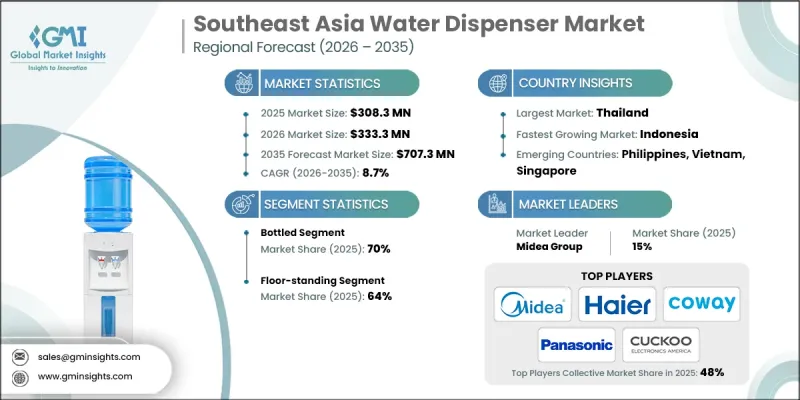
The Southeast Asia water dispenser industry is witnessing consistent growth as access to clean and convenient drinking water becomes a fundamental requirement across residential, commercial, and public environments. Increasing awareness around hygiene and health is encouraging consumers to adopt reliable hydration solutions that offer both safety and ease of use. Water dispensers are becoming a preferred choice due to their ability to provide immediate access to potable water without complexity. At the same time, shifting consumer preferences toward sustainable living are driving interest in alternatives that reduce reliance on disposable plastic packaging. The Southeast Asia water dispenser market is also benefiting from evolving lifestyles where convenience and efficiency are prioritized. As a result, manufacturers are introducing user-friendly and efficient systems that align with modern expectations, contributing to the market's steady expansion across the region.
| Market Scope | |
|---|---|
| Start Year | 2025 |
| Forecast Year | 2026-2035 |
| Start Value | $308.3 Million |
| Forecast Value | $707.3 Million |
| CAGR | 8.7% |
Across the Southeast Asia water dispenser market, demand is rising for solutions that offer simplicity, reliability, and improved water quality. Consumers are increasingly transitioning toward systems that provide hassle-free operation while meeting everyday hydration needs. Growing preference for advanced purification features is also shaping purchasing behavior, as users seek better-tasting and cleaner water. This shift reflects a broader move toward convenience-driven consumption patterns where functionality and safety are key decision factors.
The bottled segment accounted for 70% share in 2025, maintaining its leading position. This segment continues to perform strongly due to its ease of use and adaptability across different environments. Consumers prefer solutions that require minimal setup and offer dependable access to clean water. Additionally, the ability to rely on consistent supply without complex installation contributes to the segment's sustained demand and widespread acceptance.
In 2025, the floor-standing water dispensers segment held a 64% share, generating USD 196.6 million. These units remain highly popular due to their capacity, durability, and ease of placement in various settings. Their design supports high usage requirements while ensuring stable and long-term operation. Furthermore, their versatility allows them to fit seamlessly into different environments without requiring significant adjustments, making them a practical solution for a wide range of users.
Thailand Water Dispenser Market held 26% share, generating USD 78.9 million in 2025. The country's strong position is supported by high consumer awareness and widespread acceptance of water dispensing solutions. A well-developed retail and service infrastructure further enhances accessibility and encourages continued product adoption. Consistent demand and established usage patterns contribute to steady growth within the market.
Key players operating in the Southeast Asia Water Dispenser Market include Midea Group, Coway Co., Ltd., Pensonic Holdings Berhad, Haier Group, Kangaroo Group, Panasonic Corporation, Miyako Electronics, Angel Drinking Water Group, Cosmos, Cuckoo Electronics, Qinyuan Group, Gree Electric Appliances, Sharp Corporation, Modena, and Polytron. Companies in the Southeast Asia Water Dispenser Market are strengthening their market presence through innovation and strategic expansion initiatives. They are focusing on developing advanced products with improved purification technologies and user-friendly features to meet evolving consumer expectations. Partnerships and regional collaborations are being leveraged to enhance distribution networks and expand market reach. Many companies are also investing in product diversification to cater to different customer segments. In addition, firms are emphasizing after-sales services and maintenance support to improve customer satisfaction and retention. Sustainability initiatives and efficient manufacturing practices are further helping companies align with changing consumer preferences while maintaining a competitive position in the market.
Table of Contents
Chapter 1 Research Methodology
- 1.1 Research approach
- 1.2 Quality Commitments
- 1.2.1 GMI AI policy & data integrity commitment
- 1.2.1.1 Source consistency protocol
- 1.2.1 GMI AI policy & data integrity commitment
- 1.3 Research Trail & Confidence Scoring
- 1.3.1 Research Trail Components
- 1.3.2 Scoring Components
- 1.4 Data Collection
- 1.4.1 Partial list of primary sources
- 1.5 Data mining sources
- 1.5.1 Paid sources
- 1.5.1.1 Sources, by region
- 1.5.1 Paid sources
- 1.6 Base estimates and calculations
- 1.6.1 Base year calculation for any one approach
- 1.7 Forecast model
- 1.7.1 Quantified market impact analysis
- 1.7.1.1 Mathematical impact of growth parameters on forecast
- 1.7.1 Quantified market impact analysis
- 1.8 Research transparency addendum
- 1.8.1 Source attribution framework
- 1.8.2 Quality assurance metrics
- 1.8.3 Our commitment to trust
Chapter 2 Executive Summary
- 2.1 Water dispenser market 360° synopsis, 2022 - 2035
- 2.2 Business
- 2.3 Product type
- 2.4 Dispensing method
- 2.5 Functionality
- 2.6 Price Range
- 2.7 End use
- 2.8 Distribution channel
- 2.9 Country
Chapter 3 Water Dispenser Industry Insights
- 3.1 Industry ecosystem analysis
- 3.2 Impact on forces
- 3.2.1 Growth drivers
- 3.2.2 Industry pitfalls & challenges
- 3.3 Growth potential analysis
- 3.4 Regulatory landscape
- 3.4.1 Water quality standards by country (Singapore, Malaysia, Indonesia)
- 3.4.2 Product safety & certification requirements
- 3.4.3 Import/export regulations across ASEAN
- 3.4.4 Environmental & energy efficiency mandates
- 3.5 Supply chain analysis
- 3.5.1 Raw material sourcing & supplier concentration
- 3.5.2 Manufacturing hubs across Southeast Asia
- 3.5.3 Logistics & distribution network complexity
- 3.5.4 Supply chain disruption risks & mitigation
- 3.6 Pricing analysis (driven by primary research)
- 3.6.1 Historical price trend analysis
- 3.6.2 Pricing strategy by player type (premium / value / cost plus)
- 3.6.3 Price variation by country & local market dynamics
- 3.7 Porter’s analysis
- 3.8 PESTEL analysis
- 3.9 Trade analysis (driven by paid database) (HS Code: 8418/8516)
- 3.9.1 Import/export volume & value trends
- 3.9.2 Key trade corridors & tariff impact
- 3.9.3 Intra ASEAN trade dynamics
- 3.10 Impact of AI & generative AI on the market
- 3.10.1 AI driven disruption of existing business models
- 3.10.2 GenAI use cases & adoption roadmap by segment
- 3.10.3 Risks, limitations & regulatory considerations
- 3.11 Consumer buying behavior analysis
- 3.12 Distribution infrastructure & channel penetration landscape (driven by primary research)
- 3.12.1 Channel coverage by region & format (modern vs traditional trade)
- 3.12.2 Last mile infrastructure gaps & emerging channel shifts
- 3.12.3 E commerce penetration rates by country
- 3.12.4 Dealer/distributor network density mapping
Chapter 4 Competitive Landscape, 2025
- 4.1 Introduction
- 4.2 Company market share analysis
- 4.3 Company matrix analysis
- 4.4 Competitive analysis of major market players
- 4.5 Competitive positioning matrix
- 4.6 Key developments
- 4.6.1 Mergers & acquisitions
- 4.6.2 Partnerships & collaborations
- 4.6.3 New product launches
- 4.6.4 Expansion plans
Chapter 5 Water Dispenser Market Estimates & Forecast, By Product Type 2022 - 2035, (USD Billion; Million Units)
- 5.1 Key trends
- 5.2 Bottled
- 5.2.1 Bottom loading
- 5.2.2 Top loading
- 5.3 Bottle less
Chapter 6 Water Dispenser Market Estimates & Forecast, By Dispensing Method 2022 - 2035, (USD Billion; Million Units)
- 6.1 Key trends
- 6.2 Countertop
- 6.3 Floor-standing
- 6.4 Wall-mounted
Chapter 7 Water Dispenser Market Estimates & Forecast, By Functionality, 2022 - 2035, (USD Billion; Million Units)
- 7.1 Key trends
- 7.2 Hot & cold dispensers
- 7.3 Cold only
- 7.4 Hot only
- 7.5 Ambient/Room temperature
Chapter 8 Water Dispenser Market Estimates & Forecast, By Price Range 2022 - 2035, (USD Billion; Million Units)
- 8.1 Key trends
- 8.2 Low (Below $ 50)
- 8.3 Medium ($50-250)
- 8.4 High (Above $250)
Chapter 9 Water Dispenser Market Estimates & Forecast, By End Use 2022 - 2035, (USD Billion; Million Units)
- 9.1 Key trends
- 9.2 Commercial
- 9.2.1 HoReCa
- 9.2.2 Corporates
- 9.2.3 Healthcare
- 9.2.4 Institutional
- 9.2.5 Others (Retail, Spa Centers, etc.)
- 9.3 Residential
- 9.4 Industrial
Chapter 10 Water Dispenser Market Estimates & Forecast, By Distribution Channel 2022 - 2035, (USD Billion; Million Units)
- 10.1 Key trends, by distribution channel
- 10.2 Online channels
- 10.2.1 E-commerce
- 10.2.2 Company websites
- 10.3 Offline channels
- 10.3.1 Specialty stores
- 10.3.2 Mega retail stores
- 10.3.3 Others
Chapter 11 Water Dispenser Market Estimates & Forecast, By Country 2022 - 2035, (USD Billion; Million Units)
- 11.1 Key trends
- 11.2 Singapore
- 11.3 Malaysia
- 11.4 Indonesia
- 11.5 Thailand
- 11.6 Philippines
- 11.7 Vietnam
- 11.8 Rest of Southeast Asia
Chapter 12 Company Profiles
- 12.1 Midea Group
- 12.2 Coway Co., Ltd.
- 12.3 Pensonic Holdings Berhad
- 12.4 Haier Group
- 12.5 Kangaroo Group
- 12.6 Panasonic Corporation
- 12.7 Miyako Electronics
- 12.8 Angel Drinking Water Group
- 12.9 Cosmos
- 12.10 Cuckoo Electronics
- 12.11 Qinyuan Group
- 12.12 Gree Electric Appliances
- 12.13 Sharp Corporation
- 12.14 Modena
- 12.15 Polytron

