PUBLISHER: Global Market Insights Inc. | PRODUCT CODE: 2027446

PUBLISHER: Global Market Insights Inc. | PRODUCT CODE: 2027446
U.S. Golf Putter Market Opportunity, Growth Drivers, Industry Trend Analysis, and Forecast 2026 - 2035
U.S. Golf Putter Market was valued at USD 300 million in 2025 and is estimated to grow at a CAGR of 3.9% to reach USD 438.4 million by 2035.
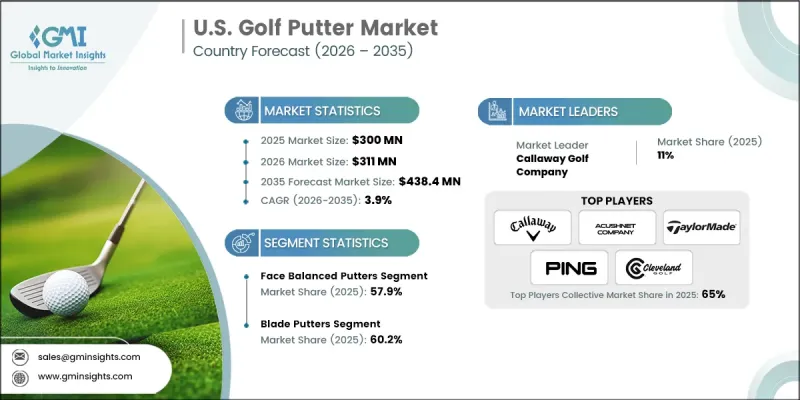
U.S. Golf Putter Industry continues to expand steadily, supported by the enduring popularity of golf as both a competitive sport and a recreational activity across the United States. The sport maintains a strong participation base, with a significant number of enthusiasts and professionals contributing to consistent demand for high-quality equipment. Among all golf clubs, the putter remains the most frequently used during play, accounting for a substantial share of total strokes, which highlights its importance in overall performance. The United States golf putter market serves as a global hub for innovation, where manufacturers consistently introduce advanced designs and technologies. Continuous product development efforts are focused on enhancing precision, control, and consistency, aligning with evolving consumer expectations. Additionally, increased awareness among golfers regarding equipment customization and performance optimization is influencing purchasing behavior, further driving market growth.
| Market Scope | |
|---|---|
| Start Year | 2025 |
| Forecast Year | 2026-2035 |
| Start Value | $300 Million |
| Forecast Value | $438.4 Million |
| CAGR | 3.9% |
Modern developments in the U.S. golf putter market reflect a shift toward technologically advanced and performance-oriented designs. Manufacturers are incorporating innovative engineering techniques and materials to improve accuracy and consistency across different skill levels. The evolution of putter design has transformed it into a highly specialized piece of equipment supported by extensive research and development. As a result, golfers are placing greater emphasis on selecting putters that align with their playing style, preferences, and performance requirements.
The face-balanced putters segment accounted for 57.9% share in 2025, generating USD 174 million. These putters are designed to support a straight and controlled putting motion, maintaining alignment throughout the stroke. Their design characteristics provide enhanced stability and balance, making them a preferred option for players seeking consistent performance. The segment continues to benefit from design advancements that improve forgiveness and overall usability.
The blade putters segment held a 60.2% share in 2025, reaching USD 180.7 million. Known for their compact and traditional design, these putters appeal to golfers who value simplicity and precision. Despite their classic appearance, ongoing enhancements in materials and construction techniques have enabled these products to deliver improved performance while retaining their traditional profile.
United States Golf Putter Market accounted for USD 300 million in 2025. The country remains a leader in product innovation, with strong demand for premium and high-performance equipment. The market is characterized by a focus on precision engineering, advanced materials, and strict compliance with regulatory standards governing equipment design. Consumers continue to prioritize performance-driven products, contributing to sustained demand for technologically advanced and carefully engineered putters.
Key players operating in the U.S. Golf Putter Market include Acushnet Company (Scotty Cameron/Titleist), Bettinardi Golf, Bridgestone Sports Ltd, Callaway Golf Company (Odyssey), Cleveland Golf (Srixon), Cobra Golf, Evnroll Golf, Fourteen Golf, Honma Golf Ltd., L.A.B. Golf, Mizuno USA, Inc, Ping Golf, SeeMore Putter Company, TaylorMade Golf Company, and Wilson Golf. Companies in the U.S. Golf Putter Market are strengthening their market position through continuous innovation and product differentiation. They are investing heavily in research and development to introduce advanced designs that enhance precision, balance, and consistency. Customization options are being expanded to meet individual player preferences, improving customer satisfaction and brand loyalty. Strategic collaborations and endorsements are also being utilized to enhance brand visibility and credibility. In addition, companies are focusing on premium product offerings and leveraging advanced manufacturing techniques to deliver high-quality equipment. Expanding distribution channels and strengthening direct-to-consumer platforms further enable companies to reach a wider audience and maintain a competitive edge in the evolving market landscape.
Table of Contents
Chapter 1 Research Methodology
- 1.1 Research approach
- 1.2 Quality Commitments
- 1.2.1 GMI AI policy & data integrity commitment
- 1.2.1.1 Source consistency protocol
- 1.2.1 GMI AI policy & data integrity commitment
- 1.3 Research Trail & Confidence Scoring
- 1.3.1 Research Trail Components
- 1.3.2 Scoring Components
- 1.4 Data Collection
- 1.4.1 Partial list of primary sources
- 1.5 Data mining sources
- 1.5.1 Paid sources
- 1.5.1.1 Sources, by Country
- 1.5.1 Paid sources
- 1.6 Base estimates and calculations
- 1.6.1 Base year calculation for any one approach
- 1.7 Forecast model
- 1.7.1 Quantified market impact analysis
- 1.7.1.1 Mathematical impact of growth parameters on forecast
- 1.7.1 Quantified market impact analysis
- 1.8 Research transparency addendum
- 1.8.1 Source attribution framework
- 1.8.2 Quality assurance metrics
- 1.8.3 Our commitment to trust
Chapter 2 Executive Summary
- 2.1 Industry synopsis, 2022 - 2035
- 2.2 Key market trends
- 2.2.1 Product type trends
- 2.2.2 Design trends
- 2.2.3 Length trends
- 2.2.4 Price range trends
- 2.2.5 End user trends
- 2.2.6 Distribution channel trends
Chapter 3 Industry Insights
- 3.1 Industry ecosystem analysis
- 3.1.1 Factor affecting the value chain
- 3.1.2 Profit margin analysis
- 3.1.3 Disruptions
- 3.1.4 Future outlook
- 3.1.5 Manufacturers
- 3.1.6 Distributors
- 3.1.7 Retailers
- 3.2 Impact forces
- 3.2.1 Growth drivers
- 3.2.2 Industry pitfalls & challenges
- 3.2.3 Market opportunities
- 3.3 Consumer buying behavior analysis
- 3.3.1 Demographic trends
- 3.3.2 Factors affecting buying decision
- 3.3.3 Consumer product adoption
- 3.3.4 Preferred distribution channel
- 3.3.5 Preferred price range
- 3.4 Growth potential analysis
- 3.5 Regulatory landscape
- 3.6 Pricing analysis (Driven by Primary Research)
- 3.6.1 Historical price trend analysis (driven by primary research)
- 3.6.2 Pricing strategy by player type (premium / mid-range / economy)
- 3.6.3 Price elasticity of demand by customer segment
- 3.7 Porter's analysis
- 3.8 PESTEL analysis
- 3.9 Trade Data Analysis (Driven by paid database)
- 3.9.1 U.S. import volume & value trends for golf putters
- 3.9.2 Key sourcing countries & trade corridors (driven by primary research)
- 3.9.3 U.S. export activity (minimal but growing)
- 3.9.4 Tariff impact on landed costs & pricing
- 3.10 Impact of AI & generative AI on the Market
- 3.10.1 AI-driven disruption of custom fitting (virtual fitting, swing analysis)
- 3.10.1.1 GenAI driven disruption of custom fitting (virtual fitting, swing analysis)
- 3.10.1.2 AI in manufacturing (quality control, precision machining)
- 3.10.1.3 Risks, limitations & consumer acceptance
- 3.10.1 AI-driven disruption of custom fitting (virtual fitting, swing analysis)
Chapter 4 Competitive Landscape, 2025
- 4.1 Introduction
- 4.2 Company market share analysis
- 4.3 Company matrix analysis
- 4.4 Competitive positioning matrix
- 4.5 Strategic outlook matrix
- 4.6 Key developments
- 4.6.1 Mergers & acquisitions
- 4.6.2 Partnerships & collaborations
- 4.6.3 New product launches
- 4.6.4 Expansion plan
Chapter 5 Market Estimates and Forecast, By Product Type, 2022 - 2035 (USD Million) (Thousand Units)
- 5.1 Key trends
- 5.2 Face balanced putters
- 5.3 Toe balanced putters
Chapter 6 Market Estimates & Forecast, By Design 2022 - 2035 (USD Million) (Thousand Units)
- 6.1 Key trends
- 6.2 Blade putter
- 6.3 Mallet putter
Chapter 7 Market Estimates & Forecast, By Length 2022 - 2035 (USD Million) (Thousand Units)
- 7.1 Key trends
- 7.2 Traditional length (32-36 inches)
- 7.3 Belly putter (41-46 inches)
- 7.4 Long putter (48-52 inches)
Chapter 8 Market Estimates & Forecast, By Price Range 2022 - 2035 (USD Million) (Thousand Units)
- 8.1 Key trends
- 8.2 Premium or high
- 8.3 Economy or Mid-Range
Chapter 9 Market Estimates & Forecast, By End Use 2022 - 2035 (USD Million) (Thousand Units)
- 9.1 Key trends
- 9.2 Professionals
- 9.3 Amateur
Chapter 10 Market Estimates & Forecast, By Distribution Channel, 2022 - 2035 (USD Million) (Thousand Units)
- 10.1 Key trends
- 10.2 Direct sales
- 10.3 Indirect sales
Chapter 11 Company Profiles (Business Overview, Financial Data, Product Landscape, Strategic Outlook, SWOT Analysis)
- 11.1 Acushnet Company.
- 11.2 Bettinardi Golf
- 11.3 Bridgestone Sports Ltd
- 11.4 Callaway Golf Company.
- 11.5 Cleveland Golf (Srixon)
- 11.6 Cobra Golf
- 11.7 Evnroll Golf
- 11.8 Fourteen Golf
- 11.9 Honma Golf Ltd.
- 11.10 L.A.B. Golf
- 11.11 Mizuno USA, Inc
- 11.12 Ping Golf
- 11.13 SeeMore Putter Company
- 11.14 TaylorMade Golf Company
- 11.15 Wilson Golf

