PUBLISHER: Global Market Insights Inc. | PRODUCT CODE: 2027457

PUBLISHER: Global Market Insights Inc. | PRODUCT CODE: 2027457
Asia-Pacific Facial Care Products Market Opportunity, Growth Drivers, Industry Trend Analysis, and Forecast 2026 - 2035
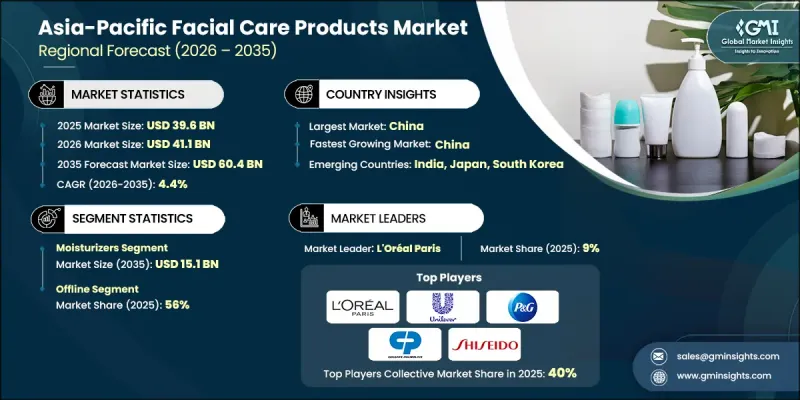
Asia-Pacific Facial Care Products Market was valued at USD 39.6 billion in 2025 and is estimated to grow at a CAGR of 4.4% to reach USD 60.4 billion by 2035.
The Asia-Pacific facial care products industry continues to gain strong momentum as consumer demand evolves toward high-performance skincare solutions. A major factor driving this expansion is the increasing preference for advanced ingredient platforms that combine scientific efficacy with sustainable formulation practices. Consumers are moving away from basic skincare approaches and are instead prioritizing targeted solutions designed to deliver visible and measurable outcomes. This shift is also supported by the rising influence of digital engagement channels, more structured at-home skincare routines, and ongoing portfolio expansion by global beauty companies. Industry consolidation and investments in innovative ingredient development and packaging technologies are further accelerating product advancements across the Asia-Pacific facial care products market. As awareness around skincare deepens, consumers are placing greater emphasis on product quality, formulation transparency, and long-term skin health benefits, which is shaping the competitive landscape across the region.
| Market Scope | |
|---|---|
| Start Year | 2025 |
| Forecast Year | 2026-2035 |
| Start Value | $39.6 Billion |
| Forecast Value | $60.4 Billion |
| CAGR | 4.4% |
Across the Asia-Pacific facial care products market, demand is expanding rapidly due to the growing adoption of high-efficacy ingredient technologies that integrate clinical performance with environmentally responsible sourcing. Consumer preferences are increasingly shifting toward solutions that offer proven results and address specific skin concerns. This transition reflects a broader movement toward precision-based skincare, where effectiveness and formulation integrity are key decision factors, further strengthening the region's growth trajectory.
The moisturizers segment generated USD 9.6 billion in 2025 and is expected to reach USD 15.1 billion by 2035. Rising demand within this segment is being driven by increasing consumer focus on maintaining skin health and protecting against external environmental stressors. Lightweight and adaptable formulations are gaining popularity as they align with diverse climate conditions and evolving skincare routines. Additionally, premium products that combine multiple functional benefits are supporting continued segment expansion.
The offline distribution channel accounted for 56% share in 2025 and is projected to grow at a CAGR of 4.7% through 2035. Physical retail remains a key channel as consumers prefer direct interaction with products before purchase. This channel supports informed decision-making and enhances consumer confidence through personalized assistance and immediate product availability. Retailers continue to invest in enhancing in-store experiences, further strengthening the role of offline distribution.
Asia-Pacific Facial Care Products Market captured USD 39.6 billion in 2025. Growth is supported by strong consumer interest in advanced skincare routines and increasing demand for high-quality facial care solutions. The region is recognized for its continuous innovation in product development and formulation technologies, supported by a dynamic retail ecosystem and growing digital influence. These factors collectively contribute to rapid product adoption and sustained market expansion.
Key players operating in the Asia-Pacific Facial Care Products Market include Amorepacific Corporation, Avon Products, Inc., Beiersdorf AG, Colgate-Palmolive Company, Coty Inc., Estee Lauder Companies Inc., Himalaya Wellness Company, Johnson & Johnson Services, Inc., Kao Corporation, L'Oreal S.A., Natura &Co, Procter & Gamble Co. (P&G), Revlon, Inc., Shiseido Company, Limited, and Unilever PLC. Companies in the Asia-Pacific Facial Care Products Market are strengthening their presence through continuous innovation and strategic expansion initiatives. They are investing in advanced research to develop high-performance formulations that meet evolving consumer expectations. Partnerships and acquisitions are being used to expand product portfolios and enhance regional reach. Many companies are also focusing on digital transformation and omnichannel strategies to improve customer engagement and accessibility. Premiumization and product differentiation remain key priorities, supported by targeted marketing and personalized offerings. Additionally, sustainability initiatives, including eco-friendly packaging and responsible sourcing, are gaining importance as companies align their operations with shifting consumer preferences and regulatory standards, ensuring long-term competitiveness in the market.
Table of Contents
Chapter 1 Methodology and Scope
- 1.1 Market scope and definition
- 1.2 Research design
- 1.2.1 Research approach
- 1.2.2 Data collection methods
- 1.3 Data mining sources
- 1.3.1 Regional/Country
- 1.4 Base estimates and calculations
- 1.4.1 Base year calculation
- 1.4.2 Key trends for market estimation
- 1.5 Primary research and validation
- 1.5.1 Primary sources
- 1.6 Forecast model
- 1.7 Research assumptions and limitations
Chapter 2 Executive Summary
- 2.1 Industry 360° synopsis
- 2.2 Key market trends
- 2.2.1 Regional
- 2.2.2 Product Type
- 2.2.3 Skin Type
- 2.2.4 Ingredient
- 2.2.5 Consumer Group
- 2.2.6 Price
- 2.2.7 Distribution Channel
- 2.3 CXO perspectives: Strategic imperatives
- 2.3.1 Key decision points for industry executives
- 2.3.2 Critical success factors for market players
- 2.4 Future outlook and strategic recommendations
Chapter 3 Industry Insights
- 3.1 Industry ecosystem analysis
- 3.1.1 Supplier landscape
- 3.1.2 Profit margin
- 3.1.3 Value addition at each stage
- 3.1.4 Factor affecting the value chain
- 3.2 Industry impact forces
- 3.2.1 Growth drivers
- 3.2.1.1 Rising adoption of clinical grade brightening solutions
- 3.2.1.2 Clean-beauty movement & ingredient transparency
- 3.2.1.3 Dermatology & professional skincare influence
- 3.2.2 Industry pitfalls & challenges
- 3.2.2.1 Market saturation & trend fatigue
- 3.2.2.2 Trust deficit & "greenwashing"
- 3.2.3 Opportunities
- 3.2.3.1 Rise of the "prejuvenation" shift
- 3.2.3.2 Clinical confidence & dermocosmetics
- 3.2.1 Growth drivers
- 3.3 Growth potential analysis
- 3.4 Future market trends
- 3.5 Technology and innovation landscape
- 3.5.1 Current technological trends
- 3.5.2 Emerging technologies
- 3.6 Price trends
- 3.6.1 Historical Price Trend Analysis (Driven by Primary Research)
- 3.6.2 Pricing Strategy by Player Type (Premium / Value / Cost-plus) (Driven by Primary Research)
- 3.6.3 Regional Price Variations (Driven by Primary Research)
- 3.7 Regulatory landscape
- 3.7.1 China NMPA Requirements
- 3.7.2 ASEAN Cosmetic Directive
- 3.8 Patent Landscape (Driven by Primary Research)
- 3.8.1 Active Ingredient Patents (Driven by Primary Research)
- 3.8.2 Formulation & Delivery System Patents (Driven by Primary Research)
- 3.8.3 Patent Activity by Key Players (Driven by Primary Research)
- 3.9 Porter's analysis
- 3.10 PESTEL analysis
- 3.11 Trade Data Analysis
- 3.11.1 Import & Export Volume & Value Trends(Driven by Primary Research)
- 3.11.2 Key Trade Corridors & Tariff Impact(Driven by Primary Research)
- 3.11.3 Top Importing & Exporting Countries (Driven by Primary Research)
- 3.12 Impact of AI & Generative AI on the Market
- 3.12.1 AI-Driven Disruption of Existing Business Models
- 3.12.2 Predictive Analytics for Product Development
- 3.13 Risks, Limitations & Regulatory Considerations
- 3.13.1 Distribution Infrastructure & Channel Penetration Landscape (Driven by Primary Research)
- 3.13.2 Channel Coverage by Country(Modern vs. Traditional Trade) (Driven by Primary Research)
- 3.13.3 Last-Mile Infrastructure Gaps & Emerging Channel Shifts (Driven by Primary Research)
Chapter 4 Competitive Landscape, 2025
- 4.1 Introduction
- 4.2 Company market share analysis
- 4.2.1 By country
- 4.2.1.1 China
- 4.2.1.2 Japan
- 4.2.1.3 India
- 4.2.1.4 South Korea
- 4.2.1.5 Australia
- 4.2.1.6 Indonesia
- 4.2.1 By country
- 4.3 Company matrix analysis
- 4.4 Competitive analysis of major market players
- 4.5 Competitive positioning matrix
- 4.6 Key developments
- 4.6.1 Mergers & acquisitions
- 4.6.2 Partnerships & collaborations
- 4.6.3 New product launches
- 4.6.4 Expansion plans
Chapter 5 Market Estimates & Forecast, By Product Type, 2022 - 2035, (USD Billion) (Million Unit)
- 5.1 Key trends
- 5.2 Cleansers
- 5.2.1 Face wash
- 5.2.2 Micellar water
- 5.2.3 Cleansing Oils
- 5.2.4 Others (Cleansing wipes, balms etc.)
- 5.3 Moisturizers
- 5.3.1 Day creams
- 5.3.2 Night creams
- 5.3.3 Anti-aging
- 5.3.4 Brightening creams
- 5.3.5 Others (Face butter, BB/CC Creams etc.)
- 5.4 Toners
- 5.5 Serums
- 5.6 Face masks
- 5.6.1 Clay masks
- 5.6.2 Sheet masks
- 5.6.3 Others (Gel masks etc.)
- 5.7 Sunscreens
- 5.7.1 Cream
- 5.7.2 Gel
- 5.7.3 Powder
- 5.7.4 Lotion
- 5.7.5 Other (Aerosol etc.)
- 5.8 Exfoliators
- 5.8.1 Scrubs
- 5.8.2 Chemical exfoliants
- 5.8.3 Other (Peel-off etc.)
- 5.9 Others (Face mist, Pimple patches etc.)
Chapter 6 Market Estimates & Forecast, By Skin Type, 2022 - 2035, (USD Billion) (Million Unit)
- 6.1 Key trends
- 6.2 Normal skin
- 6.3 Dry skin
- 6.4 Oily skin
- 6.5 Combination skin
- 6.6 Sensitive skin
Chapter 7 Market Estimates & Forecast, By Ingredient, 2022 - 2035, (USD Billion) (Million Unit)
- 7.1 Key trends
- 7.2 Chemical
- 7.3 Natural
Chapter 8 Market Estimates & Forecast, By Consumer Group, (USD Billion) (Million Unit)
- 8.1 Key trends
- 8.2 Men
- 8.3 Women
- 8.4 Children's
Chapter 9 Market Estimates & Forecast, By Price, 2022 - 2035, (USD Billion) (Million Unit)
- 9.1 Key trends
- 9.2 Low
- 9.3 Medium
- 9.4 High
Chapter 10 Market Estimates & Forecast, By Distribution Channel, 2022 - 2035, (USD Billion) (Million Unit)
- 10.1 Key trends
- 10.2 Online retail
- 10.2.1 E-commerce platforms
- 10.2.2 Brand websites
- 10.3 Offline retail
- 10.3.1 Supermarkets/Hypermarkets
- 10.3.2 Specialty stores
- 10.3.3 Pharmacies & Drugstores
- 10.3.4 Departmental stores
Chapter 11 Market Estimates and Forecast, By Region, 2022 - 2035 (USD Billion) (USD Billion) (Million Unit)
- 11.1 Key trends
- 11.2 Asia Pacific
- 11.2.1 China
- 11.2.2 Japan
- 11.2.3 India
- 11.2.4 South Korea
- 11.2.5 Australia
- 11.2.6 Indonesia
Chapter 12 Company Profiles
- 12.1 Amorepacific Corporation
- 12.2 Avon Products, Inc.
- 12.3 Beiersdorf AG
- 12.4 Colgate-Palmolive Company
- 12.5 Coty Inc.
- 12.6 Estee Lauder Companies Inc.
- 12.7 Himalaya Wellness Company
- 12.8 Johnson & Johnson Services, Inc.
- 12.9 Kao Corporation
- 12.10 L'Oreal S.A.
- 12.11 Natura &Co
- 12.12 Procter & Gamble Co. (P&G)
- 12.13 Revlon, Inc.
- 12.14 Shiseido Company, Limited
- 12.15 Unilever PLC

