PUBLISHER: Global Market Insights Inc. | PRODUCT CODE: 2027470

PUBLISHER: Global Market Insights Inc. | PRODUCT CODE: 2027470
Europe Flatbed Die-Cutter Market Opportunity, Growth Drivers, Industry Trend Analysis, and Forecast 2026 - 2035
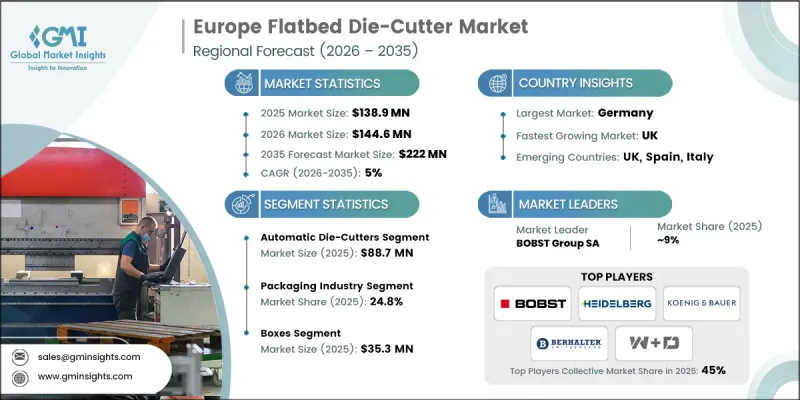
Europe Flatbed Die-Cutter Market was valued at USD 138.9 million in 2025 and is estimated to grow at a CAGR of 5% to reach USD 222 million by 2035.
The growth is driven by the integration of automation and digital technologies, which are transforming traditional die-cutting equipment into intelligent, connected systems. Modern flatbed die-cutters are increasingly designed to operate seamlessly within integrated production environments, enhancing efficiency, precision, and cost-effectiveness across operations of varying scales. The adoption of advanced control systems is enabling manufacturers to improve workflow coordination, reduce material waste, and optimize production output. The transition toward digitally enabled machinery reflects a broader shift toward smart manufacturing practices, where data-driven decision-making and real-time insights play a critical role in operational performance. As a result, companies are embracing next-generation equipment that delivers enhanced productivity, accuracy, and long-term value.
| Market Scope | |
|---|---|
| Start Year | 2025 |
| Forecast Year | 2026-2035 |
| Start Value | $138.9 Million |
| Forecast Value | $222 Million |
| CAGR | 5% |
Technological progress remains central to the Europe flatbed die-cutter market, with manufacturers adopting advanced features that enhance operational control and efficiency. The integration of intelligent systems allows for improved process visibility and streamlined production management. Enhanced cutting precision is being achieved through modern drive technologies, while digital interfaces provide real-time insights into machine performance, maintenance requirements, and production status. These capabilities are helping businesses optimize workflows and improve overall productivity. Connectivity with enterprise systems and advanced scheduling functions is further enabling organizations to refine production planning and reduce operational inefficiencies, contributing to a more agile and responsive manufacturing environment.
The automatic flatbed die-cutters segment accounted for 63.9% share in 2025, generating USD 88.7 million. Their widespread adoption reflects the growing need for high-volume production solutions that require minimal manual intervention. These machines are engineered to deliver consistent output quality while maintaining high operational speeds, making them a preferred choice for industrial-scale applications. Increasing demand for reliability, efficiency, and compliance with quality standards continues to support the dominance of this segment. Features such as programmable controls and automated configurations are further enhancing their appeal across multiple end-use industries.
The packaging segment reached USD 34.4 million, accounting for 24.8% share in 2025. Strong demand for precision-cut materials is driving the adoption of specialized equipment within this segment. Manufacturers require solutions that can deliver consistent performance, efficient material handling, and flexibility in production processes. The ability of flatbed die-cutters to support high accuracy and operational efficiency is making them an essential component in modern manufacturing environments focused on quality and scalability.
Germany Flatbed Die-Cutter Market held 26.9% share in 2025, generating USD 37.3 million. The market in Germany is expected to expand at a CAGR of 5.2% over the forecast period. Growth is supported by a strong industrial base and a well-established manufacturing ecosystem that emphasizes engineering excellence and technological innovation. The presence of advanced production capabilities and a focus on automation are driving the adoption of next-generation die-cutting solutions. Additionally, the country's commitment to smart manufacturing practices is encouraging the integration of digitally enabled machinery, further strengthening its leadership position within the regional market.
Key companies operating in the Europe Flatbed Die-Cutter Market include Heidelberger Druckmaschinen AG, Koenig & Bauer AG, BOBST Group SA, Berhalter AG, Winkler+Dunnebier GmbH, Hunkeler AG, Tunkers Maschinenbau GmbH, IBIS Automation, Grafisk Maskinfabrik, Taurus Converting Equipment, Presto S.A., Autoprint Machinery, Rollem International, and Bobst Mex. Companies in the Europe Flatbed Die-Cutter Market are enhancing their competitive positioning through innovation, strategic collaborations, and expansion initiatives. Significant investments in research and development are enabling the introduction of advanced, automated, and digitally integrated machinery. Organizations are focusing on improving product efficiency, precision, and connectivity to meet evolving industrial requirements. Strategic partnerships and collaborations are helping companies expand their technological capabilities and strengthen market reach. Additionally, businesses are enhancing their service networks and customer support to build long-term relationships. Emphasis on customization, energy efficiency, and smart manufacturing solutions is further enabling companies to differentiate their offerings and secure a stronger foothold in the competitive landscape.
Table of Contents
Chapter 1 Methodology and Scope
- 1.1 Market scope and definition
- 1.2 Research design
- 1.2.1 Research approach
- 1.2.2 Data collection methods
- 1.3 Data mining sources
- 1.3.1 Global
- 1.3.2 Regional/Country
- 1.4 Base estimates and calculations
- 1.4.1 Base year calculation
- 1.4.2 Key trends for market estimation
- 1.5 Primary research and validation
- 1.5.1 Primary sources
- 1.6 Forecast model
- 1.7 Research assumptions and limitations
Chapter 2 Executive Summary
- 2.1 Industry 360° synopsis
- 2.2 Key market trends
- 2.2.1 Mode Of Operation
- 2.2.2 Application
- 2.2.3 End-Use Industry
- 2.2.4 Distribution Channel
- 2.3 CXO perspectives: Strategic imperatives
- 2.3.1 Key decision points for industry executives
- 2.3.2 Critical success factors for market players
- 2.4 Future outlook and strategic recommendations
Chapter 3 Industry Insights
- 3.1 Industry ecosystem analysis
- 3.1.1 Supplier landscape
- 3.1.2 Profit margin
- 3.1.3 Value addition at each stage
- 3.1.4 Factor affecting the value chain
- 3.2 Industry impact forces
- 3.2.1 Growth drivers
- 3.2.1.1 Rising demand for sustainable packaging solutions
- 3.2.1.2 Technological advancements in automation
- 3.2.1.3 Growing e-commerce and packaging industry expansion
- 3.2.2 Industry pitfalls & challenges
- 3.2.2.1 High initial investment for automatic systems
- 3.2.2.2 Shortage of skilled operators
- 3.2.3 Opportunities
- 3.2.3.1 Expansion into pharmaceutical and automotive sectors
- 3.2.3.2 Integration of smart features (IoT, predictive maintenance)
- 3.2.1 Growth drivers
- 3.3 Growth potential analysis
- 3.4 Future market trends
- 3.5 Technology and innovation landscape
- 3.5.1 Current technological trends
- 3.5.2 Emerging technologies
- 3.6 Pricing analysis - Europe (Driven by Primary Research)
- 3.6.1 Historical Price Trend Analysis- Europe (Driven by Primary Research)
- 3.6.2 Pricing Strategy by Player Type (Premium/Value/Cost-plus) (Driven by Primary Research)
- 3.7 Regulatory landscape
- 3.7.1 Standards and compliance requirements
- 3.7.2 Regional regulatory frameworks
- 3.7.3 Certification standards
- 3.8 Porter's analysis
- 3.9 PESTEL analysis
- 3.10 Trade Data Analysis- Europe (Driven by Paid Database)
- 3.10.1 Import/Export Volume & Value Trends (Driven by Primary Research)
- 3.10.2 Canada Import/Export Volume & Value Trends (Driven by Primary Research)
- 3.10.3 Key Trade Corridors & Tariff Impact (Driven by Primary Research)
- 3.11 Impact of AI & Generative AI on the Market
- 3.11.1 AI-Driven Disruption of Existing Business Models
- 3.11.2 GenAI Use Cases & Adoption Roadmap by Segment
- 3.11.3 Risks, Limitations & Regulatory Considerations
- 3.12 Distribution Infrastructure & Channel Penetration Landscape (Driven by Primary Research)
- 3.12.1 Channel Coverage by Region & Format (Modern vs. Traditional Retail) (Driven by Primary Research)
- 3.12.2 Last-Mile Infrastructure Gaps & Emerging Channel Shifts (Driven by Primary Research)
Chapter 4 Competitive Landscape, 2025
- 4.1 Introduction
- 4.2 Company market share analysis
- 4.2.1 Germany
- 4.2.2 UK
- 4.2.3 France
- 4.2.4 Italy
- 4.2.5 Spain
- 4.2.6 Portugal
- 4.3 Company matrix analysis
- 4.4 Competitive analysis of major market players
- 4.5 Competitive positioning matrix
- 4.6 Key developments
- 4.6.1 Mergers & acquisitions
- 4.6.2 Partnerships & collaborations
- 4.6.3 New product launches
- 4.6.4 Expansion plans
Chapter 5 Flatbed Die-Cutter Market Estimates & Forecast, By Mode of Operation, 2022-2035 (USD Million)
- 5.1 Key trends
- 5.2 Automatic
- 5.3 Semi-automatic
Chapter 6 Flatbed Die-Cutter Market Estimates & Forecast, By Application, 2022-2035 (USD Million)
- 6.1 Key trends
- 6.2 Boxes
- 6.3 Cartons
- 6.4 Labels and Stickers
- 6.5 Decorative Items
- 6.6 Rubber gaskets
- 6.7 Others (Flyers, etc.)
Chapter 7 Flatbed Die-Cutter Market Estimates & Forecast, By End-Use, 2022-2035 (USD Million)
- 7.1 Key trends
- 7.2 Packaging Industry
- 7.3 Automotive Industry
- 7.4 Pharmaceuticals
- 7.5 Textile
- 7.6 Printing and Publishing
- 7.7 Others (Electronics, etc.)
Chapter 8 Flatbed Die-Cutter Market Estimates & Forecast, By Distribution Channel, 2022-2035 (USD Million)
- 8.1 Key trends
- 8.2 Direct Sales
- 8.3 Indirect Sales
Chapter 9 Flatbed Die-Cutter Market Estimates and Forecast, By Country, 2022 - 2035 (USD Million)
- 9.1 Key trends
- 9.2 Germany
- 9.3 UK
- 9.4 France
- 9.5 Italy
- 9.6 Spain
- 9.7 Portugal
Chapter 10 Company Profiles
- 10.1 BOBST Group SA
- 10.2 Heidelberger Druckmaschinen AG
- 10.3 Koenig & Bauer AG
- 10.4 Berhalter AG
- 10.5 Winkler+Dunnebier GmbH
- 10.6 Hunkeler AG
- 10.7 Tunkers Maschinenbau GmbH
- 10.8 IBIS Automation
- 10.9 Bobst Mex
- 10.10 Rollem International
- 10.11 Autoprint Machinery
- 10.12 Presto S.A.
- 10.13 Taurus Converting Equipment
- 10.14 Grafisk Maskinfabrik

