
PUBLISHER: Global Market Insights Inc. | PRODUCT CODE: 2027473

PUBLISHER: Global Market Insights Inc. | PRODUCT CODE: 2027473
South America Material Handling Equipment Tire Market Opportunity, Growth Drivers, Industry Trend Analysis, and Forecast 2026 - 2035
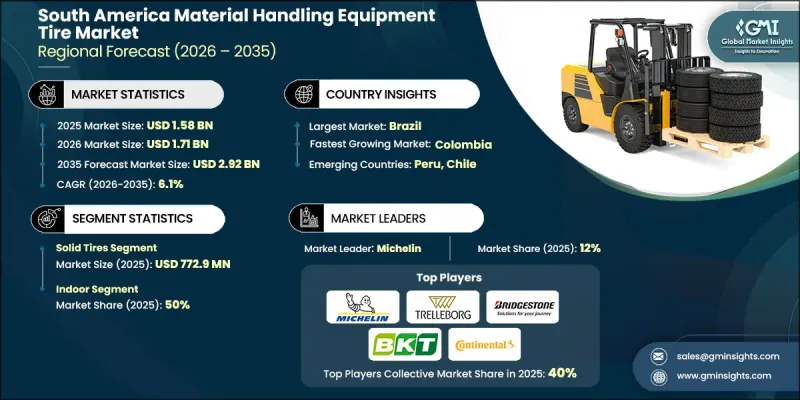
South America Material Handling Equipment Tire Market was valued at USD 1.58 billion in 2025 and is estimated to grow at a CAGR of 6.1% to reach USD 2.92 billion by 2035.
The growth reflects evolving operational demands and changing customer expectations for reliable, high-performance equipment components. Businesses are placing greater focus on the role of tires in maintaining consistent equipment performance, particularly in high-volume environments where efficiency is critical. As operational conditions vary significantly across different sites, there is a rising demand for durable tire solutions that can withstand challenging surfaces while minimizing downtime. At the same time, increasing movement of goods across regional supply chains is driving the need for tires capable of supporting continuous operations over extended periods. Advancements in materials and tire design are also contributing to improved durability, stability, and overall performance, reinforcing the market's long-term growth potential.
| Market Scope | |
|---|---|
| Start Year | 2025 |
| Forecast Year | 2026-2035 |
| Start Value | $1.58 Billion |
| Forecast Value | $2.92 Billion |
| CAGR | 6.1% |
The solid tire segment accounted for 49% share in 2025, generating USD 772.9 million. This segment continues to gain prominence due to its durability and reliability in demanding operating conditions. Unlike conventional alternatives, these tires eliminate the risk of pressure-related issues, enabling uninterrupted performance in environments where equipment is exposed to continuous use and varying surface conditions. Their ability to reduce maintenance requirements and improve operational uptime makes them a preferred choice across multiple industries. Additionally, growing emphasis on safety and stability is further supporting the adoption of solid tire solutions, as businesses seek to enhance equipment performance while reducing operational risks.
The indoor segment held a 50% share in 2025, generating USD 787.9 million. This segment is gaining traction as warehouse and logistics operations increasingly shift toward controlled indoor environments. The design of modern facilities, which emphasizes smoother flooring, optimized layouts, and faster material movement, is driving demand for specialized tire solutions suited for these conditions. Indoor tires offer enhanced traction, consistent movement, and low rolling resistance, allowing equipment to operate more efficiently. Their compatibility with compact and electric machinery further strengthens their adoption, as these applications require quiet operation, minimal surface impact, and reliable long-term performance. These advantages are making indoor tires an essential component in modern logistics and warehousing operations.
Brazil Material Handling Equipment Tire Market held a 52% share, generating USD 819.3 million in 2025. The country's leadership is supported by its extensive industrial and logistics infrastructure, which drives consistent demand for material handling equipment and associated components. A strong presence of manufacturing, distribution, and logistics activities is contributing to sustained usage of equipment across various applications. As operational requirements continue to expand, the need for high-performance tire solutions is increasing accordingly. Growth in logistics networks and evolving distribution systems is further supporting demand for reliable and efficient equipment components, reinforcing Brazil's dominant position in the regional market.
Key companies operating in the South America Material Handling Equipment Tire Market include Bridgestone Corporation, Michelin, Continental AG, Trelleborg Wheel Systems, Titan International, Yokohama Off-Highway Tires, BKT (Balkrishna Industries Limited), Nokian Heavy Tyres, Maxam Tire International, Rinaldi S.A., GRI (Global Rubber Industries), Techking Tires Ltd., Prinx Chengshan, Double Coin Holdings, and Galaxy Tire. Companies in the South America Material Handling Equipment Tire Market are strengthening their competitive position through product innovation, regional expansion, and strategic partnerships. Investments in research and development are enabling the introduction of advanced tire materials and designs that enhance durability, performance, and safety. Businesses are also focusing on expanding their distribution networks to improve product availability and customer reach across key markets. Strategic collaborations with equipment manufacturers and logistics providers are helping companies align their offerings with evolving industry requirements. In addition, firms are emphasizing cost-efficient solutions and maintenance optimization to meet customer expectations. Continuous improvement in product quality, along with targeted marketing and after-sales support, is further supporting long-term market growth and brand positioning.
Table of Contents
Chapter 1 Research Methodology
- 1.1 Research approach
- 1.2 Quality Commitments
- 1.2.1 GMI AI policy & data integrity commitment
- 1.2.1.1 Source consistency protocol
- 1.2.1 GMI AI policy & data integrity commitment
- 1.3 Research Trail & Confidence Scoring
- 1.3.1 Research Trail Components
- 1.3.2 Scoring Components
- 1.4 Data Collection
- 1.4.1 Partial list of primary sources
- 1.5 Data mining sources
- 1.5.1 Paid sources
- 1.5.1.1 Sources, by region
- 1.5.1 Paid sources
- 1.6 Base estimates and calculations
- 1.6.1 Base year calculation for any one approach
- 1.7 Forecast model
- 1.7.1 Quantified market impact analysis
- 1.7.1.1 Mathematical impact of growth parameters on forecast
- 1.7.1 Quantified market impact analysis
- 1.8 Research transparency addendum
- 1.8.1 Source attribution framework
- 1.8.2 Quality assurance metrics
- 1.8.3 Our commitment to trust
Chapter 2 Executive Summary
- 2.1 Industry 360° synopsis, 2022-2035
- 2.2 Key Trends
- 2.3 Country
- 2.4 Tire type
- 2.5 Equipment type
- 2.6 Application
- 2.7 End-user
- 2.8 Sales Channel
Chapter 3 Industry Insights
- 3.1 Industry ecosystem analysis
- 3.1.1 Raw material suppliers
- 3.1.2 Tire manufacturers
- 3.1.3 Distribution networks
- 3.1.4 End users
- 3.2 Supply chain analysis
- 3.2.1 Regional manufacturing footprint
- 3.2.2 Import dependency and trade corridors
- 3.2.3 Supply chain disruptions and mitigation strategies
- 3.3 Industry impact forces
- 3.3.1 Growth drivers
- 3.3.2 Industry pitfalls & challenges
- 3.3.3 Opportunities
- 3.4 Growth potential analysis
- 3.5 Future market trends
- 3.6 Technology and innovation landscape
- 3.6.1 Current technological trends
- 3.6.2 Emerging technologies
- 3.7 Price trends (driven by primary research)
- 3.7.1 Historical price trend analysis (2022-2024) (driven by primary research)
- 3.7.2 Pricing strategy by player type (premium, value, cost plus) (driven by primary research)
- 3.7.3 Price comparison: solid vs pneumatic vs polyurethane (driven by primary research)
- 3.8 Regulatory landscape
- 3.8.1 Import tariffs and trade regulations (Mercosur, Pacific Alliance)
- 3.8.2 Safety and performance standards
- 3.8.3 Environmental regulations and tire disposal laws
- 3.9 Trade data analysis (driven by paid database)
- 3.9.1 Import/export volume and value trends (2022-2024)
- 3.9.2 Key trade corridors and tariff impact (Mercosur, China, USA, EU)
- 3.9.3 Domestic production vs import penetration by country
- 3.10 Impact of AI & Generative AI on the Market
- 3.10.1 AI-driven disruption of tire distribution and inventory management
- 3.10.2 GenAI use cases (demand forecasting, predictive maintenance, customer service)
- 3.10.3 Risks, limitations, and data privacy considerations
- 3.11 Capacity & Production Landscape (driven by primary research)
- 3.11.1 Installed manufacturing capacity by country and key producers (driven by primary research)
- 3.11.2 Capacity utilization rates and expansion pipelines in South America (driven by primary research)
- 3.12 Porter’s analysis
- 3.13 PESTEL analysis
Chapter 4 Competitive Landscape, 2025
- 4.1 Introduction
- 4.2 Company market share analysis
- 4.2.1 By Country
- 4.2.1.1 Brazil
- 4.2.1.2 Argentina
- 4.2.1.3 Chile
- 4.2.1.4 Colombia
- 4.2.1.5 Peru
- 4.2.1.6 Rest of South America
- 4.2.1 By Country
- 4.3 Company matrix analysis
- 4.4 Competitive analysis of major market players
- 4.5 Competitive positioning matrix
- 4.6 Key developments
- 4.6.1 Mergers & acquisitions
- 4.6.2 Partnerships & collaborations
- 4.6.3 New product launches
- 4.6.4 Expansion plans
Chapter 5 Market Estimates & Forecast, By Tire Type, 2022-2035 ($Bn, Thousand Units)
- 5.1 Key trends
- 5.2 Pneumatic tires
- 5.2.1 Cushion pneumatic
- 5.2.2 Standard pneumatic
- 5.3 Solid tires
- 5.3.1 Press-on solid
- 5.3.2 Standard solid
- 5.3.3 Resilient solid
- 5.4 Polyurethane tires
- 5.5 Others
Chapter 6 Market Estimates & Forecast, By Equipment Type, 2022-2035 ($Bn, Thousand Units)
- 6.1 Key trends
- 6.2 Forklift
- 6.3 Conveyor systems
- 6.4 Industrial carts/tuggers
- 6.5 Reach stackers
- 6.6 Pallet jacks
- 6.7 Order pickers
- 6.8 Others
Chapter 7 Market Estimates & Forecast, By Application, 2022-2035 ($Bn, Thousand Units)
- 7.1 Key trends
- 7.2 Indoor
- 7.3 Outdoor
- 7.4 Severe duty/OTR
Chapter 8 Market Estimates & Forecast, By End-User, 2022-2035 ($Bn, Thousand Units)
- 8.1 Key trends
- 8.2 Warehousing & distribution
- 8.3 Manufacturing
- 8.4 Construction
- 8.5 Retail & e-commerce
- 8.6 Ports & shipping
- 8.7 Mining & extraction
- 8.8 Others
Chapter 9 Market Estimates & Forecast, By Sales Channel, 2022-2035 ($Bn, Thousand Units)
- 9.1 Key trends
- 9.2 Direct sales
- 9.2.1 Direct OEM
- 9.2.2 Direct aftermarket
- 9.3 Indirect sales
- 9.3.1 Indirect OEM
- 9.3.2 Indirect aftermarket
Chapter 10 Market Estimates & Forecast, By Region, 2022-2035 ($Bn, Thousand Units)
- 10.1 Key trends
- 10.2 Brazil
- 10.3 Argentina
- 10.4 Chile
- 10.5 Colombia
- 10.6 Peru
- 10.7 Rest of South America
Chapter 11 Company Profiles
- 11.1 Michelin
- 11.2 Bridgestone Corporation
- 11.3 Continental AG
- 11.4 Titan International
- 11.5 Rinaldi S.A.
- 11.6 Trelleborg Wheel Systems
- 11.7 BKT (Balkrishna Industries Limited)
- 11.8 Yokohama Off-Highway Tires
- 11.9 Nokian Heavy Tyres
- 11.10 Maxam Tire International
- 11.11 GRI (Global Rubber Industries)
- 11.12 Techking Tires Ltd.
- 11.13 Prinx Chengshan
- 11.14 Galaxy Tire
- 11.15 Double Coin Holdings

