PUBLISHER: Global Market Insights Inc. | PRODUCT CODE: 2027481

PUBLISHER: Global Market Insights Inc. | PRODUCT CODE: 2027481
Camping Tent Market Opportunity, Growth Drivers, Industry Trend Analysis, and Forecast 2026 - 2035
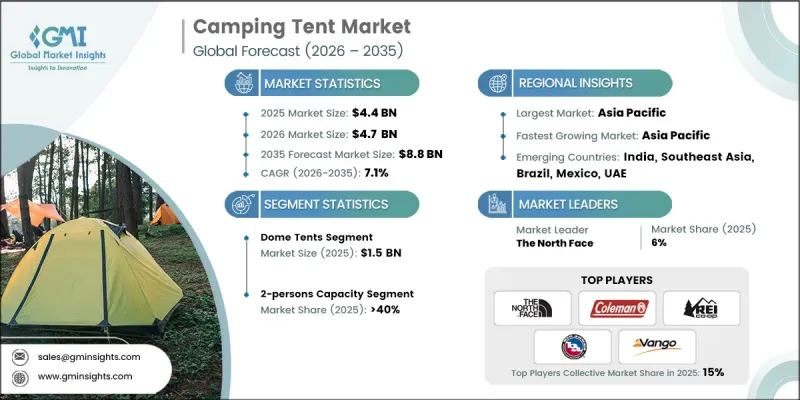
The Global Camping Tent Market was valued at USD 4.4 billion in 2025 and is estimated to grow at a CAGR of 7.1% to reach USD 8.8 billion by 2035.
The market is benefiting from an increased focus on experiential travel and wellness-oriented outdoor activities, fueled by post-pandemic lifestyle shifts. Consumers are gravitating toward socially distanced, nature-based leisure experiences that enhance mental well-being and foster family connections. Rising interest in adventure travel, including hiking, trekking, and wildlife exploration, has created higher demand for durable, lightweight, and versatile camping gear. Government support for outdoor recreation, including funding for public lands and eco-tourism initiatives, has also contributed to market expansion. The market is witnessing innovation in tent designs, materials, and ease of assembly, while portable and performance-driven solutions are increasingly preferred. As camping becomes more popular across urban and rural populations, manufacturers are emphasizing comfort, durability, and efficiency in product offerings to meet evolving consumer expectations.
| Market Scope | |
|---|---|
| Start Year | 2025 |
| Forecast Year | 2026-2035 |
| Start Value | $4.4 Billion |
| Forecast Value | $8.8 Billion |
| CAGR | 7.1% |
The dome tents segment generated USD 1.5 billion in 2025, owing to their versatile, user-friendly design. Their curved pole structure provides stability, effective wind resistance, and lightweight portability, making them suitable for a wide range of camping scenarios. Three-season dome tents are the most common, offering ventilation for warm weather, moderate rain protection, and structural durability for typical wind conditions. Their ease of setup and relatively low weight, typically 4-7 pounds for 2-person models, make them accessible to novice and experienced campers alike, while their affordability strengthens adoption across the market.
The 2-person tent segment held a 40% share in 2025. These tents appeal to solo campers seeking extra space for gear, couples looking for comfortable accommodations, and small families needing compact yet functional solutions. They offer a practical balance between livable interior space and portability, with backpacking models weighing 3-6 pounds and car camping variants weighing 8-12 pounds. Floor dimensions generally range from 7-8 feet in length and 4.5-5.5 feet in width, providing adequate room for two adults or one adult with substantial gear. The combination of manageable weight, ease of setup, and versatile usage keeps this segment at the forefront of consumer preference.
China Camping Tent Market generated USD 400 million in 2025 and is expected to grow at a CAGR of 8.4% through 2035. Market growth accelerated after the COVID-19 pandemic as domestic consumers increasingly embraced camping as a safe and leisure-oriented activity. Young urban professionals in major cities have driven demand for high-quality tents, while social media platforms significantly influence aspirational camping trends. Chinese consumers are showing a willingness to invest in premium equipment, creating opportunities for both international and domestic brands to expand their market presence.
Key players in the Global Camping Tent Market include Coleman Company, Inc., MSR, Marmot, Heimplanet, Naturehike, Nemo Equipment, Inc., Big Agnes, Snow Peak, Vango, Hyperlite Mountain Gear, REI Co-op, Ozark Trail, Lotus Belle, Zpacks, The North Face, Decathlon / Quechua, and iKamper.Companies in the Camping Tent Market are leveraging product innovation, brand differentiation, and expanded distribution to strengthen their market foothold. Manufacturers focus on developing lightweight, modular, and high-durability tents while integrating new materials and performance-enhancing technologies. Strategic collaborations, partnerships with outdoor retailers, and e-commerce channel expansion enable broader reach to urban and adventure-focused consumers. Firms are investing in marketing campaigns emphasizing lifestyle and wellness benefits, supported by social media influencers and experiential events to boost brand engagement. Product diversification, including specialized tent designs for backpacking, family camping, and adventure sports, along with premium and eco-friendly offerings, further enhances competitiveness and market positioning.
Table of Contents
Chapter 1 Methodology and Scope
- 1.1 Market scope and definition
- 1.2 Research design
- 1.2.1 Research approach
- 1.2.2 Data collection methods
- 1.3 Data mining sources
- 1.3.1 Global
- 1.3.2 Regional/Country
- 1.4 Base estimates and calculations
- 1.4.1 Base year calculation
- 1.4.2 Key trends for market estimation
- 1.5 Primary research and validation
- 1.5.1 Primary sources
- 1.6 Forecast model
- 1.7 Research assumptions and limitations
Chapter 2 Executive Summary
- 2.1 Industry 360° synopsis
- 2.2 Key market trends
- 2.2.1 Regional
- 2.2.2 Product type
- 2.2.3 Capacity
- 2.2.4 Price
- 2.2.5 End use
- 2.2.6 Distribution channel
Chapter 3 Industry Insights
- 3.1 Industry ecosystem analysis
- 3.1.1 Supplier landscape
- 3.1.2 Profit margin
- 3.1.3 Value addition at each stage
- 3.1.4 Factor affecting the value chain
- 3.2 Industry impact forces
- 3.2.1 Growth drivers
- 3.2.1.1 Technological advancements in tent design and materials
- 3.2.1.2 Rising disposable incomes and changing consumer lifestyles
- 3.2.1.3 Expansion of glamping and premium camping segments
- 3.2.2 Industry pitfalls & challenges
- 3.2.2.1 Seasonal demand fluctuations and weather dependence
- 3.2.2.2 Intense market competition and price sensitivity
- 3.2.3 Opportunities
- 3.2.3.1 Glamping market expansion
- 3.2.3.2 Sustainable & eco-friendly tent innovations
- 3.2.1 Growth drivers
- 3.3 Growth potential analysis
- 3.4 Future market trends
- 3.5 Technology and innovation landscape
- 3.5.1 Current technological trends
- 3.5.2 Emerging technologies
- 3.6 Pricing analysis (driven by primary research)
- 3.6.1 Historical price trend analysis (2019-2024)
- 3.6.2 Pricing strategy by player type (premium/value/budget)
- 3.6.3 Regional price variation analysis
- 3.6.4 Price elasticity of demand
- 3.7 Regulatory landscape
- 3.8 Porter’s analysis
- 3.9 PESTEL analysis
- 3.10 Impact of AI & generative AI on the market
- 3.10.1 AI-driven disruption of existing business models
- 3.10.2 GenAI use cases (design optimization, customer service, demand forecasting)
- 3.10.3 Adoption roadmap by segment
- 3.10.4 Risks, limitations & regulatory considerations
- 3.11 Distribution infrastructure & channel penetration landscape (driven by primary research)
- 3.11.1 Channel coverage by region & format (modern vs. traditional trade)
- 3.11.2 Last-mile infrastructure gaps & emerging channel shifts
- 3.11.3 E-commerce penetration & fulfillment network analysis
- 3.11.4 Specialty retail footprint & market coverage
- 3.12 Consumer buying behavior analysis
- 3.12.1 Demographic trends (age, income, geography)
- 3.12.2 Psychographic segmentation (adventure seekers, family campers, minimalists)
- 3.12.3 Factors affecting buying decisions (price, weight, setup ease, brand)
- 3.12.4 Product adoption lifecycle
- 3.12.5 Preferred distribution channel analysis
- 3.12.6 Brand loyalty & switching behavior
- 3.12.7 Online review & social media influence
Chapter 4 Competitive Landscape, 2025
- 4.1 Introduction
- 4.2 Company market share analysis
- 4.2.1 By region
- 4.2.1.1 North America
- 4.2.1.2 Europe
- 4.2.1.3 Asia Pacific
- 4.2.1.4 Latin America
- 4.2.1.5 Middle East and Africa
- 4.2.1 By region
- 4.3 Competitive analysis of major market players
- 4.4 Competitive positioning matrix
- 4.5 Key developments
- 4.5.1 Mergers & acquisitions
- 4.5.2 Partnerships & collaborations
- 4.5.3 New product launches
- 4.5.4 Expansion plans
Chapter 5 Market Estimates and Forecast, By Product Type, 2022 - 2035 (USD Billion) (Thousand Units)
- 5.1 Key trends
- 5.2 Dome tents
- 5.3 Tunnel tents
- 5.4 Geodesic tents
- 5.5 Cabin tents
- 5.6 Backpacking/lightweight tents
- 5.7 Pop-up/instant tents
- 5.8 Others
Chapter 6 Market Estimates and Forecast, By Capacity, 2022 - 2035 (USD Billion) (Thousand Units)
- 6.1 Key trends
- 6.2 Solo (1 Person)
- 6.3 2 Persons
- 6.4 3-4 Persons
- 6.5 5-8 Persons
- 6.6 Above 8 Persons
Chapter 7 Market Estimates and Forecast, By Price, 2022 - 2035 (USD Billion) (Thousand Units)
- 7.1 Key trends
- 7.2 Low (Under $100)
- 7.3 Mid-range ($100-$300)
- 7.4 Premium ($300-$600)
- 7.5 Luxury/high-performance ($600+)
Chapter 8 Market Estimates and Forecast, By End Use, 2022 - 2035 (USD Billion) (Thousand Units)
- 8.1 Key trends
- 8.2 Personal
- 8.3 Commercial
Chapter 9 Market Estimates and Forecast, By Distribution Channel, 2022 - 2035 (USD Billion) (Thousand Units)
- 9.1 Key trends
- 9.2 Online
- 9.2.1 E-commerce
- 9.2.2 Company websites
- 9.3 Offline
- 9.3.1 Supermarkets
- 9.3.2 Specialty Stores
- 9.3.3 Others (departmental stores, etc.)
Chapter 10 Market Estimates and Forecast, By Region, 2022 - 2035 (USD Billion) (Thousand Units)
- 10.1 Key trends
- 10.2 North America
- 10.2.1 U.S.
- 10.2.2 Canada
- 10.3 Europe
- 10.3.1 Germany
- 10.3.2 UK
- 10.3.3 France
- 10.3.4 Italy
- 10.3.5 Spain
- 10.4 Asia Pacific
- 10.4.1 China
- 10.4.2 Japan
- 10.4.3 India
- 10.4.4 Australia
- 10.4.5 South Korea
- 10.5 Latin America
- 10.5.1 Brazil
- 10.5.2 Mexico
- 10.5.3 Argentina
- 10.6 Middle East and Africa
- 10.6.1 South Africa
- 10.6.2 Saudi Arabia
- 10.6.3 UAE
Chapter 11 Company Profiles
- 11.1 Big Agnes
- 11.2 Coleman Company, Inc.
- 11.3 Decathlon / Quechua
- 11.4 Heimplanet
- 11.5 Hyperlite Mountain Gear
- 11.6 iKamper
- 11.7 Lotus Belle
- 11.8 Marmot
- 11.9 MSR
- 11.10 Naturehike
- 11.11 Nemo Equipment, Inc.
- 11.12 Ozark Trail
- 11.13 REI Co-op
- 11.14 Snow Peak
- 11.15 The North Face
- 11.16 Vango
- 11.17 Zpacks

