
PUBLISHER: Global Market Insights Inc. | PRODUCT CODE: 2027484

PUBLISHER: Global Market Insights Inc. | PRODUCT CODE: 2027484
Acrylic Fibers Market Opportunity, Growth Drivers, Industry Trend Analysis, and Forecast 2026 - 2035
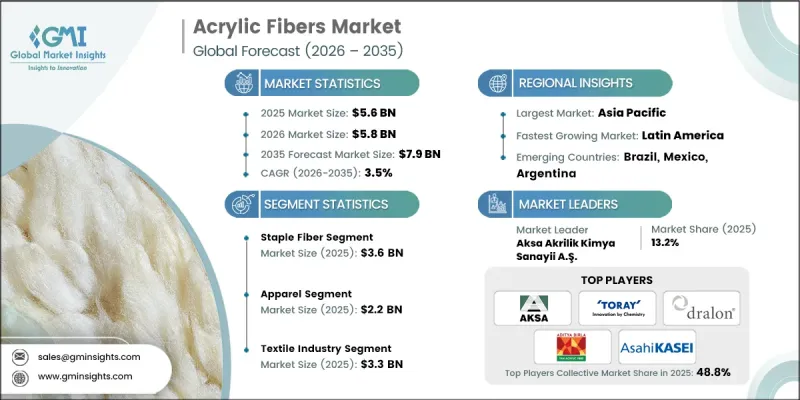
The Global Acrylic Fibers Market was valued at USD 5.6 billion in 2025 and is estimated to grow at a CAGR of 3.5% to reach USD 7.9 billion by 2035.
Acrylic fibers are synthetic materials derived from polyacrylonitrile (PAN), where at least 85% of the units are acrylonitrile. The production begins with chemical processes that transform petroleum derivatives into long-chain polymers, which are then spun into fibers. These fibers are widely used as wool alternatives because they offer a lightweight, soft texture while retaining warmth and durability. Their resistance to sunlight, mildew, wrinkles, and chemicals makes them ideal for both clothing and home textiles. Acrylic fibers maintain insulation and elasticity, preserving body heat, while their excellent dye absorption ensures vibrant, long-lasting colors. The versatility of acrylic fibers allows their use in apparel such as sweaters, scarves, socks, and sportswear, as well as in home textiles like blankets, carpets, upholstery, and outdoor furniture covers, providing affordable alternatives to natural wool.
| Market Scope | |
|---|---|
| Start Year | 2025 |
| Forecast Year | 2026-2035 |
| Start Value | $5.6 Billion |
| Forecast Value | $7.9 Billion |
| CAGR | 3.5% |
The staple fiber segment reached USD 3.6 billion in 2025. This segment is critical because short-length fibers blend easily with cotton, wool, and polyester to produce fabrics with enhanced flexibility, performance, and comfort. Manufacturers rely on staple acrylic fibers to create clothing, blankets, carpets, and upholstery that combine softness, warmth, and compatibility with standard spinning equipment.
The apparel segment captured USD 2.2 billion in 2025. Acrylic fibers are extensively used in garments and home textiles due to their lightweight, soft, and insulating characteristics. The fibers enable the production of sweaters, socks, scarves, blankets, bedding, and curtains, providing durability and low-maintenance convenience. Their resilience also makes them suitable for carpets and rugs, maintaining color longevity and stain resistance.
U.S. Acrylic Fibers Market reached USD 794.3 million in 2025. The North American market benefits from established manufacturing processes that serve textile, industrial, and automotive interior applications. Growth is fueled by technological advancements in fiber production, rising demand for home furnishings, and increasing adoption of outdoor textile products.
Key players in the Acrylic Fibers Market include TORAY INDUSTRIES, INC., Asahi Kasei Corp., Aksa Akrilik Kimya Sanayii A.S., Dralon GmbH, Kaneka Corporation, Thai Acrylic Fibre Co. Ltd., Exlan Japan Co., Ltd., TAIRYLAN ACRYLIC FIBER, Kaltex Fibers, and Indian Acrylics Limited. Companies in the acrylic fibers market strengthen their position through strategies such as expanding production capacities to meet growing global demand, investing in advanced polymerization and spinning technologies to enhance fiber quality, and developing specialized fiber variants for apparel, home textiles, and industrial applications. Firms focus on forming strategic alliances with textile manufacturers and distributors to increase market penetration and improve supply chain efficiency. Marketing initiatives highlight the eco-friendly and cost-effective advantages of acrylic fibers, while research and development efforts target improved durability, dye retention, and thermal performance to differentiate products and capture a larger market share.
Table of Contents
Chapter 1 Methodology & Scope
- 1.1 Market scope and definition
- 1.2 Research design
- 1.2.1 Research approach
- 1.2.2 Data collection methods
- 1.3 Data mining sources
- 1.3.1 Global
- 1.3.2 Regional/Country
- 1.4 Base estimates and calculations
- 1.4.1 Base year calculation
- 1.4.2 Key trends for market estimation
- 1.5 Primary research and validation
- 1.5.1 Primary sources
- 1.6 Forecast model
- 1.7 Research assumptions and limitations
Chapter 2 Executive Summary
- 2.1 Industry 360° synopsis
- 2.2 Key market trends
- 2.2.1 Fiber Type
- 2.2.2 Application
- 2.2.3 End Use
- 2.2.4 Regional
- 2.3 TAM Analysis, 2026-2035
- 2.4 CXO perspectives: Strategic imperatives
- 2.5 Future outlook and strategic recommendations
Chapter 3 Industry Insights
- 3.1 Industry ecosystem analysis
- 3.1.1 Supplier landscape
- 3.1.2 Profit margin
- 3.1.3 Value addition at each stage
- 3.1.4 Factor affecting the value chain
- 3.1.5 Disruptions
- 3.2 Industry impact forces
- 3.2.1 Growth drivers
- 3.2.1.1 Rising demand for affordable textiles
- 3.2.1.2 Growth of the global textile industry
- 3.2.1.3 Durability and easy maintenance
- 3.2.2 Pitfalls/challenge
- 3.2.2.1 Competition from other synthetic fibers
- 3.2.2.2 Flammability and heat sensitivity
- 3.2.3 Opportunities
- 3.2.3.1 Technological innovations in fiber production
- 3.2.3.2 Growing demand for blended fabrics
- 3.2.1 Growth drivers
- 3.3 Growth potential analysis
- 3.4 Regulatory landscape
- 3.4.1 North America
- 3.4.2 Europe
- 3.4.3 Asia Pacific
- 3.4.4 Latin America
- 3.4.5 Middle East & Africa
- 3.5 Porter's analysis
- 3.6 PESTEL analysis
- 3.7 Technology and innovation landscape
- 3.7.1 Current technological trends
- 3.7.2 Emerging technologies
- 3.8 Price trends
- 3.8.1 By region
- 3.8.2 By fiber type
- 3.9 Future market trends
- 3.10 Technology and innovation landscape
- 3.10.1 Current technological trends
- 3.10.2 Emerging technologies
- 3.11 Patent landscape
- 3.12 Trade statistics (HS code)
- 3.12.1 Major importing countries
- 3.12.2 Major exporting countries
- 3.13 Sustainability and environmental aspects
- 3.13.1 Sustainable practices
- 3.13.2 Waste reduction strategies
- 3.13.3 Energy efficiency in production
- 3.13.4 Eco-friendly initiatives
- 3.14 Carbon footprint consideration
Chapter 4 Competitive Landscape, 2025
- 4.1 Introduction
- 4.2 Company market share analysis
- 4.2.1 By region
- 4.2.1.1 North America
- 4.2.1.2 Europe
- 4.2.1.3 Asia Pacific
- 4.2.1.4 LATAM
- 4.2.1.5 MEA
- 4.2.1 By region
- 4.3 Company matrix analysis
- 4.4 Competitive analysis of major market players
- 4.5 Competitive positioning matrix
- 4.6 Key developments
- 4.6.1 Mergers & acquisitions
- 4.6.2 Partnerships & collaborations
- 4.6.3 New product launches
- 4.6.4 Expansion plans
Chapter 5 Market Estimates and Forecast, By Fiber Type, 2022-2035 (USD Billion) (Kilo Tons)
- 5.1 Key trends
- 5.2 Staple fiber
- 5.3 Tow (tow-dyed) fiber
Chapter 6 Market Estimates and Forecast, By Application, 2022-2035 (USD Billion) (Kilo Tons)
- 6.1 Key trends
- 6.2 Home textiles
- 6.3 Nonwoven fabrics
- 6.4 Industrial and technical textiles
- 6.5 Carpets and rugs
- 6.6 Outdoor and recreational products
- 6.7 Upholstery
- 6.8 Blankets and bedding
- 6.9 Craft and hobby
- 6.10 Others
Chapter 7 Market Estimates and Forecast, By End Use, 2022-2035 (USD Billion) (Kilo Tons)
- 7.1 Key trends
- 7.2 Textile industry
- 7.3 Automotive industry
- 7.4 Construction industry
- 7.5 Filtration and separation
- 7.6 Aerospace and defense
- 7.7 Healthcare industry
- 7.8 Others
Chapter 8 Market Estimates and Forecast, By Region, 2022-2035 (USD Billion) (Kilo Tons)
- 8.1 Key trends
- 8.2 North America
- 8.2.1 U.S.
- 8.2.2 Canada
- 8.3 Europe
- 8.3.1 Germany
- 8.3.2 UK
- 8.3.3 France
- 8.3.4 Spain
- 8.3.5 Italy
- 8.3.6 Rest of Europe
- 8.4 Asia Pacific
- 8.4.1 China
- 8.4.2 India
- 8.4.3 Japan
- 8.4.4 Australia
- 8.4.5 South Korea
- 8.4.6 Rest of Asia Pacific
- 8.5 Latin America
- 8.5.1 Brazil
- 8.5.2 Mexico
- 8.5.3 Argentina
- 8.5.4 Rest of Latin America
- 8.6 Middle East and Africa
- 8.6.1 Saudi Arabia
- 8.6.2 South Africa
- 8.6.3 UAE
- 8.6.4 Rest of Middle East and Africa
Chapter 9 Company Profiles
- 9.1 Aksa Akrilik Kimya Sanayii A.S.
- 9.2 TORAY INDUSTRIES, INC.
- 9.3 Dralon GmbH
- 9.4 Thai Acrylic Fibre Co. Ltd.
- 9.5 TAIRYLAN ACRYLIC FIBER
- 9.6 Kaneka Corporation
- 9.7 Exlan Japan Co., Ltd.
- 9.8 Asahi Kasei Corp.
- 9.9 Kaltex Fibers
- 9.10 Indian Acrylics Limited

