
PUBLISHER: Global Market Insights Inc. | PRODUCT CODE: 2027485

PUBLISHER: Global Market Insights Inc. | PRODUCT CODE: 2027485
HVAC Market Opportunity, Growth Drivers, Industry Trend Analysis, and Forecast 2026 - 2035
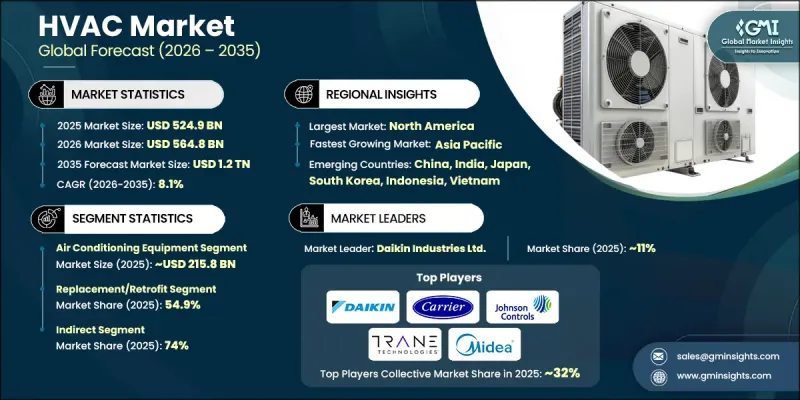
The Global HVAC Market was valued at USD 524.9 billion in 2025 and is estimated to grow at a CAGR of 8.1% to reach USD 1.2 trillion by 2035.
Rapid urban development is a key factor driving growth, as the increasing number of buildings requires reliable heating, ventilation, and air conditioning solutions. Consumers and businesses alike are prioritizing comfort, air quality, and energy efficiency in indoor environments. Modern construction projects increasingly incorporate HVAC systems to maintain consistent temperature and airflow, while renovation activities are also contributing to market demand. The need for improved energy performance and longer system lifespan is encouraging the adoption of advanced HVAC technologies. Additionally, expanding infrastructure across various sectors is creating demand for systems that ensure stable environmental conditions. The growing emphasis on indoor air quality standards and sustainable building practices is further strengthening the global HVAC market, positioning it as a critical component of modern infrastructure development.
| Market Scope | |
|---|---|
| Start Year | 2025 |
| Forecast Year | 2026-2035 |
| Start Value | $524.9 Billion |
| Forecast Value | $1.2 Trillion |
| CAGR | 8.1% |
The HVAC market is further supported by the rising need for controlled environmental conditions across a wide range of facilities. Increasing infrastructure development is driving demand for advanced systems that ensure consistent temperature regulation and air quality. The need for efficient cooling solutions in high-performance environments is encouraging the adoption of technologically advanced HVAC systems that support operational reliability and efficiency.
The air conditioning equipment segment generated USD 215.8 billion in 2025 and is expected to grow at a CAGR of 10.3% from 2026 to 2035. This segment holds a dominant position within the HVAC market due to its essential role in maintaining indoor comfort across various applications. A wide range of systems is available to meet diverse cooling requirements, and growing awareness of energy-efficient solutions is further driving adoption. Continuous innovation, including smart technologies and environmentally friendly refrigerants, is enhancing system performance and supporting long-term growth.
The indirect distribution channel accounted for 74% share in 2025 and is projected to grow at a CAGR of 10.1% during 2026-2035. This channel leads the market due to the extensive network of distributors and service providers that facilitate product availability and customer support. Indirect sales enable manufacturers to deliver installation services, maintenance, and technical expertise, which are essential for complex HVAC systems. The preference for purchasing through authorized channels ensures access to professional support and reliable service, reinforcing the importance of this distribution model.
United States HVAC Market captured USD 156.9 billion in 2025 and is expected to grow at a CAGR of 10.2% from 2026 to 2035. Market growth is driven by increasing demand for energy-efficient systems across multiple sectors. Rising urbanization, changing climate conditions, and the need to upgrade aging infrastructure are encouraging the adoption of modern HVAC solutions. Residential demand is supported by the growing use of smart home technologies, while commercial and industrial sectors continue to invest in systems that meet regulatory requirements for air quality and energy efficiency.
Key companies operating in the Global HVAC Market include Bosch Thermotechnology, Carrier Global Corporation, Daikin Industries, Ltd., Fujitsu General Limited, GREE Electric Appliances Inc., Haier Smart Home Co., Ltd., Johnson Controls International plc, Lennox International Inc., LG Electronics, Midea Group, Mitsubishi Electric Corporation, Panasonic Corporation, Rheem Manufacturing Company, Samsung Electronics, and Trane Technologies plc. Companies in the Global HVAC Market are implementing a variety of strategies to strengthen their competitive position and expand their global presence. A key focus is placed on technological innovation, particularly in developing energy-efficient and environmentally sustainable systems. Manufacturers are investing in research and development to enhance system performance and integrate smart features such as automation and remote monitoring. Strategic partnerships and collaborations are being pursued to expand distribution networks and improve market reach. Companies are also focusing on expanding their product portfolios to cater to diverse customer needs across different sectors. Strengthening after-sales services, including maintenance and technical support, is helping build long-term customer relationships.
Table of Contents
Chapter 1 Methodology & Scope
- 1.1 Market scope and definition
- 1.2 Research design
- 1.2.1 Research approach
- 1.2.2 Data collection methods
- 1.3 Data mining sources
- 1.3.1 Global
- 1.3.2 Regional/Country
- 1.4 Base estimates and calculations
- 1.4.1 Base year calculation
- 1.4.2 Key trends for market estimation
- 1.5 Primary research and validation
- 1.5.1 Primary sources
- 1.6 Forecast model
- 1.7 Research assumptions and limitations
Chapter 2 Executive Summary
- 2.1 Industry 360° synopsis
- 2.2 Key market trends
- 2.2.1 Regional
- 2.2.2 Product type
- 2.2.3 Installation
- 2.2.4 End use
- 2.2.5 Distribution channel
Chapter 3 Industry Insights
- 3.1 Industry ecosystem analysis
- 3.1.1 Supplier landscape
- 3.1.2 Profit margin
- 3.1.3 Value addition at each stage
- 3.1.4 Factor affecting the value chain
- 3.2 Industry impact forces
- 3.2.1 Growth drivers
- 3.2.1.1 Rapid urbanization and growth in residential and commercial construction
- 3.2.1.2 Expansion of data centers, healthcare facilities, and industrial infrastructure
- 3.2.1.3 Rising demand for indoor thermal comfort and air quality
- 3.2.2 Pitfalls & Challenges
- 3.2.2.1 High installation and maintenance costs of HVAC systems
- 3.2.2.2 Volatility in raw material prices such as copper, aluminum, and steel
- 3.2.3 Opportunities
- 3.2.3.1 Growing adoption of smart HVAC systems with IoT integration
- 3.2.3.2 Retrofit and upgrade of aging HVAC infrastructure in developed markets
- 3.2.1 Growth drivers
- 3.3 Growth potential analysis
- 3.4 Future market trends
- 3.5 Technology and innovation landscape
- 3.5.1 Current technological trends
- 3.5.2 Emerging technologies
- 3.6 Price trends
- 3.6.1 By region
- 3.6.2 By product
- 3.7 Regulatory landscape
- 3.7.1 Standards and compliance requirements
- 3.7.2 Regional regulatory frameworks
- 3.7.3 Certification standards
- 3.8 Porter's analysis
- 3.9 PESTEL analysis
- 3.10 Pricing analysis (driven by primary research)
- 3.10.1 Historical price trend analysis (driven by primary research)
- 3.10.2 Pricing strategy by player type (premium / value / cost-plus) (driven by primary research)
- 3.11 Trade data analysis (driven by paid database)
- 3.11.1 Import/export volume & value trends (driven by paid database)
- 3.11.2 Key trade corridors & tariff impact (driven by paid database)
- 3.11.3 Trade flow analysis by equipment type
- 3.12 Capacity & production landscape (driven by primary research)
- 3.12.1 Installed capacity by region & key producer (driven by primary research)
- 3.12.2 Capacity utilization rates & expansion pipelines (driven by primary research)
Chapter 4 Competitive Landscape, 2025
- 4.1 Introduction
- 4.2 Company market share analysis
- 4.2.1 By Region
- 4.2.1.1 North America
- 4.2.1.2 Europe
- 4.2.1.3 Asia Pacific
- 4.2.1.4 Latin America
- 4.2.1.5 Middle East & Africa
- 4.2.1 By Region
- 4.3 Company matrix analysis
- 4.4 Competitive analysis of major market players
- 4.5 Competitive positioning matrix
- 4.6 Key developments
- 4.6.1 Mergers & acquisitions
- 4.6.2 Partnerships & collaborations
- 4.6.3 New product launches
- 4.6.4 Expansion plans
Chapter 5 Market Estimates & Forecast, By Product Type, 2022 - 2035, (USD Billion) (Thousand Units)
- 5.1 Key trends
- 5.2 Heating equipment
- 5.3 Ventilation equipment
- 5.4 Air conditioning equipment
- 5.5 Chillers
- 5.6 Cooling towers
Chapter 6 Market Estimates & Forecast, By Installation, 2022 - 2035, (USD Billion) (Thousand Units)
- 6.1 Key trends
- 6.2 New construction
- 6.3 Replacement/Retrofit
Chapter 7 Market Estimates & Forecast, By End Use, 2022 - 2035, (USD Billion) (Thousand Units)
- 7.1 Key trends
- 7.2 Residential
- 7.3 Commercial
- 7.4 Industrials
Chapter 8 Market Estimates & Forecast, By Distribution Channel, 2022 - 2035, (USD Billion) (Thousand Units)
- 8.1 Key trends
- 8.2 Direct
- 8.3 Indirect
Chapter 9 Market Estimates & Forecast, By Region, 2022 - 2035, (USD Billion) (Thousand Units)
- 9.1 Key trends
- 9.2 North America
- 9.2.1 U.S.
- 9.2.2 Canada
- 9.3 Europe
- 9.3.1 Germany
- 9.3.2 UK
- 9.3.3 France
- 9.3.4 Italy
- 9.3.5 Spain
- 9.4 Asia Pacific
- 9.4.1 China
- 9.4.2 India
- 9.4.3 Japan
- 9.4.4 South Korea
- 9.4.5 Australia
- 9.5 Latin America
- 9.5.1 Brazil
- 9.5.2 Mexico
- 9.5.3 Argentina
- 9.6 MEA
- 9.6.1 Saudi Arabia
- 9.6.2 UAE
- 9.6.3 South Africa
Chapter 10 Company Profiles
- 10.1 Bosch Thermotechnology
- 10.2 Carrier Global Corporation
- 10.3 Daikin Industries, Ltd.
- 10.4 Fujitsu General Limited
- 10.5 GREE Electric Appliances Inc.
- 10.6 Haier Smart Home Co., Ltd.
- 10.7 Johnson Controls International plc
- 10.8 Lennox International Inc.
- 10.9 LG Electronics
- 10.10 Midea Group
- 10.11 Mitsubishi Electric Corporation
- 10.12 Panasonic Corporation
- 10.13 Rheem Manufacturing Company
- 10.14 Samsung Electronics
- 10.15 Trane Technologies plc

