PUBLISHER: Global Market Insights Inc. | PRODUCT CODE: 2027488

PUBLISHER: Global Market Insights Inc. | PRODUCT CODE: 2027488
Pneumatic Conveying Systems Market Opportunity, Growth Drivers, Industry Trend Analysis, and Forecast 2026 - 2035
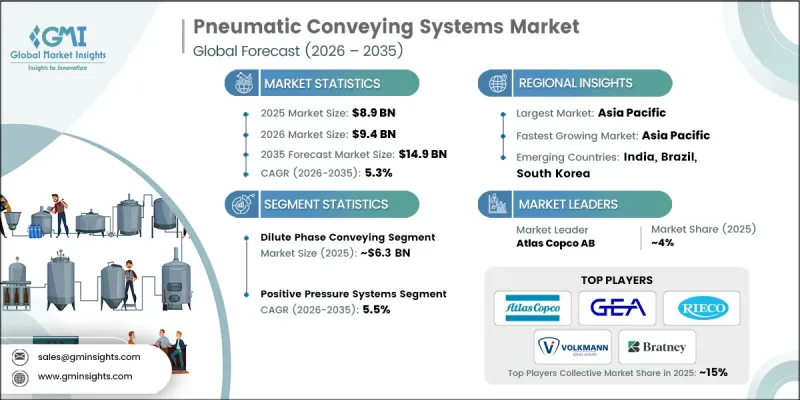
The Global Pneumatic Conveying Systems Market was valued at USD 8.9 billion in 2025 and is estimated to grow at a CAGR of 5.3% to reach USD 14.9 billion by 2035.
Market growth is driven by rising demand from industries such as food processing, pharmaceuticals, and chemicals, where efficient bulk material handling is critical. Ongoing industrial expansion and modernization have increased the need for reliable, automated conveying solutions that improve productivity and reduce operational costs. Advancements in system efficiency, enhanced control technologies, and the use of durable pipeline materials are contributing to sustained adoption. In addition, the integration of smart technologies is enabling better process monitoring and improved system performance. Continuous innovation in design, including improved airflow mechanisms and energy-efficient configurations, is further supporting market growth. Increasing emphasis on automation across manufacturing environments is also accelerating adoption, as pneumatic conveying systems provide consistent and contamination-free material transfer. As industries continue to focus on operational efficiency and process optimization, the demand for advanced conveying solutions is expected to rise steadily across global markets.
| Market Scope | |
|---|---|
| Start Year | 2025 |
| Forecast Year | 2026-2035 |
| Start Value | $8.9 Billion |
| Forecast Value | $14.9 Billion |
| CAGR | 5.3% |
The dilute phase conveying segment generated USD 6.3 billion in 2025 and is anticipated to grow at a CAGR of 5.4% from 2026 to 2035. This segment remains dominant due to its ability to transport materials at high velocities while maintaining consistent flow characteristics. The technology supports long-distance conveying and complex routing configurations, making it suitable for diverse industrial applications. Its capability to handle multiple input and output points enhances operational flexibility, while maintaining efficiency across various material types further strengthens its adoption. The combination of speed, adaptability, and reliability continues to drive demand for dilute phase systems.
The positive pressure systems segment accounted for 44.3% share in 2025 and is projected to grow at a CAGR of 5.5% during 2026-2035. These systems operate by generating pressure at the feed point to move materials through pipelines toward designated discharge points. Their ability to support long-distance transportation and multiple discharge locations makes them a preferred solution in many industrial settings. Positive pressure systems are also valued for their relatively simple design, ease of integration, and efficient operation. Their versatility in handling various materials and configurations contributes to their strong market position.
United States Pneumatic Conveying Systems Market reached USD 1.9 billion in 2025 and is expected to grow at a CAGR of 5.2% from 2026 to 2035. Market growth is supported by the presence of well-established industrial sectors, including food processing, pharmaceuticals, and chemicals, all of which require advanced material handling solutions. Increasing focus on safety, regulatory compliance, and operational efficiency is driving the adoption of enclosed and automated systems. Ongoing modernization efforts, including the replacement of legacy equipment and the implementation of advanced technologies, are further contributing to market expansion. Strong industrial infrastructure and continued investments in process optimization are reinforcing the country's leadership in the regional market.
Key players operating in the Global Pneumatic Conveying Systems Market include Atlas Copco AB, Bratney Companies, Claudius Peters (Americas) Inc., Compass Systems & Sales, LLC, Coperion GmbH, Delfin Industrial Vacuums, Dynamic Air Inc., GEA Group Aktiengesellschaft, Gericke AG, Macawber Engineering, Inc., Rieco Industries Limited, Spiroflow Systems, Inc., VAC-U-MAX, VOLKMANN, Inc., and Whirl-Air-Flow Corporation. Companies in the Pneumatic Conveying Systems Market are focusing on innovation, system efficiency, and strategic partnerships to strengthen their competitive position. Investments in advanced control systems, energy-efficient designs, and automation technologies are enhancing product performance and reliability. Manufacturers are also expanding their global footprint through collaborations and distribution network development to reach new markets. Customization of solutions to meet specific industry requirements is becoming a key differentiator. In addition, companies are prioritizing research and development to improve material handling efficiency and reduce operational costs. The integration of digital monitoring and smart technologies is further enabling predictive maintenance and optimized system performance.
Table of Contents
Chapter 1 Methodology & Scope
- 1.1 Market scope and definition
- 1.2 Research design
- 1.2.1 Research approach
- 1.2.2 Data collection methods
- 1.3 Data mining sources
- 1.3.1 Global
- 1.3.2 Regional/Country
- 1.4 Base estimates and calculations
- 1.4.1 Base year calculation
- 1.4.2 Key trends for market estimation
- 1.5 Primary research and validation
- 1.5.1 Primary sources
- 1.6 Forecast model
- 1.7 Research assumptions and limitations
Chapter 2 Executive Summary
- 2.1 Industry 360° synopsis
- 2.2 Key market trends
- 2.2.1 Regional
- 2.2.2 Type
- 2.2.3 Technology
- 2.2.4 Material type
- 2.2.5 End use industry
- 2.2.6 Distribution channel
Chapter 3 Industry Insights
- 3.1 Industry ecosystem analysis
- 3.1.1 Supplier landscape
- 3.1.2 Profit margin
- 3.1.3 Value addition at each stage
- 3.1.4 Factor affecting the value chain
- 3.2 Industry impact forces
- 3.2.1 Growth drivers
- 3.2.1.1 Expansion of manufacturing and processing industries
- 3.2.1.2 Automation and industry 4.0 adoption
- 3.2.1.3 Growth in pharmaceutical and food & beverage sectors
- 3.2.2 Industry pitfalls & challenges
- 3.2.2.1 High upfront capital and installation costs
- 3.2.2.2 Maintenance complexity and specialized requirements
- 3.2.1 Growth drivers
- 3.3 Growth potential analysis
- 3.4 Future market trends
- 3.5 Technology and innovation landscape
- 3.5.1 Current technological trends
- 3.5.2 Emerging technologies
- 3.6 Price trends
- 3.6.1 By region
- 3.6.2 By type
- 3.7 Regulatory landscape
- 3.7.1 Standards and compliance requirements
- 3.7.2 Regional regulatory frameworks
- 3.7.3 Certification standards
- 3.8 Porter’s analysis
- 3.9 PESTEL analysis
Chapter 4 Competitive Landscape, 2025
- 4.1 Introduction
- 4.2 Company market share analysis
- 4.2.1 By Region
- 4.2.1.1 North America
- 4.2.1.2 Europe
- 4.2.1.3 Asia Pacific
- 4.2.1.4 Latin America
- 4.2.1.5 Middle East & Africa
- 4.2.1 By Region
- 4.3 Company matrix analysis
- 4.4 Competitive analysis of major market players
- 4.5 Competitive positioning matrix
- 4.6 Key developments
- 4.6.1 Mergers & acquisitions
- 4.6.2 Partnerships & collaborations
- 4.6.3 New product launches
- 4.6.4 Expansion plans
Chapter 5 Market Estimates & Forecast, By Type, 2022 - 2035, (USD Billion) (Units)
- 5.1 Key trends
- 5.2 Dilute phase conveying
- 5.3 Dense phase conveying
Chapter 6 Market Estimates & Forecast, By Technology, 2022 - 2035, (USD Billion) (Units)
- 6.1 Key trends
- 6.2 Positive pressure systems
- 6.3 Vacuum systems
- 6.4 Combination systems
Chapter 7 Market Estimates & Forecast, By Material Type, 2022 - 2035, (USD Billion) (Units)
- 7.1 Key trends
- 7.2 Powder & granules
- 7.3 Pellets
- 7.4 Flakes & fibers
Chapter 8 Market Estimates & Forecast, By End Use Industry, 2022 - 2035, (USD Billion) (Units)
- 8.1 Key trends
- 8.2 Chemicals
- 8.3 Pharmaceuticals
- 8.4 Food & beverages
- 8.5 Cement & construction
- 8.6 Minerals & mining
- 8.7 Pulp & paper
- 8.8 Others
Chapter 9 Market Estimates & Forecast, By Distribution Channel, 2022 - 2035, (USD Billion) (Units)
- 9.1 Key trends
- 9.2 Direct sales
- 9.3 Indirect sales
Chapter 10 Market Estimates & Forecast, By Region, 2022 - 2035, (USD Billion) (Units)
- 10.1 Key trends
- 10.2 North America
- 10.2.1 U.S.
- 10.2.2 Canada
- 10.3 Europe
- 10.3.1 Germany
- 10.3.2 UK
- 10.3.3 France
- 10.3.4 Italy
- 10.3.5 Spain
- 10.4 Asia Pacific
- 10.4.1 China
- 10.4.2 India
- 10.4.3 Japan
- 10.4.4 South Korea
- 10.4.5 Australia
- 10.4.6 Indonesia
- 10.4.7 Malaysia
- 10.5 Latin America
- 10.5.1 Brazil
- 10.5.2 Mexico
- 10.5.3 Argentina
- 10.6 MEA
- 10.6.1 Saudi Arabia
- 10.6.2 UAE
- 10.6.3 South Africa
Chapter 11 Company Profiles
- 11.1 Atlas Copco AB
- 11.2 Bratney Companies
- 11.3 Claudius Peters (Americas) Inc.
- 11.4 Compass Systems & Sales, LLC
- 11.5 Coperion GmbH
- 11.6 Delfin Industrial Vacuums
- 11.7 Dynamic Air Inc.
- 11.8 GEA Group Aktiengesellschaft
- 11.9 Gericke AG
- 11.10 Macawber Engineering, Inc.
- 11.11 Rieco Industries Limited
- 11.12 Spiroflow Systems, Inc.
- 11.13 VAC-U-MAX
- 11.14 VOLKMANN, Inc.
- 11.15 Whirl-Air-Flow Corporation

