PUBLISHER: Global Market Insights Inc. | PRODUCT CODE: 2027503

PUBLISHER: Global Market Insights Inc. | PRODUCT CODE: 2027503
Acerola Extract Market Opportunity, Growth Drivers, Industry Trend Analysis, and Forecast 2026 - 2035
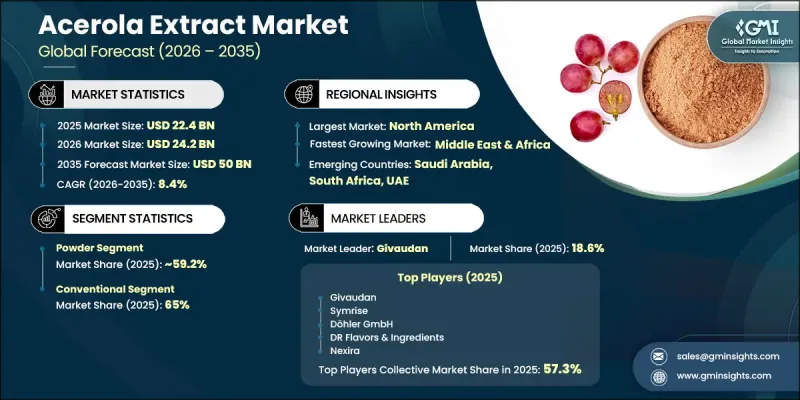
The Global Acerola Extract Market was valued at USD 22.4 billion in 2025 and is estimated to grow at a CAGR of 8.4% to reach USD 50 billion by 2035.
The market is expanding as consumers increasingly prioritize health-focused and naturally derived ingredients in their daily nutrition. Acerola extract, recognized for its high vitamin C concentration, plays a vital role as a natural antioxidant and is widely incorporated into functional formulations. Demand is being driven by the growing preference for clean-label products and plant-based nutritional solutions, particularly within dietary supplements and fortified food categories. The ingredient is also gaining traction in applications focused on wellness and product stability due to its beneficial properties. At the same time, supply dynamics are influenced by agricultural cycles and geographic sourcing limitations, which can impact consistency in availability. Market participants continue to navigate pricing pressure from synthetic alternatives, which offer cost advantages. However, increasing consumer inclination toward natural ingredients is supporting long-term adoption. Continuous advancements in processing techniques, along with improvements in sourcing and logistics, are further shaping the competitive landscape and strengthening the market outlook.
| Market Scope | |
|---|---|
| Start Year | 2025 |
| Forecast Year | 2026-2035 |
| Start Value | $22.4 Billion |
| Forecast Value | $50 Billion |
| CAGR | 8.4% |
The powder-based acerola extract accounted for 59.2% share in 2025 and is expected to grow at a CAGR of 9.1% through 2035. This form is widely preferred due to its stability, longer shelf life, and ease of integration into diverse product formulations. It allows precise measurement and efficient handling, making it suitable for large-scale production requirements. Its ability to retain key nutritional components during processing further reinforces its strong position in the market.
The conventional segment held a share of 65% in 2025. This segment continues to lead due to well-established cultivation and production practices that support consistent output and cost efficiency. These advantages enable manufacturers to maintain competitive pricing while meeting large-scale demand across various industrial applications.
North America Acerola Extract Market was valued at USD 8.9 billion in 2025 and is expected to grow at a CAGR of 8.5% between 2026 and 2035. Growth in the region is supported by rising awareness of natural health ingredients and increasing demand for functional food products. The market continues to expand as consumers place greater emphasis on immunity-supporting nutrients and clean-label formulations, supported by a strong focus on product innovation and quality standards.
Key companies operating in the Global Acerola Extract Industry include Dohler GmbH, Givaudan, Symrise, Nexira, Martin Bauer Group, Kemin Industries, Blue Macaw Flora, DR Flavors & Ingredients, NP Nutra, The Green Labs LLC, and Xi'an Lyphar Biotech. Companies in the Global Acerola Extract Market are strengthening their market position by investing in advanced extraction technologies and improving supply chain efficiency to ensure consistent quality and availability. Many players are focusing on expanding their product portfolios with clean-label and organic-certified offerings to align with evolving consumer preferences. Strategic collaborations with food, beverage, and nutraceutical manufacturers are helping companies broaden their application reach. In addition, firms are enhancing global distribution networks and targeting emerging markets to increase revenue opportunities. Sustainability initiatives, including responsible sourcing and environmentally friendly processing methods, are also gaining importance.
Table of Contents
Chapter 1 Methodology & Scope
- 1.1 Market scope and definition
- 1.2 Research design
- 1.2.1 Research approach
- 1.2.2 Data collection methods
- 1.3 Data mining sources
- 1.3.1 Global
- 1.3.2 Regional/Country
- 1.4 Base estimates and calculations
- 1.4.1 Base year calculation
- 1.4.2 Key trends for market estimation
- 1.5 Primary research and validation
- 1.5.1 Primary sources
- 1.6 Forecast model
- 1.7 Research assumptions and limitations
Chapter 2 Executive Summary
- 2.1 Industry 360° synopsis
- 2.2 Key market trends
- 2.2.1 Regional
- 2.2.2 Form
- 2.2.3 Category
- 2.2.4 Packaging
- 2.2.5 Application
- 2.2.6 Distribution channel
- 2.3 TAM Analysis, 2026-2035
- 2.4 CXO perspectives: Strategic imperatives
Chapter 3 Industry Insights
- 3.1 Industry ecosystem analysis
- 3.1.1 Supplier landscape
- 3.1.2 Profit margin
- 3.1.3 Value addition at each stage
- 3.1.4 Factor affecting the value chain
- 3.1.5 Disruptions
- 3.2 Industry impact forces
- 3.2.1 Growth drivers
- 3.2.1.1 Increasing consumer awareness on health benefits
- 3.2.1.2 Growing food and beverage industry
- 3.2.1.3 Expansion of the pharmaceutical and nutraceutical industry
- 3.2.2 Industry pitfalls and challenges
- 3.2.2.1 Competition from synthetic alternatives
- 3.2.2.2 Seasonal availability
- 3.2.3 Market opportunities
- 3.2.3.1 Expanding cultivation to new geographic regions
- 3.2.3.2 Waste-to-value opportunities (pomace, seeds, bagasse utilization)
- 3.2.1 Growth drivers
- 3.3 Growth potential analysis
- 3.4 Regulatory landscape
- 3.4.1 North America
- 3.4.2 Europe
- 3.4.3 Asia Pacific
- 3.4.4 Latin America
- 3.4.5 Middle East & Africa
- 3.5 Porter's analysis
- 3.6 PESTEL analysis
- 3.7 Price trends
- 3.7.1 By region
- 3.7.2 By form
- 3.8 Future market trends
- 3.9 Technology and innovation landscape
- 3.9.1 Current technological trends
- 3.9.2 Emerging technologies
- 3.10 Patent Landscape
- 3.11 Trade statistics (HS code)
- 3.11.1 Major importing countries
- 3.11.2 Major exporting countries
- 3.12 Sustainability and environmental aspects
- 3.12.1 Sustainable practices
- 3.12.2 Waste reduction strategies
- 3.12.3 Energy efficiency in production
- 3.12.4 Eco-friendly initiatives
- 3.13 Carbon footprint consideration
Chapter 4 Competitive Landscape, 2025
- 4.1 Introduction
- 4.2 Company market share analysis
- 4.2.1 By region
- 4.2.1.1 North America
- 4.2.1.2 Europe
- 4.2.1.3 Asia Pacific
- 4.2.1.4 LATAM
- 4.2.1.5 MEA
- 4.2.1 By region
- 4.3 Competitive analysis of major market players
- 4.4 Competitive positioning matrix
- 4.5 Key developments
- 4.5.1 Mergers & acquisitions
- 4.5.2 Partnerships & collaborations
- 4.5.3 New Product Launches
- 4.5.4 Expansion Plans
Chapter 5 Market Estimates and Forecast, By Form, 2022-2035 (USD Billion) (Kilo Tons)
- 5.1 Key trends
- 5.2 Powder
- 5.3 Liquid
- 5.4 Solid dosage forms
- 5.4.1 Tablets
- 5.4.2 Capsules
- 5.5 Others
Chapter 6 Market Estimates and Forecast, By Category, 2022-2035 (USD Billion) (Kilo Tons)
- 6.1 Key trends
- 6.2 Organic
- 6.3 Conventional
Chapter 7 Market Estimates and Forecast, By Packaging, 2022-2035 (USD Billion) (Kilo Tons)
- 7.1 Key trends
- 7.2 Bottles
- 7.3 Pouches
- 7.4 Cartons
- 7.5 Others
Chapter 8 Market Estimates and Forecast, By Application, 2022-2035 (USD Billion) (Kilo Tons)
- 8.1 Key trends
- 8.2 Dietary supplements
- 8.3 Food & beverage
- 8.3.1 Beverages
- 8.3.2 Bakery products
- 8.3.3 Confectioneries
- 8.3.4 Dairy & frozen desserts
- 8.3.5 Meat products
- 8.3.6 Snacks & cereals
- 8.3.7 Others
- 8.4 Cosmetics & personal care
- 8.4.1 Skin care
- 8.4.2 Hair care
- 8.4.3 Color cosmetics
- 8.5 Pharmaceutical
- 8.6 Others
Chapter 9 Market Estimates and Forecast, By Distribution Channel, 2022-2035 (USD Billion) (Kilo Tons)
- 9.1 Key trends
- 9.2 Offline
- 9.2.1 Supermarkets
- 9.2.2 Hypermarkets
- 9.2.3 Pharmacies
- 9.2.4 Others
- 9.3 Online Retail
- 9.3.1 Brand websites
- 9.3.2 E-commerce platforms
Chapter 10 Market Estimates and Forecast, By Region, 2022-2035 (USD Billion) (Kilo Tons)
- 10.1 Key trends
- 10.2 North America
- 10.2.1 U.S.
- 10.2.2 Canada
- 10.3 Europe
- 10.3.1 Germany
- 10.3.2 UK
- 10.3.3 France
- 10.3.4 Spain
- 10.3.5 Italy
- 10.3.6 Rest of Europe
- 10.4 Asia Pacific
- 10.4.1 China
- 10.4.2 India
- 10.4.3 Japan
- 10.4.4 Australia
- 10.4.5 South Korea
- 10.4.6 Rest of Asia Pacific
- 10.5 Latin America
- 10.5.1 Brazil
- 10.5.2 Mexico
- 10.5.3 Argentina
- 10.5.4 Rest of Latin America
- 10.6 Middle East and Africa
- 10.6.1 Saudi Arabia
- 10.6.2 South Africa
- 10.6.3 UAE
- 10.6.4 Rest of Middle East and Africa
Chapter 11 Company Profiles
- 11.1 Blue Macaw Flora
- 11.2 Dohler GmbH
- 11.3 DR Flavors & Ingredients
- 11.4 Givaudan
- 11.5 Kemin Industries
- 11.6 Martin Bauer Group
- 11.7 Nexira
- 11.8 NP Nutra
- 11.9 Symrise
- 11.10 The Green Labs LLC
- 11.11 Xi'an Lyphar Biotech

