PUBLISHER: Global Market Insights Inc. | PRODUCT CODE: 2027513

PUBLISHER: Global Market Insights Inc. | PRODUCT CODE: 2027513
Pinch Tube Valve Market Opportunity, Growth Drivers, Industry Trend Analysis, and Forecast 2026 - 2035
The Global Pinch Tube Valve Market was valued at USD 636.6 million in 2025 and is estimated to grow at a CAGR of 5.1% to reach USD 1.04 billion by 2035.
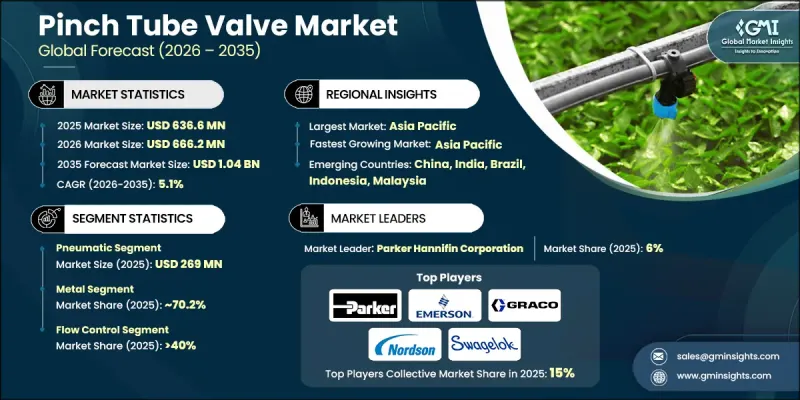
Market growth is driven by the increasing need for contamination-free processing, rapid progress in industrial automation, and the ongoing development of highly regulated manufacturing sectors. Pinch tube valves are designed to isolate process media using flexible elastomer sleeves, which help minimize leakage risks, reduce maintenance requirements, and ensure operational reliability. These features make them particularly suitable for environments where hygiene and precision are critical. The ability of these valves to deliver consistent performance while simplifying maintenance procedures further supports their adoption. In addition, the growing focus on operational efficiency and process optimization is encouraging industries to integrate advanced valve technologies, positioning the global pinch tube valve market as a key component in modern fluid handling systems.
| Market Scope | |
|---|---|
| Start Year | 2025 |
| Forecast Year | 2026-2035 |
| Start Value | $636.6 Million |
| Forecast Value | $1.04 Billion |
| CAGR | 5.1% |
Strict regulatory frameworks across highly controlled industries are reinforcing the need for hygienic and reliable fluid handling systems. Compliance requirements mandate the use of equipment that prevents contamination and ensures product integrity throughout processing stages. Pinch tube valves meet these expectations by allowing fluids to interact only with the internal sleeve, significantly reducing the risk of contamination. This design simplifies cleaning procedures and enhances adherence to established regulatory standards, while also improving overall process efficiency.
The metal segment accounted for 70.2% share in 2025. This dominance reflects the widespread use of metal-based valve constructions in demanding industrial applications. Valves made from materials such as stainless steel, aluminum, and specialized alloys offer strong resistance to extreme operating conditions, including high pressure, elevated temperatures, and exposure to aggressive substances. Their durability and structural integrity make them a preferred choice for complex industrial environments.
The flow control segment held 40% share in 2025, making it the primary application area within the global pinch tube valve market. These valves are widely used for regulating flow rates by adjusting the compression of the internal sleeve, allowing for accurate and consistent fluid management. This capability supports precise control in processes that require reliable and repeatable flow regulation. Advanced systems with automated and proportional control features further enhance performance, enabling seamless integration with modern process control systems.
Asia Pacific Pinch Tube Valve Market held 30% share in 2025 and is anticipated to grow at a CAGR of 5.3% from 2026 to 2035, driven by rapid industrial development, expanding manufacturing capacity, and increasing infrastructure investments. A diverse industrial base across multiple sectors continues to generate strong demand for advanced fluid control solutions. Supportive government initiatives aimed at improving industrial quality and promoting manufacturing growth are further encouraging the adoption of modern valve technologies, contributing to sustained market expansion.
Key companies operating in the Global Pinch Tube Valve Market include Badger Meter, Burkert Fluid Control Systems, ControlAir, Crane, Emerson Electric, Festo, Gore, Graco, Kitz Corporation, Nordson Corporation, Omega Engineering, Parker Hannifin Corporation, Pentair, Schneider Electric, and Swagelok Company. Companies in the Global Pinch Tube Valve Market are implementing strategic initiatives to strengthen their competitive positioning and expand their global presence. A strong emphasis is placed on research and development to enhance product performance, durability, and compatibility with advanced industrial systems. Manufacturers are investing in automation and smart technologies to improve precision and operational efficiency. Strategic partnerships and collaborations are being pursued to expand distribution networks and improve customer reach. Companies are also focusing on offering customized solutions tailored to specific industry requirements, which helps build long-term client relationships.
Table of Contents
Chapter 1 Methodology and Scope
- 1.1 Market scope and definition
- 1.2 Research design
- 1.2.1 Research approach
- 1.2.2 Data collection methods
- 1.3 Data mining sources
- 1.3.1 Global
- 1.3.2 Regional/Country
- 1.4 Base estimates and calculations
- 1.4.1 Base year calculation
- 1.4.2 Key trends for market estimation
- 1.5 Primary research and validation
- 1.5.1 Primary sources
- 1.6 Forecast model
- 1.7 Research assumptions and limitations
Chapter 2 Executive Summary
- 2.1 Industry 360° synopsis
- 2.2 Key market trends
- 2.2.1 Regional
- 2.2.2 Type
- 2.2.3 Function
- 2.2.4 End use industry
- 2.2.5 Distribution channel
Chapter 3 Industry Insights
- 3.1 Industry ecosystem analysis
- 3.1.1 Supplier landscape
- 3.1.2 Profit margin
- 3.1.3 Value addition at each stage
- 3.1.4 Factor affecting the value chain
- 3.2 Industry impact forces
- 3.2.1 Growth drivers
- 3.2.1.1 Demand for contamination-free fluid control
- 3.2.1.2 Industrial automation and process control requirements
- 3.2.1.3 Cost-effectiveness and maintenance efficiency
- 3.2.2 Industry pitfalls & challenges
- 3.2.2.1 Installation and operational cost considerations
- 3.2.2.2 Seasonal demand fluctuations
- 3.2.3 Opportunities
- 3.2.3.1 Smart valve development with predictive maintenance
- 3.2.3.2 Bio-based & sustainable elastomer materials
- 3.2.1 Growth drivers
- 3.3 Growth potential analysis
- 3.4 Future market trends
- 3.5 Technology and innovation landscape
- 3.5.1 Current technological trends
- 3.5.2 Emerging technologies
- 3.6 Pricing analysis (Driven by Primary Research)
- 3.6.1 Historical price trend analysis (Driven by Primary Research)
- 3.6.2 Pricing strategy by player type (premium / value / cost-plus) (Driven by Primary Research)
- 3.6.3 Price variation by valve type & material
- 3.7 Regulatory landscape
- 3.8 Porter’s analysis
- 3.9 PESTEL analysis
- 3.10 Trade Data Analysis (Driven by Paid Data Base)
- 3.10.1 Import/export volume & value trends (Driven by Paid Data Base)
- 3.10.2 Key trade corridors & tariff impact (Driven by Paid Data Base)
- 3.10.3 Trade flow by region & HS code classification
- 3.11 Impact of AI & generative AI on the market
- 3.11.1 AI-driven disruption of existing business models
- 3.11.2 GenAI use cases & adoption roadmap by segment
- 3.11.3 Risks, limitations & regulatory considerations
- 3.12 Capacity & production landscape (Driven by Primary Research)
- 3.12.1 Installed capacity by region & key producer (Driven by Primary Research)
- 3.12.2 Capacity utilization rates & expansion pipelines (Driven by Primary Research)
Chapter 4 Competitive Landscape, 2025
- 4.1 Introduction
- 4.2 Company market share analysis
- 4.2.1 By region
- 4.2.1.1 North America
- 4.2.1.2 Europe
- 4.2.1.3 Asia Pacific
- 4.2.1.4 Latin America
- 4.2.1.5 Middle East and Africa
- 4.2.1 By region
- 4.3 Competitive analysis of major market players
- 4.4 Competitive positioning matrix
- 4.5 Key developments
- 4.5.1 Mergers & acquisitions
- 4.5.2 Partnerships & collaborations
- 4.5.3 New product launches
- 4.5.4 Expansion plans
Chapter 5 Market Estimates and Forecast, By Type, 2022 - 2035 (USD Million) (Thousand Units)
- 5.1 Key trends
- 5.2 Manual
- 5.3 Pneumatic
- 5.4 Automatic
- 5.5 Electric
Chapter 6 Market Estimates and Forecast, By Material, 2022 - 2035 (USD Million) (Thousand Units)
- 6.1 Key trends
- 6.2 Metal
- 6.3 Plastic/Polymer (PVC, PP, PVDF)
- 6.4 Others
Chapter 7 Market Estimates and Forecast, By Function, 2022 - 2035 (USD Million) (Thousand Units)
- 7.1 Key trends
- 7.2 Flow control
- 7.3 Shut-off
- 7.4 Others
Chapter 8 Market Estimates and Forecast, By End-Use Industry, 2022 - 2035 (USD Million) (Thousand Units)
- 8.1 Key trends
- 8.2 Chemical & petrochemical
- 8.3 Food and beverage
- 8.4 Pharmaceutical & biotechnology
- 8.5 Water & wastewater treatment
- 8.6 Mining & minerals
- 8.7 Pulp & paper
- 8.8 Oil and gas
- 8.9 Others (ceramics, textiles, agriculture, power generation)
Chapter 9 Market Estimates and Forecast, By Distribution Channel, 2022 - 2035 (USD Million) (Thousand Units)
- 9.1 Key trends
- 9.2 Direct sales
- 9.3 Indirect sales
Chapter 10 Market Estimates and Forecast, By Region, 2022 - 2035 (USD Million) (Thousand Units)
- 10.1 Key trends
- 10.2 North America
- 10.2.1 U.S.
- 10.2.2 Canada
- 10.3 Europe
- 10.3.1 Germany
- 10.3.2 UK
- 10.3.3 France
- 10.3.4 Italy
- 10.3.5 Spain
- 10.4 Asia Pacific
- 10.4.1 China
- 10.4.2 Japan
- 10.4.3 India
- 10.4.4 Australia
- 10.4.5 South Korea
- 10.5 Latin America
- 10.5.1 Brazil
- 10.5.2 Mexico
- 10.5.3 Argentina
- 10.6 Middle East and Africa
- 10.6.1 South Africa
- 10.6.2 Saudi Arabia
- 10.6.3 UAE
Chapter 11 Company Profiles
- 11.1 Badger Meter
- 11.2 Burkert Fluid Control Systems
- 11.3 ControlAir
- 11.4 Crane
- 11.5 Emerson Electric
- 11.6 Festo
- 11.7 Gore
- 11.8 Graco
- 11.9 Kitz Corporation
- 11.10 Nordson Corporation
- 11.11 Omega Engineering
- 11.12 Parker Hannifin Corporation
- 11.13 Pentair
- 11.14 Schneider Electric
- 11.15 Swagelok Company

