PUBLISHER: Global Market Insights Inc. | PRODUCT CODE: 2027517

PUBLISHER: Global Market Insights Inc. | PRODUCT CODE: 2027517
Women Outdoor Apparel Market Opportunity, Growth Drivers, Industry Trend Analysis, and Forecast 2026 - 2035
The Global Women Outdoor Apparel Market was valued at USD 21.1 billion in 2025 and is estimated to grow at a CAGR of 5.8% to reach USD 36.9 billion by 2035.
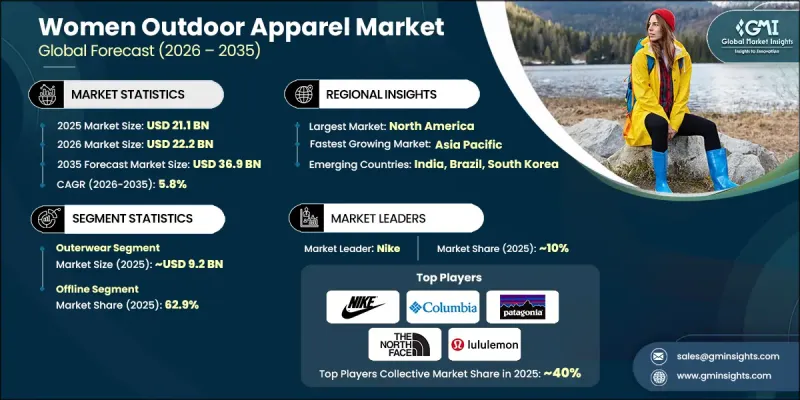
This market encompasses performance-driven clothing designed for a wide range of outdoor activities, including hiking, trekking, winter sports, and adventure travel. Growth is being fueled by rising female participation in outdoor recreation, evolving preferences that combine functionality with style, and increasing awareness of sustainable manufacturing practices. In recent years, more women have actively engaged in outdoor activities, significantly reshaping market demand and encouraging brands to develop specialized apparel tailored to their needs. The influence of digital platforms and community-driven engagement has further accelerated participation, creating a continuous cycle of demand for innovative products. Sustainability has also become a key focus area, with companies investing in traceability systems and advanced technologies to improve transparency and ethical sourcing. These efforts are driving the adoption of circular business models that emphasize durability, reuse, and responsible production, positioning the market for long-term growth.
| Market Scope | |
|---|---|
| Start Year | 2025 |
| Forecast Year | 2026-2035 |
| Start Value | $21.1 Billion |
| Forecast Value | $36.9 Billion |
| CAGR | 5.8% |
The outerwear segment generated USD 9.2 billion in 2025 and is expected to grow at a CAGR of 5.9% between 2026 and 2035. This category represents the largest and most valuable segment due to its essential role in outdoor protection and its ability to command premium pricing. Products in this segment are designed to deliver performance, comfort, and durability, making them highly visible and influential in shaping brand identity. Continuous advancements in fabric technologies, including improved weather resistance, insulation efficiency, and sustainable material integration, are driving segment growth. Outerwear also serves as a platform for brands to showcase innovation and technical expertise, reinforcing their competitive positioning in the market.
The offline distribution segment accounted for 62.9% share in 2025 and is anticipated to grow at a CAGR of 5.3% through 2035. Physical retail outlets remain highly relevant due to the value they provide in terms of personalized customer service and product evaluation. Consumers benefit from the ability to assess fit, material quality, and layering compatibility before making purchasing decisions. Retail environments that offer knowledgeable staff and curated product selections continue to attract both new and experienced outdoor participants, contributing to sustained demand across this channel.
United States Women Outdoor Apparel Market reached USD 6.8 billion in 2025, and is projected to grow at a CAGR of 5.3% from 2026 to 2035. The region benefits from a well-established outdoor culture, strong industry infrastructure, and a growing focus on health and active lifestyles. Canada contributes significantly due to its extensive outdoor recreation landscape, while Mexico is emerging as a developing market supported by increasing consumer interest and economic growth. Overall, the North America market demonstrates stable expansion, driven by premium product offerings, evolving consumer preferences, and consistent replacement demand.
Leading companies in the Global Women Outdoor Apparel Market include Nike, Adidas, Patagonia, The North Face (VF Corporation), Columbia Sportswear, Lululemon Athletica, Puma, Decathlon, Arc'teryx, Mammut, prAna, Salomon, Outdoor Research, Under Armour, and REI Co-op. Companies operating in the women outdoor apparel market are focusing on innovation, sustainability, and brand differentiation to strengthen their competitive position. Investments in advanced fabric technologies and eco-friendly materials enable the development of high-performance products that meet evolving consumer expectations. Strategic collaborations and partnerships help expand global reach and enhance distribution capabilities. Brands leverage digital marketing and community engagement to build strong customer loyalty and promote outdoor participation. Additionally, companies are adopting circular economy practices, including recycling programs and product lifecycle management, to align with sustainability goals. Expanding product portfolios and targeting diverse consumer segments further support market growth and long-term positioning.
Table of Contents
Chapter 1 Methodology & Scope
- 1.1 Market scope and definition
- 1.2 Research design
- 1.2.1 Research approach
- 1.2.2 Data collection methods
- 1.3 Data mining sources
- 1.3.1 Global
- 1.3.2 Regional/Country
- 1.4 Base estimates and calculations
- 1.4.1 Base year calculation
- 1.4.2 Key trends for market estimation
- 1.5 Primary research and validation
- 1.5.1 Primary sources
- 1.6 Forecast model
- 1.7 Research assumptions and limitations
Chapter 2 Executive Summary
- 2.1 Industry 360° synopsis
- 2.2 Key market trends
- 2.2.1 Regional
- 2.2.2 Product type
- 2.2.3 Functionality
- 2.2.4 End use
- 2.2.5 Distribution channel
Chapter 3 Industry Insights
- 3.1 Industry ecosystem analysis
- 3.1.1 Supplier landscape
- 3.1.2 Profit margin
- 3.1.3 Value addition at each stage
- 3.1.4 Factor affecting the value chain
- 3.2 Industry impact forces
- 3.2.1 Growth drivers
- 3.2.1.1 Rising outdoor participation among women
- 3.2.1.2 Consumer preference for sustainable, traceable materials
- 3.2.1.3 Growth of e-commerce and digital channels
- 3.2.2 Industry pitfalls & challenges
- 3.2.2.1 Chemical regulation and compliance costs
- 3.2.2.2 Raw material and input volatility
- 3.2.1 Growth drivers
- 3.3 Growth potential analysis
- 3.4 Future market trends
- 3.5 Technology and innovation landscape
- 3.5.1 Current technological trends
- 3.5.2 Emerging technologies
- 3.6 Price trends
- 3.6.1 By region
- 3.6.2 By product type
- 3.7 Regulatory landscape
- 3.7.1 Standards and compliance requirements
- 3.7.2 Regional regulatory frameworks
- 3.7.3 Certification standards
- 3.8 Porter's analysis
- 3.9 PESTEL analysis
- 3.10 Consumer behavior analysis
- 3.10.1 Purchasing patterns
- 3.10.2 Preference analysis
- 3.10.3 Regional variations in consumer behavior
Chapter 4 Competitive Landscape, 2025
- 4.1 Introduction
- 4.2 Company market share analysis
- 4.2.1 By Region
- 4.2.1.1 North America
- 4.2.1.2 Europe
- 4.2.1.3 Asia Pacific
- 4.2.1.4 Latin America
- 4.2.1.5 Middle East & Africa
- 4.2.1 By Region
- 4.3 Company matrix analysis
- 4.4 Competitive analysis of major market players
- 4.5 Competitive positioning matrix
- 4.6 Key developments
- 4.6.1 Mergers & acquisitions
- 4.6.2 Partnerships & collaborations
- 4.6.3 New product launches
- 4.6.4 Expansion plans
Chapter 5 Market Estimates & Forecast, By Product Type, 2022 - 2035, (USD Billion) (Units)
- 5.1 Key trends
- 5.2 Outerwear
- 5.3 Tops
- 5.4 Bottoms
- 5.5 Others
Chapter 6 Market Estimates & Forecast, By Functionality, 2022 - 2035, (USD Billion) (Units)
- 6.1 Key trends
- 6.2 Rain gear
- 6.3 Winter gear
- 6.4 Others
Chapter 7 Market Estimates & Forecast, By End Use, 2022 - 2035, (USD Billion) (Units)
- 7.1 Key trends
- 7.2 Hiking & trekking
- 7.3 Camping & backpacking
- 7.4 Winter Sports
- 7.5 Trail running & outdoor fitness
- 7.6 Casual outdoor/lifestyle
- 7.7 Others
Chapter 8 Market Estimates & Forecast, By Distribution Channel, 2022 - 2035, (USD Billion) (Units)
- 8.1 Key trends
- 8.2 Online
- 8.2.1 E-commerce websites
- 8.2.2 Company websites
- 8.3 Offline
- 8.3.1 Hypermarket/Supermarket
- 8.3.2 Specialty stores
- 8.3.3 Others
Chapter 9 Market Estimates & Forecast, By Region, 2022 - 2035, (USD Billion) (Units)
- 9.1 Key trends
- 9.2 North America
- 9.2.1 U.S.
- 9.2.2 Canada
- 9.3 Europe
- 9.3.1 Germany
- 9.3.2 UK
- 9.3.3 France
- 9.3.4 Italy
- 9.3.5 Spain
- 9.4 Asia Pacific
- 9.4.1 China
- 9.4.2 India
- 9.4.3 Japan
- 9.4.4 South Korea
- 9.4.5 Australia
- 9.4.6 Indonesia
- 9.4.7 Malaysia
- 9.5 Latin America
- 9.5.1 Brazil
- 9.5.2 Mexico
- 9.5.3 Argentina
- 9.6 MEA
- 9.6.1 Saudi Arabia
- 9.6.2 UAE
- 9.6.3 South Africa
Chapter 10 Company Profiles
- 10.1 Adidas
- 10.2 Arc'teryx
- 10.3 Columbia Sportswear
- 10.4 Decathlon
- 10.5 Lululemon Athletica
- 10.6 Mammut
- 10.7 Nike
- 10.8 Outdoor Research
- 10.9 Patagonia
- 10.10 prAna
- 10.11 Puma
- 10.12 REI Co-op
- 10.13 Salomon
- 10.14 The North Face (VF Corporation)
- 10.15 Under Armour

