
PUBLISHER: Global Market Insights Inc. | PRODUCT CODE: 2027521

PUBLISHER: Global Market Insights Inc. | PRODUCT CODE: 2027521
Multiwall Bags Market Opportunity, Growth Drivers, Industry Trend Analysis, and Forecast 2026 - 2035
The Global Multiwall Bags Market was valued at USD 14.5 billion in 2025 and is estimated to grow at a CAGR of 3.7% to reach USD 21.2 billion by 2035.
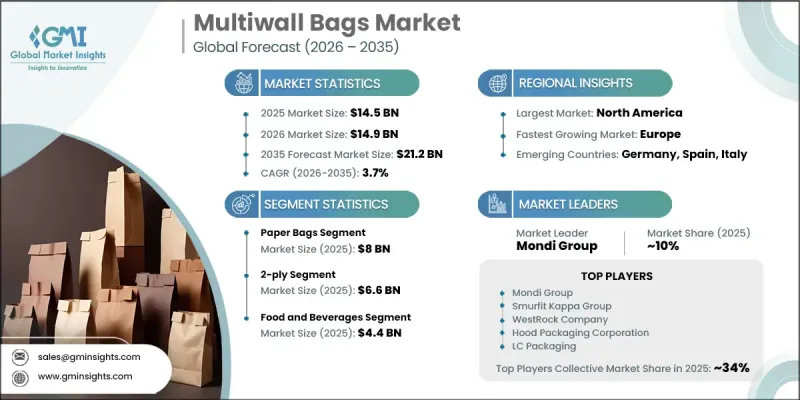
The market is steadily expanding as industries shift toward more sustainable and high-performance packaging solutions. Multiwall bags are widely recognized for their durability, cost efficiency, and environmental advantages compared to conventional packaging alternatives. Rising environmental awareness is pushing end-use industries, particularly food and agriculture, to adopt recyclable and biodegradable packaging formats. These bags are primarily manufactured using paper-based materials, and continuous innovations are improving their moisture resistance, strength, and overall functional performance without compromising sustainability goals. Regulatory frameworks aimed at reducing plastic waste, along with corporate sustainability commitments, are further accelerating adoption. Growing consumer preference for eco-friendly packaging is also influencing procurement decisions across industries. Expanding food production and agricultural trade are reinforcing demand for reliable packaging solutions that protect product integrity during storage and transportation. In addition, improvements in barrier technologies are enhancing shelf life, reducing spoilage risks, and improving handling efficiency. As industries continue to prioritize sustainability and operational efficiency, multiwall bags are increasingly positioned as a preferred packaging solution across global supply chains.
| Market Scope | |
|---|---|
| Start Year | 2025 |
| Forecast Year | 2026-2035 |
| Start Value | $14.5 Billion |
| Forecast Value | $21.2 Billion |
| CAGR | 3.7% |
The paper bags segment reached a value of USD 8 billion in 2025 and is expected to grow at a CAGR of 3.6% through 2035. This segment leads the market due to its widespread application across the packaging of industrial materials and food-related products, supported by strong alignment with sustainability objectives and recyclability requirements.
The food & beverages segment accounted for USD 4.4 billion in 2025, capturing a 30.3% share, and is projected to grow at a CAGR of 4% during the forecast period. Growth in this segment is driven by rising demand for hygienic and secure packaging solutions used for dry food ingredients that require protection from contamination and moisture exposure.
North America Multiwall Bags Market was valued at USD 3.8 billion in 2025. Demand in the region remains consistent due to well-established supply chains across construction, agriculture, and food processing industries. The United States serves as the leading contributor, driven by strong usage across industrial packaging applications. Increasing emphasis on sustainability and recyclable packaging materials is influencing purchasing decisions, while product adoption is further supported by requirements for strength, safety compliance, and customized packaging solutions tailored to end-user needs.
Major companies operating in the Global Multiwall Bags Market include Mondi Group, Smurfit Kappa Group, WestRock Company, LC Packaging, Hood Packaging Corporation, TOPPAN Inc., Langston Bag Company, Bag Supply Company, Inc., Agnel Packaging, Aumento Polymer Tekniks Pvt. Ltd., Avocado Multipack LLP, Central Ohio Bag & Burlap, Inc., Nilay Paper Products, Premier Polymer, Shanghai Ailu Package Co., Ltd, United Bags, and others. Companies operating in the Multiwall Bags Market are focusing on enhancing product durability while maintaining sustainability through advanced material engineering and improved barrier technologies. Manufacturers are expanding production capacities and optimizing supply chains to meet rising global demand. Strategic partnerships with raw material suppliers and distribution networks are strengthening market reach. Continuous investment in eco-friendly and recyclable packaging innovations is helping firms align with environmental regulations and consumer preferences. Businesses are also prioritizing customization capabilities to cater to diverse end-use requirements across industries. In addition, digitalization of manufacturing processes and automation are improving efficiency, reducing production costs, and ensuring consistent product quality, thereby strengthening long-term competitiveness in the market.
Table of Contents
Chapter 1 Methodology
- 1.1 Market scope and definition
- 1.2 Research design
- 1.2.1 Research approach
- 1.2.2 Data collection methods
- 1.3 Data mining sources
- 1.3.1 Global
- 1.3.2 Regional/Country
- 1.4 Base estimates and calculations
- 1.4.1 Base year calculation
- 1.4.2 Key trends for market estimation
- 1.5 Primary research and validation
- 1.5.1 Primary sources
- 1.6 Forecast model
- 1.7 Research assumptions and limitations
Chapter 2 Executive Summary
- 2.1 Industry 360° synopsis
- 2.2 Key market trends
- 2.2.1 Regional
- 2.2.2 Product
- 2.2.3 Layer
- 2.2.4 Application
- 2.3 TAM Analysis, 2026-2035
- 2.4 CXO perspectives: Strategic imperatives
Chapter 3 Industry Insights
- 3.1 Industry ecosystem analysis
- 3.1.1 Supplier Landscape
- 3.1.2 Profit Margin
- 3.1.3 Value addition at each stage
- 3.1.4 Factor affecting the value chain
- 3.1.5 Disruptions
- 3.2 Industry impact forces
- 3.2.1 Growth drivers
- 3.2.2 Industry pitfalls and challenges
- 3.2.3 Market opportunities
- 3.3 Growth potential analysis
- 3.4 Regulatory landscape
- 3.4.1 North America
- 3.4.2 Europe
- 3.4.3 Asia Pacific
- 3.4.4 Latin America
- 3.4.5 Middle East & Africa
- 3.5 Porter’s analysis
- 3.6 PESTEL analysis
- 3.7 Price trends
- 3.7.1 By region
- 3.7.2 By product
- 3.8 Future market trends
- 3.9 Technology and Innovation landscape
- 3.9.1 Current technological trends
- 3.9.2 Emerging technologies
- 3.10 Patent Landscape
- 3.11 Trade statistics
- 3.11.1 Major importing countries
- 3.11.2 Major exporting countries
- 3.12 Sustainability and Environmental Aspects
- 3.12.1 Sustainable Practices
- 3.12.2 Waste Reduction Strategies
- 3.12.3 Energy Efficiency in Production
- 3.12.4 Eco-friendly Initiatives
- 3.13 Carbon Footprint Considerations
Chapter 4 Competitive Landscape, 2025
- 4.1 Introduction
- 4.2 Company market share analysis
- 4.2.1 By region
- 4.2.1.1 North America
- 4.2.1.2 Europe
- 4.2.1.3 Asia Pacific
- 4.2.1.4 LATAM
- 4.2.1.5 MEA
- 4.2.1 By region
- 4.3 Company matrix analysis
- 4.4 Competitive analysis of major market players
- 4.5 Competitive positioning matrix
- 4.6 Key developments
- 4.6.1 Mergers & acquisitions
- 4.6.2 Partnerships & collaborations
- 4.6.3 New Product Launches
- 4.6.4 Expansion Plans
Chapter 5 Market Estimates and Forecast, By Product, 2022-2035 (USD Billion, Kilo Tons)
- 5.1 Key trends
- 5.2 Paper bags
- 5.3 Plastic bags
- 5.4 Woven Polypropylene bags
- 5.5 Hybrid bags
Chapter 6 Market Estimates and Forecast, By Layer, 2022-2035 (USD Billion, Kilo Tons)
- 6.1 Key trends
- 6.2 2-ply
- 6.3 3-ply
- 6.4 Others
Chapter 7 Market Estimates and Forecast, By Application, 2022-2035 (USD Billion, Kilo Tons)
- 7.1 Key trends
- 7.2 Agriculture
- 7.3 Food and beverages
- 7.4 Chemicals
- 7.5 Pharmaceuticals
- 7.6 Retail and consumer goods
- 7.7 Building materials & construction
- 7.8 Others
Chapter 8 Market Estimates and Forecast, By Region, 2022-2035 (USD Billion, Kilo Tons)
- 8.1 Key trends
- 8.2 North America
- 8.2.1 U.S.
- 8.2.2 Canada
- 8.3 Europe
- 8.3.1 Germany
- 8.3.2 UK
- 8.3.3 France
- 8.3.4 Italy
- 8.3.5 Spain
- 8.3.6 Rest of Europe
- 8.4 Asia Pacific
- 8.4.1 China
- 8.4.2 India
- 8.4.3 Japan
- 8.4.4 Australia
- 8.4.5 South Korea
- 8.4.6 Rest of Asia Pacific
- 8.5 Latin America
- 8.5.1 Brazil
- 8.5.2 Mexico
- 8.5.3 Argentina
- 8.5.4 Rest of Latin America
- 8.6 Middle East & Africa
- 8.6.1 Saudi Arabia
- 8.6.2 South Africa
- 8.6.3 UAE
- 8.6.4 Rest of Middle East & Africa
Chapter 9 Company Profiles
- 9.1 Agnel Packaging
- 9.2 Aumento Polymer Tekniks Pvt. Ltd.
- 9.3 Avocado Multipack LLP
- 9.4 Bag Supply Company, Inc.
- 9.5 Central Ohio Bag & Burlap, Inc.
- 9.6 Hood Packaging Corporation
- 9.7 Langston Bag Company
- 9.8 LC Packaging
- 9.9 Mondi Group
- 9.10 Nilay Paper Products
- 9.11 Premier Polymer
- 9.12 Shanghai Ailu package CO.,Ltd
- 9.13 Smurfit Kappa Group
- 9.14 TOPPAN Inc.
- 9.15 United Bags.
- 9.16 WestRock Company

