PUBLISHER: Global Market Insights Inc. | PRODUCT CODE: 2027529

PUBLISHER: Global Market Insights Inc. | PRODUCT CODE: 2027529
Smart Rings Market Opportunity, Growth Drivers, Industry Trend Analysis, and Forecast 2026 - 2035
The Global Smart Rings Market was valued at USD 697.6 million in 2025 and is estimated to grow at a CAGR of 25.4% to reach USD 7.8 billion by 2035.
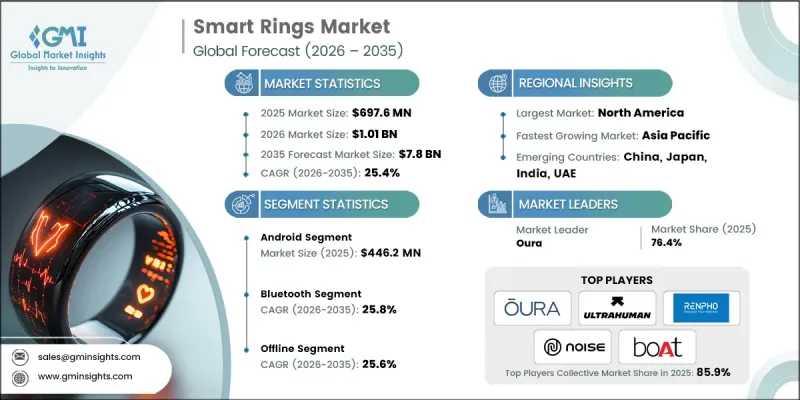
Smart rings merge style with advanced technology, offering users a variety of functionalities through integrated sensors and connectivity features. These devices allow tracking of key health metrics, managing notifications, and even performing contactless payments. Market expansion is being driven by the widespread adoption of smartphones, tablets, and other connected devices, alongside growing interest in wearable technology for health monitoring, such as tracking heart rate and sleep patterns. The increasing demand for contactless payment solutions, accelerated by global events, has further fueled industry growth, particularly in emerging economies that are rapidly transitioning toward cashless transactions. However, high device costs and competition from more established wearable alternatives, including smartwatches and fitness trackers, present challenges to broader adoption. Despite this, the market continues to grow as consumer awareness of multifunctional wearables increases.
| Market Scope | |
|---|---|
| Start Year | 2025 |
| Forecast Year | 2026-2035 |
| Start Value | $697.6 Million |
| Forecast Value | $7.8 Billion |
| CAGR | 25.4% |
The android segment generated USD 446.2 million in revenue in 2025, supported by the rapidly expanding global base of Android smartphone users. Broad device compatibility with wearable technologies, along with flexible price ranges and access to a wide ecosystem of third-party applications, continues to accelerate adoption across price-sensitive consumer groups. The platform's open architecture allows manufacturers to integrate diverse features and functionalities, making smart rings more accessible and customizable for a wider audience. As demand for connected health and lifestyle devices rises, Android-based ecosystems are expected to maintain strong momentum, particularly in emerging markets where affordability and versatility play a critical role in purchase decisions.
The offline distribution segment is projected to grow at a CAGR of 25.6% between 2026 and 2035, highlighting the sustained relevance of physical retail channels in the smart rings market. Consumers often prefer in-store experiences to assess product design, comfort, and functionality before making a purchase decision, especially for wearable devices. Retail outlets also provide personalized assistance, product demonstrations, and immediate availability, which enhance buyer confidence. Established distribution networks, including electronics stores and specialty outlets, further support visibility and brand trust, contributing to the robust growth trajectory of offline sales channels.
Asia Pacific Smart Rings Market accounted for USD 161.5 million in 2025, driven by strong momentum in digital adoption across key economies such as China and India. Government-led initiatives focused on expanding digital infrastructure and promoting advanced technologies are playing a significant role in shaping consumer behavior. Increasing awareness of health monitoring devices, rising disposable incomes, and growing smartphone penetration are further fueling demand for smart rings in the region. In addition, the presence of a large tech-savvy population and continuous innovation by regional manufacturers are creating favorable conditions for sustained market expansion.
Key players in the Global Smart Rings Market include Bellabeat, Kerv Wearables, Moen Smart Ring, Noise, Fujitsu, Boat, Circular Ring, Ultrahuman, Logbar, Sleepon Ring, Sky Labs, McLear Ltd., Moodmetric, and Oura. Companies in the Global Smart Rings Market strengthen their position by investing in product innovation, introducing rings with enhanced health tracking, long battery life, and multifunctional capabilities. Expanding global distribution networks, including online marketplaces and retail partnerships, helps improve accessibility. Firms focus on user experience by integrating seamless connectivity with smartphones and offering customizable features. Strategic collaborations with technology and payment service providers enhance the functionality of their devices. Marketing campaigns highlighting health benefits and digital payment convenience, along with participation in technology expos and regional promotions, are key tactics to increase market visibility and drive adoption.
Table of Contents
Chapter 1 Methodology and scope
- 1.1 Research approach
- 1.2 Quality Commitments
- 1.2.1 GMI AI policy & data integrity commitment
- 1.2.1.1 Source consistency protocol
- 1.2.1 GMI AI policy & data integrity commitment
- 1.3 Research Trail & Confidence Scoring
- 1.3.1 Research Trail Components
- 1.3.2 Scoring Components
- 1.4 Data Collection
- 1.4.1 Partial list of primary sources
- 1.5 Data mining sources
- 1.5.1 Paid sources
- 1.5.1.1 Sources, by region
- 1.5.1 Paid sources
- 1.6 Base estimates and calculations
- 1.6.1 Base year calculation for any one approach
- 1.7 Forecast model
- 1.7.1 Quantified market impact analysis
- 1.7.1.1 Mathematical impact of growth parameters on forecast
- 1.7.1 Quantified market impact analysis
- 1.8 Research transparency addendum
- 1.8.1 Source attribution framework
- 1.8.2 Quality assurance metrics
- 1.8.3 Our commitment to trust
Chapter 2 Executive summary
- 2.1 Industry 360° synopsis
- 2.2 Key market trends
- 2.2.1 Regional
- 2.2.2 Operating system trends
- 2.2.3 Technology trends
- 2.2.4 Consumer group trends
- 2.2.5 Price range trends
- 2.2.6 Distribution channel trends
Chapter 3 Industry insights
- 3.1 Industry ecosystem analysis
- 3.1.1 Supplier landscape
- 3.1.2 Profit margin
- 3.1.3 Value addition at each stage
- 3.1.4 Factor affecting the value chain
- 3.1.5 Disruptions
- 3.2 Industry impact forces
- 3.2.1 Growth drivers
- 3.2.2 Industry pitfalls & challenges
- 3.2.3 Opportunities
- 3.3 Growth potential analysis
- 3.4 Future market trends
- 3.5 Technology and innovation landscape
- 3.5.1 Current technological trends
- 3.5.2 Emerging technologies
- 3.6 Price trends, 2025 (Driven by Primary Research)
- 3.6.1 Historical price trend analysis (Driven by Primary Research) (2022-2025)
- 3.6.2 Pricing strategy by player type (Premium / Value / Cost-plus) (Driven by Primary Research)
- 3.6.3 Regional price variations & purchasing power analysis
- 3.6.4 Component cost structure & material cost drivers
- 3.7 Regulatory framework
- 3.7.1 Standards and certifications
- 3.7.2 Environmental regulations
- 3.7.3 Import export regulations
- 3.8 Trade Data Analysis (Driven by Paid Database)
- 3.8.1 Import/Export Volume & Value Trends (2022-2025)
- 3.8.2 Major exporting countries (China, Taiwan, South Korea)
- 3.8.3 Major importing countries & regions
- 3.8.4 HS code classification & trade data methodology
- 3.9 Impact of AI & generative ai on the market
- 3.9.1 AI-driven disruption of traditional business models
- 3.9.2 GenAI use cases & adoption roadmap by customer segment
- 3.9.3 Risks, limitations & regulatory considerations
- 3.9.4 AI-enabled smart home ecosystem integration
- 3.10 Porter's five forces analysis
- 3.11 PESTEL analysis
- 3.12 Consumer behavior analysis
- 3.12.1 Purchasing patterns
- 3.12.2 Preference analysis
- 3.12.3 Regional variations in consumer behavior
- 3.12.4 Impact of e-commerce on buying decisions
Chapter 4 Competitive landscape, 2025
- 4.1 Introduction
- 4.2 Company market share analysis
- 4.2.1 North America
- 4.2.2 Europe
- 4.2.3 Asia Pacific
- 4.2.4 Latin America
- 4.2.5 MEA
- 4.3 Company matrix analysis
- 4.4 Competitive analysis of major market players
- 4.5 Competitive positioning matrix
- 4.6 Key developments
- 4.6.1 Mergers & acquisitions
- 4.6.2 Partnerships & collaborations
- 4.6.3 New product launches
- 4.6.4 Expansion plans
Chapter 5 Market Estimates & Forecast, By Operating System, 2022 - 2035 ($Billion, Thousand Units)
- 5.1 Key trends
- 5.2 Android
- 5.3 iOS
Chapter 6 Market Estimates & Forecast, By Technology, 2022 - 2035 ($Billion, Thousand Units)
- 6.1 Key trends
- 6.2 Bluetooth
- 6.3 NFC
- 6.4 Hybrid smart rings
Chapter 7 Market Estimates & Forecast, By Consumer Group, 2022 - 2035 ($Billion, Thousand Units)
- 7.1 Key trends
- 7.2 Men
- 7.3 Women
- 7.4 Unisex
Chapter 8 Market Estimates & Forecast, By Price Range, 2022 - 2035 ($Billion, Thousand Units)
- 8.1 Key trends
- 8.2 Low (<$50)
- 8.3 Medium ($50 - $200)
- 8.4 High (>$200)
Chapter 9 Market Estimates & Forecast, By Distribution Channel, 2022 - 2035 ($Billion, Thousand Units)
- 9.1 Key trends
- 9.2 Online
- 9.2.1 E-commerce
- 9.2.2 Company websites
- 9.3 Offline
- 9.3.1 Supermarkets/hypermarket
- 9.3.2 Specialty retail stores
- 9.3.3 Others (independent retailer etc.)
Chapter 10 Market Estimates & Forecast, By Region, 2022 - 2035 ($Billion, Thousand Units)
- 10.1 Key trends
- 10.2 North America
- 10.2.1 U.S.
- 10.2.2 Canada
- 10.3 Europe
- 10.3.1 Germany
- 10.3.2 UK
- 10.3.3 France
- 10.3.4 Spain
- 10.3.5 Italy
- 10.3.6 Netherlands
- 10.4 Asia Pacific
- 10.4.1 China
- 10.4.2 Japan
- 10.4.3 India
- 10.4.4 Australia
- 10.4.5 South Korea
- 10.5 Latin America
- 10.5.1 Brazil
- 10.5.2 Mexico
- 10.5.3 Argentina
- 10.6 MEA
- 10.6.1 South Africa
- 10.6.2 Saudi Arabia
- 10.6.3 UAE
Chapter 11 Company Profiles
- 11.1 Amazfit
- 11.2 bleo
- 11.3 Boat
- 11.4 Colmi
- 11.5 Go2Sleep
- 11.6 Happy Health (Happy Ring)
- 11.7 Movano Health
- 11.8 Noise
- 11.9 Oura
- 11.10 Renpho US
- 11.11 RingConn
- 11.12 Samsung Electronics
- 11.13 Sky Labs
- 11.14 Ultrahuman
- 11.15 Wellue

