PUBLISHER: Global Market Insights Inc. | PRODUCT CODE: 2027536

PUBLISHER: Global Market Insights Inc. | PRODUCT CODE: 2027536
Automotive HUD (Head-up Displays) Market Opportunity, Growth Drivers, Industry Trend Analysis, and Forecast 2026 - 2035
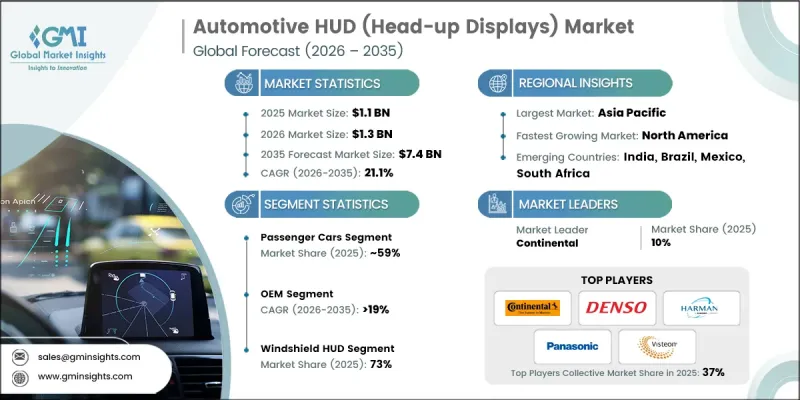
The Global Automotive Head-Up Display (HUD) Market was valued at USD 1.1 billion in 2025 and is estimated to grow at a CAGR of 21.1% to reach USD 7.4 billion by 2035.
The rapid adoption of advanced driver assistance systems (ADAS) is driving the demand for HUDs, as these displays provide real-time information on speed, navigation, and potential hazards, improving driver awareness and safety. Automakers are integrating HUDs into mid-range and premium vehicles to meet consumer expectations for intuitive, distraction-free interfaces. The evolution of augmented reality HUD technology is enhancing in-vehicle experiences by overlaying navigation, lane guidance, and hazard alerts directly onto the driver's field of view. This immersive interface improves depth perception and reaction time. HUD innovation has resulted in more accurate, scalable, and commercially viable solutions. The rise of connected and electric vehicles has further accelerated the adoption of digital cockpit solutions, positioning HUDs as essential components for delivering battery status, range, and navigation information efficiently.
| Market Scope | |
|---|---|
| Start Year | 2025 |
| Forecast Year | 2026-2035 |
| Start Value | $1.1 Billion |
| Forecast Value | $7.4 Billion |
| CAGR | 21.1% |
The passenger car segment held a 59% share and is projected to maintain a CAGR of 21% from 2026 to 2035. Consumer demand for safety, convenience, and premium features drives HUD adoption in passenger vehicles. HUDs allow drivers to access critical information while keeping their focus on the road, boosting popularity in mid-range and luxury cars. The trend of integrating premium technologies across passenger vehicles is encouraging automakers to offer HUDs as standard or optional features.
The original equipment manufacturers (OEMs) segment held 83% share in 2025, expected to grow at a CAGR of 19% through 2035. OEMs are increasingly using HUDs to differentiate vehicles in competitive markets, enhancing brand image and delivering a premium, futuristic experience. HUDs are also integrated with ADAS systems to display real-time alerts such as collision warnings and lane departure signals, improving driver response and vehicle safety.
U.S. Automotive Head-Up Display (HUD) Market held a 90% share, generating USD 265.7 million in 2025. High demand for technologically advanced and safe vehicles is driving HUD adoption in the U.S., particularly in premium cars and SUVs. Consumers are seeking features that enhance comfort, convenience, and driving experience, compelling automakers to include HUDs. Regulatory pressure to improve driver safety further supports market growth in the region.
Key players operating in the Global Automotive HUD (Head-up Displays) Market include Continental, Panasonic, Harman International, Denso, Bosch, Valeo, Visteon, Garmin, Hyundai Mobis, and Nippon Seiki. Companies in the Automotive HUD (Head-up Displays) Market are strengthening their positions by investing in R&D to improve augmented reality and projection technologies, enhancing clarity, accuracy, and scalability. Collaborations with automakers enable seamless integration of HUDs into next-generation vehicles. Firms are also focusing on expanding their product portfolios to cater to mid-range and premium vehicle segments. Strategic partnerships, joint ventures, and technology licensing agreements are being used to access new markets, accelerate innovation, and maintain a competitive edge. Additionally, companies are emphasizing smart cockpit integration and connected vehicle solutions to align with the growing EV and autonomous vehicle ecosystem, reinforcing their market presence globally.
Table of Contents
Chapter 1 Methodology
- 1.1 Research approach
- 1.2 Quality Commitments
- 1.2.1 GMI AI policy & data integrity commitment
- 1.2.1.1 Source consistency protocol
- 1.2.1 GMI AI policy & data integrity commitment
- 1.3 Research Trail & Confidence Scoring
- 1.3.1 Research Trail Components
- 1.3.2 Scoring Components
- 1.4 Data Collection
- 1.4.1 Partial list of primary sources
- 1.5 Data mining sources
- 1.5.1 Paid sources
- 1.5.2 Sources, by region
- 1.6 Base estimates and calculations
- 1.6.1 Base year calculation for any one approach
- 1.7 Forecast model
- 1.7.1 Quantified market impact analysis
- 1.7.1.1 Mathematical impact of growth parameters on forecast
- 1.7.1 Quantified market impact analysis
- 1.8 Research transparency addendum
- 1.8.1 Source attribution framework
- 1.8.2 Quality assurance metrics
- 1.8.3 Our commitment to trust
Chapter 2 Executive Summary
- 2.1 Industry 360° synopsis, 2022 - 2035
- 2.2 Key market trends
- 2.2.1 Regional
- 2.2.2 Vehicle
- 2.2.3 Display
- 2.2.4 Technology
- 2.2.5 Component
- 2.2.6 Display Size
- 2.2.7 Sales Channel
- 2.3 TAM Analysis, 2026-2035
- 2.4 CXO perspectives: Strategic imperatives
Chapter 3 Industry Insights
- 3.1 Industry ecosystem analysis
- 3.1.1 Supplier landscape
- 3.1.2 Profit margin analysis
- 3.1.3 Cost structure
- 3.1.4 Value addition at each stage
- 3.1.5 Factor affecting the value chain
- 3.1.6 Disruptions
- 3.2 Industry impact forces
- 3.2.1 Growth drivers
- 3.2.1.1 Rising demand for advanced driver assistance systems (ADAS)
- 3.2.1.2 Growing premium and luxury vehicle sales
- 3.2.1.3 Technological advancements in AR-based HUDs
- 3.2.1.4 Increasing focus on driver safety and regulations
- 3.2.2 Industry pitfalls and challenges
- 3.2.2.1 High system cost and integration complexity
- 3.2.2.2 Limited adoption in entry-level vehicles
- 3.2.2.3 Visibility issues in certain lighting conditions
- 3.2.2.4 Windshield compatibility and design constraints
- 3.2.3 Market opportunities
- 3.2.3.1 Expansion of AR-HUD technology
- 3.2.3.2 Rising electric and autonomous vehicles
- 3.2.3.3 Growth in emerging markets
- 3.2.3.4 Software-driven customization and UX innovation
- 3.2.1 Growth drivers
- 3.3 Growth potential analysis
- 3.4 Regulatory landscape
- 3.4.1 North America
- 3.4.1.1 Environmental Protection Agency (EPA)
- 3.4.1.2 National Highway Traffic Safety Administration (NHTSA) - FMVSS standards
- 3.4.1.3 Occupational Safety and Health Administration (OSHA)
- 3.4.1.4 Canadian Motor Vehicle Safety Standards (CMVSS)
- 3.4.1.5 State-level road safety and display regulations
- 3.4.2 Europe
- 3.4.2.1 EU general safety regulation
- 3.4.2.2 CE marking compliance
- 3.4.2.3 Low voltage directive (LVD)
- 3.4.2.4 Electromagnetic compatibility (EMC) directive
- 3.4.2.5 National vehicle homologation requirements
- 3.4.3 Asia Pacific
- 3.4.3.1 China automotive and intelligent vehicle regulatory framework
- 3.4.3.2 Indian central motor vehicle rules (CMVR)
- 3.4.3.3 Japanese road transport vehicle act
- 3.4.3.4 ASEAN vehicle safety and technology harmonization efforts
- 3.4.3.5 Australian design rules (ADR)
- 3.4.4 Latin America
- 3.4.4.1 Brazilian national traffic council (CONTRAN) regulations
- 3.4.4.2 Mexican NOM standards
- 3.4.4.3 Regional vehicle safety and digital display regulations
- 3.4.4.4 Urban mobility and intelligent transport initiatives
- 3.4.5 Middle East & Africa
- 3.4.5.1 GCC vehicle compliance and type approval regulations
- 3.4.5.2 South African national road traffic act (NRTA)
- 3.4.5.3 Regional vehicle import and safety compliance standards
- 3.4.5.4 Smart mobility and transport modernization initiatives
- 3.4.1 North America
- 3.5 Future market trends
- 3.6 Porter's analysis
- 3.7 PESTEL analysis
- 3.8 Technology and innovation landscape
- 3.8.1 Current technological trends
- 3.8.2 Emerging technologies
- 3.9 Price analysis (Driven by Primary Research)
- 3.9.1 Historical Price Trend Analysis
- 3.9.2 Pricing Strategy by Player Type (Premium / Value / Cost-plus)
- 3.10 Trade data analysis (Driven by Paid Research)
- 3.10.1 Import/export volume & value trends
- 3.10.2 Key trade corridors & tariff impact
- 3.11 Cost breakdown analysis
- 3.12 Patent analysis (Driven by Primary Research)
- 3.13 Sustainability and environmental aspects
- 3.13.1 Sustainable practices
- 3.13.2 Waste reduction strategies
- 3.13.3 Energy efficiency in production
- 3.13.4 Eco-friendly Initiatives
- 3.13.5 Carbon footprint considerations
- 3.14 Impact of AI & generative AI on the market
- 3.14.1 AI-driven disruption of existing business models
- 3.14.2 GenAI use cases & adoption roadmap by segment
- 3.14.3 Risks, limitations & regulatory considerations
- 3.15 Capacity & production landscape (Driven by Primary Research)
- 3.15.1 Installed capacity by region & key producer
- 3.15.2 Capacity utilization rates & expansion pipelines
- 3.16 Forecast assumptions & scenario analysis (Driven by Primary Research)
- 3.16.1 Base Case - key macro & industry variables driving CAGR
- 3.16.2 Optimistic Scenarios - Favorable macro and industry tailwinds
- 3.16.3 Pessimistic Scenario - Macroeconomic slowdown or industry headwinds
Chapter 4 Competitive Landscape, 2025
- 4.1 Introduction
- 4.2 Company market share analysis
- 4.2.1 North America
- 4.2.2 Europe
- 4.2.3 Asia Pacific
- 4.2.4 LATAM
- 4.2.5 MEA
- 4.3 Competitive analysis of major market players
- 4.4 Competitive positioning matrix
- 4.5 Key developments
- 4.5.1 Mergers & acquisitions
- 4.5.2 Partnerships & collaborations
- 4.5.3 New Product Launches
- 4.5.4 Expansion Plans and funding
- 4.6 Company tier benchmarking
- 4.6.1 Tier classification criteria & qualifying thresholds
- 4.6.2 Tier positioning matrix by revenue, geography & innovation
Chapter 5 Market Estimates & Forecast, By Vehicle, 2022 - 2035 ($Mn, Units)
- 5.1 Key trends
- 5.2 Passenger cars
- 5.2.1 Sedan
- 5.2.2 SUV
- 5.2.3 Hatchback
- 5.3 Commercial vehicle
- 5.3.1 LCV
- 5.3.2 MCV
- 5.3.3 HCV
- 5.4 Off highway vehicle
Chapter 6 Market Estimates & Forecast, By Display, 2022 - 2035 ($Mn, Units)
- 6.1 Key trends
- 6.2 Windshield HUD
- 6.3 Combiner HUD
Chapter 7 Market Estimates & Forecast, By Technology, 2022 - 2035 ($Mn, Units)
- 7.1 Key trends
- 7.2 Conventional HUD
- 7.3 Augmented Reality HUD
- 7.4 Holographic HUD
Chapter 8 Market Estimates & Forecast, By Component, 2022 - 2035 ($Mn, Units)
- 8.1 Key trends
- 8.2 Hardware
- 8.2.1 Display panel
- 8.2.2 Projector unit
- 8.2.3 Sensors
- 8.2.4 Others
- 8.3 Software
Chapter 9 Market Estimates & Forecast, By Display Size, 2022 - 2035 ($Mn, Units)
- 9.1 Key trends
- 9.2 Small-sized display ( 5 inches)
- 9.3 Medium-sized display (5-10 inches)
- 9.4 Large-sized display (> 10 inches)
Chapter 10 Market Estimates & Forecast, By Sales Channel, 2022 - 2035 ($Mn, Units)
- 10.1 Key trends
- 10.2 OEM
- 10.3 Aftermarket
Chapter 11 Market Estimates & Forecast, By Region, 2022 - 2035 ($Mn, Units)
- 11.1 Key trends
- 11.2 North America
- 11.2.1 US
- 11.2.2 Canada
- 11.3 Europe
- 11.3.1 UK
- 11.3.2 Germany
- 11.3.3 France
- 11.3.4 Italy
- 11.3.5 Spain
- 11.3.6 Russia
- 11.3.7 Nordics
- 11.4 Asia Pacific
- 11.4.1 China
- 11.4.2 India
- 11.4.3 Japan
- 11.4.4 South Korea
- 11.4.5 Southeast Asia
- 11.4.6 ANZ
- 11.5 Latin America
- 11.5.1 Brazil
- 11.5.2 Argentina
- 11.5.3 Mexico
- 11.6 MEA
- 11.6.1 UAE
- 11.6.2 Saudi Arabia
- 11.6.3 South Africa
Chapter 12 Company Profiles
- 12.1 Global Players
- 12.1.1 BAE Systems
- 12.1.2 Bosch
- 12.1.3 Continental
- 12.1.4 Denso
- 12.1.5 Garmin
- 12.1.6 Harman International
- 12.1.7 Hyundai Mobis
- 12.1.8 LG Electronics
- 12.1.9 Nippon Seiki
- 12.1.10 Panasonic
- 12.1.11 Valeo
- 12.1.12 Visteon
- 12.1.13 YAZAKI
- 12.2 Regional Players
- 12.2.1 Foryou
- 12.2.2 JVCKENWOOD
- 12.2.3 Kyocera
- 12.3 Emerging Players
- 12.3.1 CY Vision
- 12.3.2 Huawei
- 12.3.3 Hudway
- 12.3.4 WayRay

