
PUBLISHER: Global Market Insights Inc. | PRODUCT CODE: 2027549

PUBLISHER: Global Market Insights Inc. | PRODUCT CODE: 2027549
Panthenol Market Opportunity, Growth Drivers, Industry Trend Analysis, and Forecast 2026 - 2035
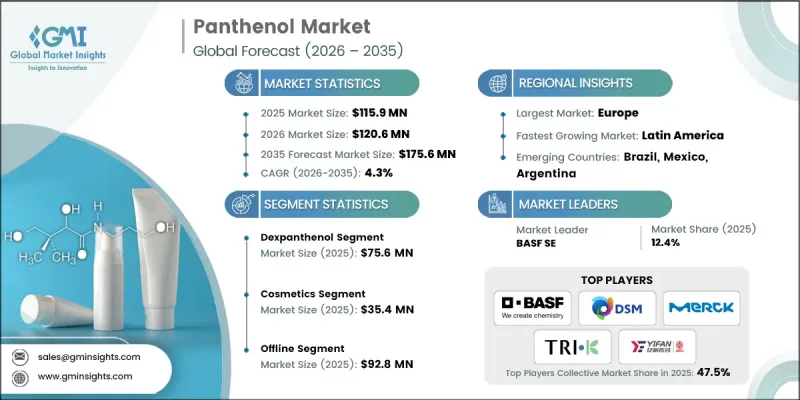
The Global Panthenol Market was valued at USD 115.9 million in 2025 and is estimated to grow at a CAGR of 4.3% to reach USD 175.6 million by 2035.
Panthenol, commonly recognized as provitamin B5, is widely utilized for its hydrating, conditioning, and protective properties. Its ability to retain moisture makes it a preferred ingredient in formulations designed to enhance skin and hair health. Manufacturers benefit from its versatility, as it can be incorporated into a wide range of products with varying concentrations and forms. The ingredient is widely accepted due to its compatibility with different skin and hair types, supporting its extensive use across consumer products. In addition, panthenol contributes to product stability during manufacturing and storage, making it suitable for both large-scale production and specialized formulations. Ongoing technological advancements are focused on improving production efficiency, enhancing formulation quality, and increasing product purity. These improvements are enabling better integration of panthenol into advanced formulations, resulting in improved texture, absorption, and extended shelf life across multiple applications.
| Market Scope | |
|---|---|
| Start Year | 2025 |
| Forecast Year | 2026-2035 |
| Start Value | $115.9 Million |
| Forecast Value | $175.6 Million |
| CAGR | 4.3% |
The panthenol market continues to benefit from advancements in formulation and production technologies. Manufacturers are adopting refined synthesis techniques and stringent quality control measures to ensure consistent product output while minimizing material waste. Improved formulation methods allow seamless incorporation of panthenol into multifunctional products, enhancing performance characteristics such as texture, stability, and absorption. These developments are strengthening its role as a key ingredient in modern product innovation.
The cosmetics segment accounted for USD 35.4 million in 2025. This segment remains dominant due to the widespread use of panthenol in personal care formulations, where it supports product consistency and enhances overall performance. Its functionality in maintaining formulation stability and enabling precise product development contributes to its strong demand. The ingredient's adaptability across various applications continues to support its leading position within the market.
The offline distribution segment captured USD 92.8 million in 2025. Traditional sales networks remain essential due to their ability to support bulk procurement and long-term supply agreements. Direct engagement with suppliers and distributors allows customers to access technical expertise and customized solutions tailored to specific application requirements. The reliability and efficiency of offline channels continue to drive their dominance in the market.
North America Panthenol Market is projected to grow from USD 30.7 million in 2025 to USD 45.3 million by 2035, supported by consistent usage across personal care, pharmaceutical, and wellness products. A well-established supply chain and stable formulation standards contribute to sustained demand. The region benefits from a strong manufacturing base and continuous product innovation focused on delivering effective and compatible solutions for diverse consumer needs.
Key companies operating in the Global Panthenol Market include BASF SE, DSM, Yifan Pharmaceutical Co., Ltd., Xinfa Pharmaceutical Co., Ltd., Aethon International LLP, TRI-K Industries, Inc., Merck KGaA, Jiangxi Tongde Chemical Technology Co., Ltd., RITA Corporation, and Dadia Chemical Industries. Companies in the Panthenol Market are implementing strategic initiatives to enhance their competitive position and expand their global reach. A key focus is placed on research and development to improve product quality, increase purity levels, and expand application capabilities. Manufacturers are investing in advanced production technologies to optimize efficiency and reduce costs. Strategic collaborations and partnerships are being pursued to strengthen distribution networks and improve market access. Companies are also focusing on developing customized formulations to meet specific industry requirements, which helps build long-term customer relationships. Expanding product portfolios and enhancing technical support services are further supporting market growth. Additionally, efforts to maintain consistent quality standards and comply with regulatory requirements are enabling companies to strengthen their credibility and sustain long-term market presence.
Table of Contents
Chapter 1 Methodology & Scope
- 1.1 Market scope and definition
- 1.2 Research design
- 1.2.1 Research approach
- 1.2.2 Data collection methods
- 1.3 Data mining sources
- 1.3.1 Global
- 1.3.2 Regional/Country
- 1.4 Base estimates and calculations
- 1.4.1 Base year calculation
- 1.4.2 Key trends for market estimation
- 1.5 Primary research and validation
- 1.5.1 Primary sources
- 1.6 Forecast model
- 1.7 Research assumptions and limitations
Chapter 2 Executive Summary
- 2.1 Industry 360° synopsis
- 2.2 Key market trends
- 2.2.1 Type
- 2.2.2 End User
- 2.2.3 Distribution Channel
- 2.2.4 Regional
- 2.3 TAM Analysis, 2026-2035
- 2.4 CXO perspectives: Strategic imperatives
- 2.5 Future outlook and strategic recommendations
Chapter 3 Industry Insights
- 3.1 Industry ecosystem analysis
- 3.1.1 Supplier landscape
- 3.1.2 Profit margin
- 3.1.3 Value addition at each stage
- 3.1.4 Factor affecting the value chain
- 3.1.5 Disruptions
- 3.2 Industry impact forces
- 3.2.1 Growth drivers
- 3.2.1.1 Rising use in skincare and haircare formulations
- 3.2.1.2 Preference for gentle ingredients in everyday consumer products
- 3.2.1.3 Compatibility with diverse formulations and processing conditions requirements
- 3.2.2 Pitfalls/challenge
- 3.2.2.1 Sensitivity to formulation balance and concentration levels variations
- 3.2.2.2 Price fluctuations influenced by raw material sourcing factors
- 3.2.3 Opportunities
- 3.2.3.1 Expansion into pharmaceutical and wellness focused applications segments
- 3.2.3.2 Growing demand for multifunctional personal care products worldwide
- 3.2.1 Growth drivers
- 3.3 Growth potential analysis
- 3.4 Regulatory landscape
- 3.4.1 North America
- 3.4.2 Europe
- 3.4.3 Asia Pacific
- 3.4.4 Latin America
- 3.4.5 Middle East & Africa
- 3.5 Porter’s analysis
- 3.6 PESTEL analysis
- 3.7 Technology and innovation landscape
- 3.7.1 Current technological trends
- 3.7.2 Emerging technologies
- 3.8 Price trends
- 3.8.1 By region
- 3.8.2 By type
- 3.9 Future market trends
- 3.10 Patent landscape
- 3.11 Trade statistics (HS code)
- 3.11.1 Major importing countries
- 3.11.2 Major exporting countries
- 3.12 Sustainability and environmental aspects
- 3.12.1 Sustainable practices
- 3.12.2 Waste reduction strategies
- 3.12.3 Energy efficiency in production
- 3.12.4 Eco-friendly initiatives
- 3.13 Carbon footprint consideration
Chapter 4 Competitive Landscape, 2025
- 4.1 Introduction
- 4.2 Company market share analysis
- 4.2.1 By region
- 4.2.1.1 North America
- 4.2.1.2 Europe
- 4.2.1.3 Asia Pacific
- 4.2.1.4 LATAM
- 4.2.1.5 MEA
- 4.2.1 By region
- 4.3 Company matrix analysis
- 4.4 Competitive analysis of major market players
- 4.5 Competitive positioning matrix
- 4.6 Key developments
- 4.6.1 Mergers & acquisitions
- 4.6.2 Partnerships & collaborations
- 4.6.3 New product launches
- 4.6.4 Expansion plans
Chapter 5 Market Estimates and Forecast, By Type, 2022-2035 (USD Million) (Kilo Tons)
- 5.1 Key trends
- 5.2 Dexpanthenol
- 5.3 D-pantothenyl alcohol
Chapter 6 Market Estimates and Forecast, By End User, 2022-2035 (USD Million) (Kilo Tons)
- 6.1 Key trends
- 6.2 Food and beverage industry
- 6.3 Cosmetics
- 6.4 Personal care products
- 6.5 Pharmaceuticals
- 6.6 Animal feed
- 6.7 Others
Chapter 7 Market Estimates and Forecast, By Distribution Channel, 2022-2035 (USD Million) (Kilo Tons)
- 7.1 Key trends
- 7.2 Online
- 7.3 Offline
Chapter 8 Market Estimates and Forecast, By Region, 2022-2035 (USD Million) (Kilo Tons)
- 8.1 Key trends
- 8.2 North America
- 8.2.1 U.S.
- 8.2.2 Canada
- 8.3 Europe
- 8.3.1 Germany
- 8.3.2 UK
- 8.3.3 France
- 8.3.4 Spain
- 8.3.5 Italy
- 8.3.6 Rest of Europe
- 8.4 Asia Pacific
- 8.4.1 China
- 8.4.2 India
- 8.4.3 Japan
- 8.4.4 Australia
- 8.4.5 South Korea
- 8.4.6 Rest of Asia Pacific
- 8.5 Latin America
- 8.5.1 Brazil
- 8.5.2 Mexico
- 8.5.3 Argentina
- 8.5.4 Rest of Latin America
- 8.6 Middle East and Africa
- 8.6.1 Saudi Arabia
- 8.6.2 South Africa
- 8.6.3 UAE
- 8.6.4 Rest of Middle East and Africa
Chapter 9 Company Profiles
- 9.1 BASF SE
- 9.2 DSM
- 9.3 Yifan Pharmaceutical Co., Ltd.
- 9.4 Xinfa Pharmaceutical Co., Ltd
- 9.5 Aethon International LLP
- 9.6 TRI-K Industries, Inc.
- 9.7 Merck KGaA
- 9.8 Jiangxi Tongde Chemical Technology Co., Ltd.
- 9.9 RITA Corporation
- 9.10 Dadia Chemical Industries

