PUBLISHER: Global Market Insights Inc. | PRODUCT CODE: 2027553

PUBLISHER: Global Market Insights Inc. | PRODUCT CODE: 2027553
Real-Time Passenger Information Systems Market Opportunity, Growth Drivers, Industry Trend Analysis, and Forecast 2026 - 2035
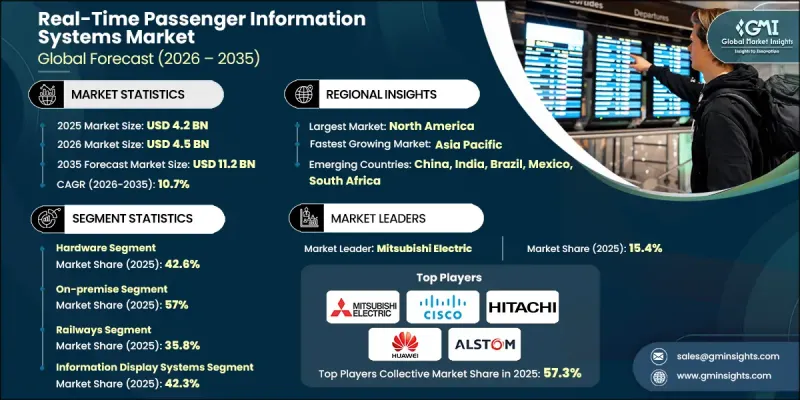
The Global Real-Time Passenger Information Systems Market was valued at USD 4.2 billion in 2025 and is estimated to grow at a CAGR of 10.7% to reach USD 11.2 billion by 2035.
Market growth is driven by rapid urbanization and increasing congestion levels, prompting cities to adopt advanced transit solutions that enhance operational efficiency and reduce delays. Real-time passenger information systems are playing a crucial role in transforming public transportation by delivering accurate, up-to-date travel information that enables passengers to make informed decisions regarding routes, timing, and connectivity. These systems improve the commuter experience by minimizing uncertainty and optimizing travel planning. Additionally, the growing emphasis on integrated mobility solutions is accelerating the adoption of platforms capable of connecting multiple transportation modes into a unified network. As public transit systems evolve, the need for seamless coordination across various transport channels continues to rise. Increasing investments in digital infrastructure and the expansion of connected technologies are further strengthening market demand. With the growing number of digitally engaged commuters, transportation authorities are prioritizing intelligent communication systems that enhance service reliability and efficiency, positioning real-time passenger information systems as a vital component of modern urban mobility ecosystems.
| Market Scope | |
|---|---|
| Start Year | 2025 |
| Forecast Year | 2026-2035 |
| Start Value | $4.2 Billion |
| Forecast Value | $11.2 Billion |
| CAGR | 10.7% |
Public transportation operators and government agencies are continuing to invest in advanced digital frameworks to support rising demand from connected users. The shift toward multimodal transportation networks is further driving the requirement for integrated real-time passenger information systems capable of synchronizing various transit services. At the same time, ongoing advancements in rail systems are being supported through collaborative efforts between technology providers and transportation solution developers, contributing to improved system performance and innovation.
The hardware segment accounted for 42.6% share in 2025 and is expected to grow at a CAGR of 10.6% from 2026 to 2035. This segment forms the backbone of these systems, encompassing essential components such as display units, communication devices, onboard processing systems, and network infrastructure installed across transit environments. These elements ensure the consistent delivery of real-time audio and visual updates, allowing passengers to access reliable travel information throughout their journey. As service expectations increase, transit operators are focusing on deploying durable and high-performance hardware solutions that support long-term operational efficiency.
The on-premise segment held a 57% share in 2025 and is projected to grow at a CAGR of 4.4% through 2035. This dominance is largely attributed to stringent data protection requirements and cybersecurity regulations governing public transportation systems. Transit authorities continue to favor on-premise deployments to maintain control over sensitive data, ensure compliance with regulatory standards, and deliver uninterrupted service across high-demand transit networks.
U.S. Real-Time Passenger Information Systems Market reached USD 1.3 billion in 2025 and is anticipated to grow at a CAGR of 10.8% between 2026 and 2035. Growth in this region is being supported by increasing investments in advanced communication technologies and infrastructure aimed at improving passenger experience across transportation networks. Transit agencies are implementing integrated platforms that provide real-time updates, accurate arrival predictions, and service notifications, enhancing overall system reliability and efficiency.
Key players operating in the Global Real-Time Passenger Information Systems Market include Alstom, Cisco Systems, Hitachi, Huawei Technologies, Indra Sistemas, Mitsubishi Electric, Nokia, Siemens Mobility, Thales, and Wabtec. Companies in the Global Real-Time Passenger Information Systems Market are strengthening their market position through continuous innovation, strategic collaborations, and expansion of digital capabilities. They are investing in advanced software platforms, cloud integration, and data analytics to deliver more accurate and scalable solutions. Partnerships with transit authorities and infrastructure providers are helping companies expand their global footprint and improve system interoperability. Market participants are also focusing on enhancing hardware reliability and integrating emerging technologies such as IoT and AI to optimize performance. In addition, companies are aligning their solutions with regulatory requirements and cybersecurity standards to ensure data protection. Expanding service portfolios and offering customized solutions tailored to specific transit networks are further supporting long-term growth and competitive advantage.
Table of Contents
Chapter 1 Methodology
- 1.1 Research approach
- 1.2 Quality commitments
- 1.2.1 GMI AI policy & data integrity commitment
- 1.3 Research trail & confidence scoring
- 1.3.1 Research trail components
- 1.3.2 Scoring components
- 1.4 Data collection
- 1.4.1 Partial list of primary sources
- 1.5 Data mining sources
- 1.5.1 Paid sources
- 1.6 Base estimates and calculations
- 1.6.1 Base year calculation
- 1.7 Forecast model
- 1.8 Research transparency addendum
Chapter 2 Executive Summary
- 2.1 Industry 360° synopsis
- 2.2 Key market trends
- 2.2.1 Regional
- 2.2.2 Component
- 2.2.3 Mode of Transport
- 2.2.4 Deployment Type
- 2.2.5 Solution
- 2.3 TAM analysis, 2026-2035
- 2.4 CXO perspectives: Strategic imperatives
- 2.4.1 Executive decision points
- 2.4.2 Critical success factors
- 2.5 Future outlook
- 2.6 Strategic recommendations
Chapter 3 Industry Insights
- 3.1 Industry ecosystem analysis
- 3.1.1 Supplier landscape
- 3.1.2 Profit margin
- 3.1.3 Cost structure
- 3.1.4 Value addition at each stage
- 3.1.5 Factor affecting the value chain
- 3.1.6 Disruptions
- 3.2 Industry impact forces
- 3.2.1 Growth drivers
- 3.2.1.1 Increased demand for smart transportation solutions
- 3.2.1.2 Government initiatives for modernizing public transport
- 3.2.1.3 Advancements in communication technologies
- 3.2.1.4 Increasing Focus on Safety and Security
- 3.2.2 Industry pitfalls and challenges
- 3.2.2.1 High implementation and maintenance costs
- 3.2.2.2 Data accuracy and reliability concern
- 3.2.3 Market opportunities
- 3.2.3.1 Expansion of Smart City Initiatives
- 3.2.3.2 Rising Adoption of Mobility-as-a-Service (MaaS)
- 3.2.3.3 Integration of AI and Predictive Analytics
- 3.2.3.4 Modernization of Aging Transit Infrastructure in Developed Markets
- 3.2.1 Growth drivers
- 3.3 Growth potential analysis
- 3.4 Regulatory landscape
- 3.4.1 North America
- 3.4.1.1 Federal Transit Administration (FTA) Public Transit Modernization & Accessibility Standards
- 3.4.1.2 Americans with Disabilities Act (ADA) Passenger Information Accessibility Requirements
- 3.4.1.3 Federal Communications Commission (FCC) Transit Communication Infrastructure Standards
- 3.4.2 Europe
- 3.4.2.1 EU Technical Specification for Interoperability (TSI) Passenger Information Requirements
- 3.4.2.2 EN 50132 & EN 50121 Railway Communication and Display Standards
- 3.4.3 Asia Pacific
- 3.4.3.1 China National Standards for Intelligent Transportation Systems (GB/T Standards)
- 3.4.3.2 India: Ministry of Railways Passenger Information System Guidelines
- 3.4.4 Latin America
- 3.4.4.1 Brazil: ANTT (National Land Transportation Agency) Transit Digital Standards
- 3.4.4.2 Mexico: SCT (Secretariat of Communications and Transportation) Transit Regulations
- 3.4.5 Middle East & Africa
- 3.4.5.1 UAE & Gulf States: Smart Mobility & Intelligent Transport System Policy
- 3.4.5.2 Saudi Arabia: Vision 2030 Smart Transportation & Digital Infrastructure Framework
- 3.4.5.3 African Union (AU): Digital Transport & Smart Mobility Policy Framework
- 3.4.1 North America
- 3.5 Porter's analysis
- 3.6 PESTEL analysis
- 3.7 Technology and innovation landscape
- 3.7.1 Current technological trends
- 3.7.2 Emerging technologies
- 3.8 Pricing trend analysis
- 3.9 Business Models and Monetization Framework
- 3.9.1 Revenue Models
- 3.9.2 Value Chain and Ecosystem
- 3.9.3 Go-to-Market Strategy
- 3.10 Data Governance, Cybersecurity, and System Risk
- 3.10.1 Passenger Data Privacy and Compliance
- 3.10.2 Transit Network and System Security
- 3.10.3 Operational and Service Continuity Risks
- 3.11 System Architecture
- 3.11.1 Multi-layer Passenger Information Delivery Models
- 3.11.2 Multimodal Transit Network Integration and Connectivity
- 3.12 Patent analysis
- 3.13 Threat Landscape
- 3.14 Sustainability and environmental aspects
- 3.14.1 Sustainable Practices in Transit Technology Deployment
- 3.14.2 Energy Efficiency in Display and Communication Infrastructure
Chapter 4 Competitive Landscape, 2025
- 4.1 Introduction
- 4.2 Company market share analysis
- 4.2.1 North America
- 4.2.2 Europe
- 4.2.3 Asia Pacific
- 4.2.4 LATAM
- 4.2.5 MEA
- 4.3 Competitive analysis of major market players
- 4.4 Competitive positioning matrix
- 4.5 Strategic outlook matrix
- 4.6 Key developments
- 4.6.1 Mergers & acquisitions
- 4.6.2 Partnerships & collaborations
- 4.6.3 New product launches
- 4.6.4 Expansion plans and funding
Chapter 5 Market Estimates & Forecast, By Component, 2022 - 2035 ($Mn)
- 5.1 Key trends
- 5.2 Hardware
- 5.2.1 Displays
- 5.2.2 Networking devices
- 5.2.3 Sensors
- 5.2.4 Communication devices
- 5.2.5 Others
- 5.3 Software
- 5.3.1 Data management software
- 5.3.2 Information display software
- 5.4 Services
- 5.4.1 Professional Services
- 5.4.2 Managed Services
Chapter 6 Market Estimates & Forecast, By Mode of Transport, 2022 - 2035 ($Mn)
- 6.1 Key trends
- 6.2 Roadways
- 6.3 Railways
- 6.4 Airways
- 6.5 Waterways
Chapter 7 Market Estimates & Forecast, By Deployment Type, 2022 - 2035 ($Mn)
- 7.1 Key trends
- 7.2 On-premise
- 7.3 Cloud-based
Chapter 8 Market Estimates & Forecast, By Solution, 2022 - 2035 ($Mn)
- 8.1 Key trends
- 8.2 Information Display Systems
- 8.3 Announcement Systems
- 8.4 Emergency Communication Systems
- 8.5 Others
Chapter 9 Market Estimates & Forecast, By Region, 2022 - 2035 ($Mn)
- 9.1 Key trends
- 9.2 North America
- 9.2.1 US
- 9.2.2 Canada
- 9.3 Europe
- 9.3.1 Germany
- 9.3.2 UK
- 9.3.3 France
- 9.3.4 Italy
- 9.3.5 Spain
- 9.3.6 Nordics
- 9.3.7 Russia
- 9.3.8 Norway
- 9.3.9 Denmark
- 9.3.10 Netherlands
- 9.3.11 Belgium
- 9.4 Asia Pacific
- 9.4.1 China
- 9.4.2 India
- 9.4.3 Japan
- 9.4.4 South Korea
- 9.4.5 ANZ
- 9.4.6 Vietnam
- 9.4.7 Indonesia
- 9.4.8 Singapore
- 9.4.9 Malaysia
- 9.4.10 Thailand
- 9.5 Latin America
- 9.5.1 Brazil
- 9.5.2 Mexico
- 9.5.3 Argentina
- 9.6 MEA
- 9.6.1 South Africa
- 9.6.2 Saudi Arabia
- 9.6.3 UAE
Chapter 10 Company Profiles
- 10.1 Global companies
- 10.1.1 Advantech Co. Ltd.
- 10.1.2 Alstom SA
- 10.1.3 Cisco Systems Inc.
- 10.1.4 Cubic Corporation
- 10.1.5 Hitachi, Ltd.
- 10.1.6 Huawei Technologies Co., Ltd.
- 10.1.7 Indra Sistemas SA
- 10.1.8 Mitsubishi Electric Corporation
- 10.1.9 Nokia
- 10.1.10 Siemens Mobility
- 10.1.11 ST Engineering Ltd
- 10.1.12 Thales Group
- 10.1.13 Wabtec Corporation
- 10.2 Regional players
- 10.2.1 Dysten Sp. z o.o.
- 10.2.2 Efftronics Systems Pvt Ltd
- 10.2.3 Icon Multimedia
- 10.2.4 Medha Servo Drives Pvt Ltd
- 10.2.5 r2p Group
- 10.2.6 Teleste Corporation
- 10.2.7 Televic Group
- 10.2.8 Eke-Electronics
- 10.2.9 Quester Tangent
- 10.2.10 Simpleway
- 10.2.11 Passio Technologies

