PUBLISHER: Global Market Insights Inc. | PRODUCT CODE: 2027557

PUBLISHER: Global Market Insights Inc. | PRODUCT CODE: 2027557
Instant Tea Premix Market Opportunity, Growth Drivers, Industry Trend Analysis, and Forecast 2026 - 2035
The Global Instant Tea Premix Market was valued at USD 1.6 billion in 2025 and is estimated to grow at a CAGR of 6.9% to reach USD 3.2 billion by 2035.
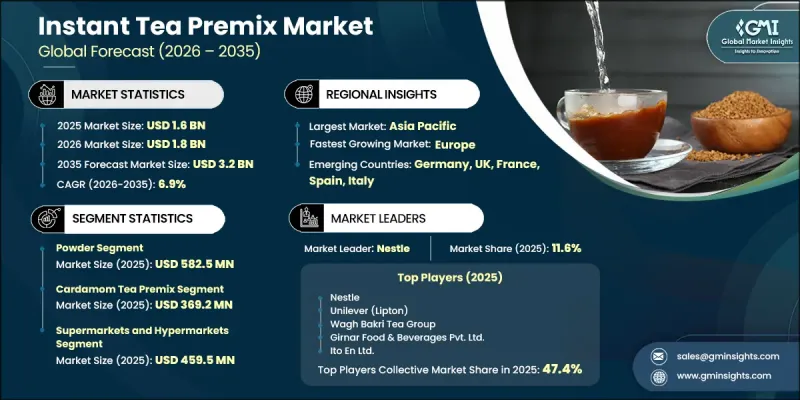
The market is expanding as consumers increasingly shift toward convenient beverage solutions that deliver consistent taste and quick preparation. Instant tea premix products are available in powder or granule formats and are designed to prepare tea instantly by mixing with hot or cold water. These formulations combine tea extracts with ingredients such as sugar, milk solids, and flavoring agents in precise proportions to ensure uniform flavor, aroma, and quality across servings. Growing urbanization, busy lifestyles, and increasing on-the-go consumption habits are strongly influencing demand. Consumers are adopting these products across home, workplace, and travel settings due to their ease of use and portability. Expanding flavor variety and improved packaging formats such as sachets, jars, and refill packs are further enhancing consumer adoption by offering convenience and portion control. Technological advancements in processing, including spray drying and granulation, are improving product stability, preserving natural tea characteristics, and extending shelf life. As a result, instant tea premixes are becoming a widely accepted alternative to traditional tea preparation methods.
| Market Scope | |
|---|---|
| Start Year | 2025 |
| Forecast Year | 2026-2035 |
| Start Value | $1.6 Billion |
| Forecast Value | $3.2 Billion |
| CAGR | 6.9% |
The powder segment accounted for USD 582.5 million in 2025, driven by its ease of mixing, convenient storage, and accurate portion control. While powder formats remain dominant, demand for granulated variants is also rising due to improved flow properties and uniform dosing performance, while paste-based forms are gaining attention for enhanced flavor delivery.
The supermarkets and hypermarkets segment reached USD 459.5 million in 2025. These retail outlets provide consumers with broad product visibility, easy comparison options, and the ability to purchase in bulk quantities, making them a preferred choice for regular household beverage purchases.
North America Instant Tea Premix Market is expected to grow from USD 533.3 million in 2025 to USD 1.1 billion by 2035. Growth in the region is driven by strong consumer preference for convenient beverage formats that ensure consistent taste and quick preparation. Increasing awareness of diverse tea varieties, along with expanding flavor availability through digital retail channels, is further supporting market expansion. The United States continues to lead regional demand due to rising adoption in home consumption and workplace beverage systems, where vending usage is also gradually increasing.
Major companies operating in the Global Instant Tea Premix Market include Nestle, PepsiCo Inc., Unilever (Lipton), Ito En Ltd., Keurig Green Mountain Inc., Girnar Food & Beverages Pvt. Ltd., Wagh Bakri Tea Group, Panama Foods, C. B. Shah & Co. (Tweak), Senso Foods Private Limited, Neel Beverages, Kingherbs Limited, Global Tea Solutions, The Republic of Tea Inc., and Vending Updates India Pvt. Ltd. Companies in the Instant Tea Premix Market are focusing on expanding product portfolios through innovative flavor development and premium positioning strategies. Strong investments are being made in advanced processing technologies to enhance taste retention, solubility, and shelf life. Manufacturers are also strengthening distribution networks by partnering with retail chains, vending operators, and e-commerce platforms to improve product accessibility. Branding initiatives and targeted marketing campaigns are being used to increase consumer engagement and build loyalty. Additionally, companies are adopting sustainable packaging solutions to align with environmental expectations while differentiating their offerings. Continuous product customization and introduction of health-oriented variants are further helping firms capture evolving consumer preferences and strengthen their competitive positioning in the global market.
Table of Contents
Chapter 1 Methodology & Scope
- 1.1 Market scope and definition
- 1.2 Research design
- 1.2.1 Research approach
- 1.2.2 Data collection methods
- 1.3 Data mining sources
- 1.3.1 Global
- 1.3.2 Regional/Country
- 1.4 Base estimates and calculations
- 1.4.1 Base year calculation
- 1.4.2 Key trends for market estimation
- 1.5 Primary research and validation
- 1.5.1 Primary sources
- 1.6 Forecast model
- 1.7 Research assumptions and limitations
Chapter 2 Executive Summary
- 2.1 Industry 360° synopsis
- 2.2 Key market trends
- 2.2.1 Form
- 2.2.2 Product Type
- 2.2.3 Distribution Channel
- 2.2.4 Regional
- 2.3 TAM Analysis, 2026-2035
- 2.4 CXO perspectives: Strategic imperatives
- 2.5 Future outlook and strategic recommendations
Chapter 3 Industry Insights
- 3.1 Industry ecosystem analysis
- 3.1.1 Supplier landscape
- 3.1.2 Profit margin
- 3.1.3 Value addition at each stage
- 3.1.4 Factor affecting the value chain
- 3.1.5 Disruptions
- 3.2 Industry impact forces
- 3.2.1 Growth drivers
- 3.2.1.1 Rising demand for quick beverage preparation solutions
- 3.2.1.2 Urban lifestyles encouraging convenient hot drink consumption patterns
- 3.2.1.3 Expanding flavor varieties appealing to diverse preferences
- 3.2.2 Pitfalls/challenge
- 3.2.2.1 High sugar perception affecting health-conscious consumers negatively
- 3.2.2.2 Taste variation compared to traditionally brewed tea methods
- 3.2.3 Opportunities
- 3.2.3.1 Development of low sugar and herbal blends options
- 3.2.3.2 Improved packaging enhancing shelf life convenience and storage
- 3.2.1 Growth drivers
- 3.3 Growth potential analysis
- 3.4 Regulatory landscape
- 3.4.1 North America
- 3.4.2 Europe
- 3.4.3 Asia Pacific
- 3.4.4 Latin America
- 3.4.5 Middle East & Africa
- 3.5 Porter’s analysis
- 3.6 PESTEL analysis
- 3.7 Technology and innovation landscape
- 3.7.1 Current technological trends
- 3.7.2 Emerging technologies
- 3.8 Price trends
- 3.8.1 By region
- 3.8.2 By product type
- 3.9 Future market trends
- 3.10 Patent landscape
- 3.11 Trade statistics (HS code)
- 3.11.1 Major importing countries
- 3.11.2 Major exporting countries
- 3.12 Sustainability and environmental aspects
- 3.12.1 Sustainable practices
- 3.12.2 Waste reduction strategies
- 3.12.3 Energy efficiency in production
- 3.12.4 Eco-friendly initiatives
- 3.13 Carbon footprint consideration
Chapter 4 Competitive Landscape, 2025
- 4.1 Introduction
- 4.2 Company market share analysis
- 4.2.1 By region
- 4.2.1.1 North America
- 4.2.1.2 Europe
- 4.2.1.3 Asia Pacific
- 4.2.1.4 LATAM
- 4.2.1.5 MEA
- 4.2.1 By region
- 4.3 Company matrix analysis
- 4.4 Competitive analysis of major market players
- 4.5 Competitive positioning matrix
- 4.6 Key developments
- 4.6.1 Mergers & acquisitions
- 4.6.2 Partnerships & collaborations
- 4.6.3 New product launches
- 4.6.4 Expansion plans
Chapter 5 Market Estimates and Forecast, By Form, 2022-2035 (USD Million) (Kilo Tons)
- 5.1 Key trends
- 5.2 Powder
- 5.3 Paste
- 5.4 Granules
Chapter 6 Market Estimates and Forecast, By Product Type, 2022-2035 (USD Million) (Kilo Tons)
- 6.1 Key trends
- 6.2 Cardamom tea premix
- 6.3 Ginger tea premix
- 6.4 Masala tea premix
- 6.5 Lemon tea premix
- 6.6 Lemongrass tea premix
- 6.7 Other tea premix
Chapter 7 Market Estimates and Forecast, By Distribution Channel, 2022-2035 (USD Million) (Kilo Tons)
- 7.1 Key trends
- 7.2 Supermarkets & hypermarkets
- 7.3 Specialty stores
- 7.4 Discount stores
- 7.5 Convenience stores
- 7.6 E-commerce
- 7.7 Others
Chapter 8 Market Estimates and Forecast, By Region, 2022-2035 (USD Million) (Kilo Tons)
- 8.1 Key trends
- 8.2 North America
- 8.2.1 U.S.
- 8.2.2 Canada
- 8.3 Europe
- 8.3.1 Germany
- 8.3.2 UK
- 8.3.3 France
- 8.3.4 Spain
- 8.3.5 Italy
- 8.3.6 Rest of Europe
- 8.4 Asia Pacific
- 8.4.1 China
- 8.4.2 India
- 8.4.3 Japan
- 8.4.4 Australia
- 8.4.5 South Korea
- 8.4.6 Rest of Asia Pacific
- 8.5 Latin America
- 8.5.1 Brazil
- 8.5.2 Mexico
- 8.5.3 Argentina
- 8.5.4 Rest of Latin America
- 8.6 Middle East and Africa
- 8.6.1 Saudi Arabia
- 8.6.2 South Africa
- 8.6.3 UAE
- 8.6.4 Rest of Middle East and Africa
Chapter 9 Company Profiles
- 9.1 Panama Foods.
- 9.2 C. B. Shah & Co. (Tweak)
- 9.3 Nestle
- 9.4 Girnar Food & Beverages Pvt. Ltd.
- 9.5 Ito En Ltd.
- 9.6 Keurig Green Mountain Inc.
- 9.7 Senso Foods Private Limited.
- 9.8 PepsiCo Inc.
- 9.9 Neel Beverages
- 9.10 Kingherbs limited
- 9.11 Global Tea Solutions
- 9.12 The Republic of Tea Inc.
- 9.13 Unilever (Lipton)
- 9.14 Vending Updates India Pvt. Ltd.
- 9.15 Wagh Bakri Tea Group

