PUBLISHER: Global Market Insights Inc. | PRODUCT CODE: 2027565

PUBLISHER: Global Market Insights Inc. | PRODUCT CODE: 2027565
Electric Household Appliances Market Opportunity, Growth Drivers, Industry Trend Analysis, and Forecast 2026 - 2035
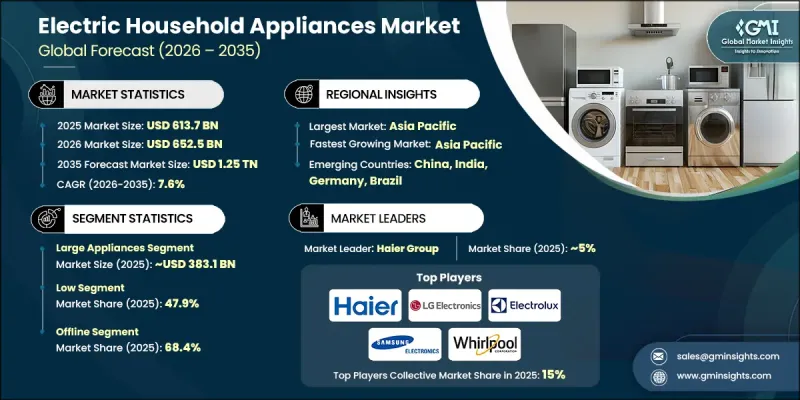
The Global Electric Household Appliances Market was valued at USD 613.7 billion in 2025 and is estimated to grow at a CAGR of 7.6% to reach USD 1.25 trillion by 2035.
Growth in the electric household appliances market is supported by increasing adoption of smart home technologies that enable seamless connectivity and remote monitoring. Manufacturers are focusing on integrating advanced features such as predictive maintenance, personalized settings, and enhanced automation to improve user experience. Energy efficiency remains a key priority, as companies develop appliances that align with sustainability goals while offering long-term cost savings to consumers. The incorporation of advanced sensors and intelligent systems is improving performance, durability, and operational efficiency. In addition, rising urbanization is influencing product design, leading to the development of compact, multifunctional appliances suited for modern living spaces. Changing consumer preferences toward convenience, connectivity, and environmentally conscious products continue to drive innovation, positioning the global electric household appliances market as a dynamic and rapidly evolving industry.
| Market Scope | |
|---|---|
| Start Year | 2025 |
| Forecast Year | 2026-2035 |
| Start Value | $613.7 Billion |
| Forecast Value | $1.25 Trillion |
| CAGR | 7.6% |
The electric household appliances market is advancing as manufacturers continue to enhance product capabilities and performance. Ongoing innovation in smart technologies and energy-efficient solutions is enabling companies to meet evolving consumer expectations while maintaining competitive differentiation. These developments are supporting increased adoption across both developed and emerging markets.
The large appliances segment generated USD 383.1 billion in 2025 and is expected to grow at a CAGR of 7.4% from 2026 to 2035. This segment holds the largest share of the electric household appliances market due to the essential nature of these products in everyday life. Demand remains steady as consumers prioritize upgrading to more efficient and technologically advanced appliances. Continuous innovation, including integration of smart features and energy optimization, is further strengthening growth within this segment.
The low-price segment accounted for 47.9% share in 2025, making it a leading category within the electric household appliances market. This segment is driven by demand from cost-conscious consumers, particularly in developing regions, where affordability and durability are key purchasing factors. High sales volumes are supported by the widespread need for basic household appliances. Intense competition among manufacturers in this segment is driving a strong focus on cost efficiency, streamlined operations, and effective supply chain management.
United States Electric Household Appliances Market reached USD 91 billion in 2025 and is expected to grow at a CAGR of 7.4% from 2026 to 2035, supported by increasing consumer spending, strong demand for smart and convenient home solutions, and the expansion of digital retail channels. Technological advancements, including AI integration and connected appliance ecosystems, are further encouraging adoption. Growing interest in sustainable products and energy-efficient solutions, combined with evolving consumer lifestyles and increased home improvement activities, is contributing to continued market expansion.
Key companies operating in the Global Electric Household Appliances Market include BSH Hausgerate, Electrolux, Gree Electric Appliances, Haier Group, Hitachi, LG Electronics, Midea Group, Miele, Panasonic, Robert Bosch, Samsung Electronics, Sharp, Siemens, Walton Group, and Whirlpool. Companies in the Global Electric Household Appliances Market are adopting a range of strategic initiatives to strengthen their market position and expand their global footprint. A major focus is placed on innovation, with investments in smart technologies, automation, and energy-efficient solutions to enhance product performance and user experience. Manufacturers are forming strategic partnerships to expand distribution networks and improve market reach. Product diversification and the introduction of multifunctional appliances are helping companies cater to evolving consumer needs. Businesses are also emphasizing sustainability by developing eco-friendly products and complying with energy regulations. Strengthening e-commerce capabilities and improving supply chain efficiency are enabling better product availability. Additionally, companies are enhancing after-sales services and customer support to build long-term brand loyalty and maintain a competitive edge.
Table of Contents
Chapter 1 Methodology & Scope
- 1.1 Market scope & definitions
- 1.2 Research design
- 1.2.1 Research approach
- 1.2.2 Data collection methods
- 1.3 Base estimates and calculations
- 1.3.1 Base year calculation
- 1.3.2 Market estimates & forecasts parameters
- 1.4 Forecast Model
- 1.4.1 Key trends for market estimates
- 1.4.2 Quantified market impact analysis
- 1.4.2.1 Mathematical impact of growth parameters on forecast
- 1.4.3 Scenario analysis framework
- 1.5 Primary research and validation
- 1.5.1 Some of the primary sources (but not limited to)
- 1.6 Data mining sources
- 1.6.1 Paid Sources
- 1.7 Primary research and validation
- 1.7.1 Primary sources
- 1.8 Research Trail & confidence scoring
- 1.8.1 Research trail components
- 1.8.2 Scoring components
- 1.9 Research transparency addendum
- 1.9.1 Source attribution framework
- 1.9.2 Quality assurance metrics
- 1.9.3 Our commitment to trust
- 1.10 Market Definitions
Chapter 2 Executive Summary
- 2.1 Industry 360° synopsis
- 2.2 Key market trends
- 2.2.1 Regional
- 2.2.2 Product type
- 2.2.3 Price
- 2.2.4 End Use
- 2.2.5 Distribution Channel
Chapter 3 Industry Insights
- 3.1 Industry ecosystem analysis
- 3.1.1 Raw material suppliers
- 3.1.2 Manufacturing footprint by region
- 3.1.3 Distribution network structure
- 3.1.4 Profit margin analysis by value chain stage
- 3.1.5 Value addition at each stage
- 3.1.6 Factor affecting the value chain
- 3.2 Industry impact forces
- 3.2.1 Growth drivers
- 3.2.1.1 Technological advancements
- 3.2.1.2 Urbanization & changing lifestyles
- 3.2.1.3 Rising disposable income
- 3.2.2 Pitfalls & challenges
- 3.2.2.1 High initial costs
- 3.2.2.2 Regulatory complexity
- 3.2.3 Opportunities
- 3.2.3.1 Smart & connected appliances
- 3.2.3.2 Energy-efficient & sustainable solutions
- 3.2.1 Growth drivers
- 3.3 Growth potential analysis
- 3.4 Future market trends
- 3.5 Technology and innovation landscape
- 3.5.1 Current technological trends
- 3.5.2 Emerging technologies
- 3.6 Price trends
- 3.6.1 By region
- 3.6.2 By product
- 3.6.3 Historical price trend analysis
- 3.6.4 Pricing strategy by player type
- 3.7 Regulatory landscape
- 3.7.1 Global energy efficiency standards landscape
- 3.7.2 Regional regulatory frameworks
- 3.7.2.1 North America
- 3.7.2.2 Europe
- 3.7.2.3 Asia Pacific
- 3.7.2.4 Latin America
- 3.7.2.5 Middle East & Africa
- 3.7.3 Safety & product standards
- 3.7.4 Environmental & recycling regulations
- 3.7.5 Trade policies & tariff landscape
- 3.7.6 Emerging regulations
- 3.8 Trade data analysis (driven by primary research) - (HS Code - 8509.90)
- 3.8.1 Global import/export volume & value trends
- 3.8.2 Key trade corridors & partners
- 3.8.3 Tariff structure & impact by region
- 3.8.4 Trade balance analysis by country & product category
- 3.8.5 Impact of trade agreements
- 3.9 Impact of AI & Generative AI on the Market
- 3.9.1 GenAI use cases & adoption roadmap by segment
- 3.9.2 AI in product development & personalization
- 3.9.3 AI in manufacturing & supply chain optimization
- 3.9.4 Risks, limitations & regulatory considerations
- 3.10 Supply chain analysis
- 3.10.1 Global component sourcing dynamics
- 3.10.2 Key component suppliers by region
- 3.10.3 Manufacturing & Assembly locations
- 3.10.4 Logistics & distribution infrastructure
- 3.10.5 Supply chain disruption risks & resilience
- 3.10.6 Nearshoring & reshoring trends
- 3.10.7 Critical material dependencies
- 3.11 Distribution infrastructure & channel penetration landscape
- 3.11.1 Channel coverage by region & format (modern vs traditional trade)
- 3.11.2 Last-mile infrastructure & delivery models
- 3.11.3 Installation & after-sales service network density
- 3.11.4 E-commerce fulfillment infrastructure by region
- 3.12 Porter's analysis
- 3.13 PESTEL analysis
Chapter 4 Competitive Landscape, 2025
- 4.1 Introduction
- 4.2 Company market share analysis
- 4.2.1 By Region
- 4.2.1.1 North America
- 4.2.1.2 Europe
- 4.2.1.3 Asia Pacific
- 4.2.1.4 Latin America
- 4.2.1.5 Middle East & Africa
- 4.2.1 By Region
- 4.3 Company matrix analysis
- 4.4 Competitive analysis of major market players
- 4.5 Competitive positioning matrix
- 4.6 Key developments
- 4.6.1 Mergers & acquisitions
- 4.6.2 Partnerships & collaborations
- 4.6.3 New product launches
- 4.6.4 Expansion plans
Chapter 5 Market Estimates & Forecast, By Type, 2022 - 2035, (USD Billion) (Million Units)
- 5.1 Key trends
- 5.2 Large appliances
- 5.2.1 Refrigerators
- 5.2.1.1 French door
- 5.2.1.2 Side-by-side
- 5.2.1.3 Top-mount
- 5.2.1.4 Mini/compact refrigerators
- 5.2.2 Cooking appliances
- 5.2.2.1 Electric ranges
- 5.2.2.2 Built-in ovens
- 5.2.2.3 Induction cooktops
- 5.2.2.4 Microwave ovens
- 5.2.2.5 Combination ovens
- 5.2.3 Laundry appliances
- 5.2.3.1 Front-load washers
- 5.2.3.2 Top-load washers
- 5.2.3.3 Washer-dryer combos
- 5.2.3.4 Dryers
- 5.2.3.5 Styler/garment care systems
- 5.2.4 Cleaning appliances
- 5.2.4.1 Robot vacuum cleaners
- 5.2.4.2 Cordless stick vacuums
- 5.2.4.3 Canister vacuums
- 5.2.4.4 Steam cleaners/mops
- 5.2.5 Climate control appliances
- 5.2.5.1 Air conditioners
- 5.2.5.2 Air purifiers
- 5.2.5.3 Dehumidifiers
- 5.2.5.4 Electric heaters
- 5.2.5.5 Air quality management systems
- 5.2.1 Refrigerators
- 5.3 Small appliances
- 5.3.1 Food preparation appliances
- 5.3.1.1 Electric rice cookers
- 5.3.1.2 Coffee makers & espresso machines
- 5.3.1.3 Blenders & mixers
- 5.3.1.4 Toasters & sandwich makers
- 5.3.1.5 Electric kettles
- 5.3.1.6 Multi-cookers & pressure cookers
- 5.3.1.7 Food steamers
- 5.3.1.8 Others
- 5.3.2 Personal care appliances
- 5.3.2.1 Hair dryers
- 5.3.2.2 Hair straighteners & curling irons
- 5.3.2.3 Electric shavers
- 5.3.2.4 Others
- 5.3.3 Water treatment appliances
- 5.3.3.1 Water purifiers
- 5.3.3.2 Water dispensers (hot & cold)
- 5.3.3.3 Others
- 5.3.3.4 Other small appliances
- 5.3.1 Food preparation appliances
Chapter 6 Market Estimates & Forecast, By Price, 2022 - 2035, (USD Billion) (Million Units)
- 6.1 Key trends
- 6.2 Low
- 6.3 Medium
- 6.4 High
Chapter 7 Market Estimates & Forecast, By End Use, 2022 - 2035, (USD Billion) (Million Units)
- 7.1 Key trends
- 7.2 Residential
- 7.2.1 Single-person households
- 7.2.2 Nuclear families
- 7.2.3 Multi-generational households
- 7.2.4 Affluent/high-net-worth households
- 7.3 Commercial
- 7.3.1 Hospitality (hotels, resorts)
- 7.3.2 Food service (restaurants, cafes)
- 7.3.3 Office buildings
- 7.3.4 Healthcare facilities
- 7.3.5 Educational institutions
- 7.3.6 Government/public buildings
Chapter 8 Market Estimates & Forecast, By Distribution Channel, 2022 - 2035, (USD Billion) (Million Units)
- 8.1 Key trends
- 8.2 Online
- 8.2.1 E-commerce
- 8.2.2 Company website
- 8.3 Offline
- 8.3.1 Mega retail stores
- 8.3.2 Supermarket/hypermarket stores
- 8.3.3 Others
Chapter 9 Market Estimates & Forecast, By Region, 2022 - 2035, (USD Billion) (Million Units)
- 9.1 Key trends
- 9.2 North America
- 9.2.1 U.S.
- 9.2.2 Canada
- 9.3 Europe
- 9.3.1 Germany
- 9.3.2 UK
- 9.3.3 France
- 9.3.4 Italy
- 9.3.5 Spain
- 9.4 Asia Pacific
- 9.4.1 China
- 9.4.2 India
- 9.4.3 Japan
- 9.4.4 South Korea
- 9.4.5 Australia
- 9.5 Latin America
- 9.5.1 Brazil
- 9.5.2 Mexico
- 9.5.3 Argentina
- 9.6 MEA
- 9.6.1 Saudi Arabia
- 9.6.2 UAE
- 9.6.3 South Africa
Chapter 10 Company Profiles
- 10.1 BSH Hausgerate
- 10.2 Electrolux
- 10.3 Gree Electric Appliances
- 10.4 Haier Group
- 10.5 Hitachi
- 10.6 LG Electronics
- 10.7 Midea Group
- 10.8 Miele
- 10.9 Panasonic
- 10.10 Robert Bosch
- 10.11 Samsung Electronics
- 10.12 Sharp
- 10.13 Siemens
- 10.14 Walton Group
- 10.15 Whirlpool

