PUBLISHER: Global Market Insights Inc. | PRODUCT CODE: 2027571

PUBLISHER: Global Market Insights Inc. | PRODUCT CODE: 2027571
Poultry Feed Market Opportunity, Growth Drivers, Industry Trend Analysis, and Forecast 2026 - 2035
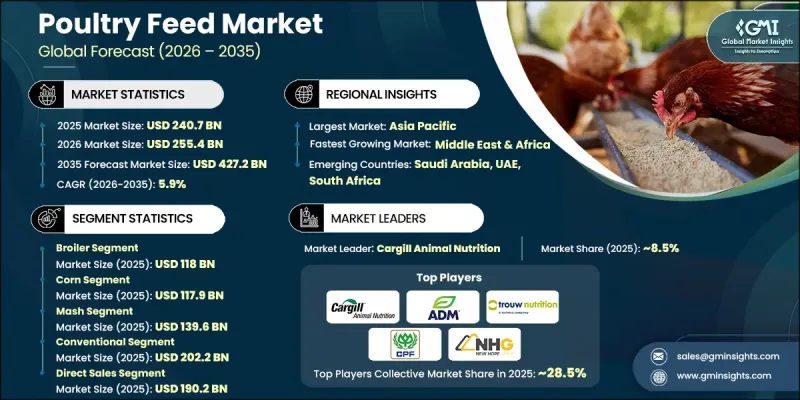
The Global Poultry Feed Market was valued at USD 240.7 billion in 2025 and is estimated to grow at a CAGR of 5.9% to reach USD 427.2 billion by 2035.
The global poultry feed industry is witnessing expansion driven by rising demand for protein-rich diets and growing awareness of optimized animal nutrition. Poultry feed formulations, typically composed of grains, cereals, and protein-rich ingredients, play a vital role in supporting the growth, health, and productivity of poultry species such as chickens, turkeys, and ducks. Increasing global consumption of poultry meat and eggs is a major factor fueling feed demand, particularly in developing economies where dietary patterns are shifting toward affordable animal protein. In response, manufacturers are developing advanced feed formulations enriched with essential nutrients and functional additives to improve feed efficiency, immunity, and overall livestock performance. The industry is also experiencing a shift toward alternative protein sources and sustainable feed ingredients as environmental concerns gain importance. Investments in feed research and formulation technologies are helping reduce production costs while improving nutritional outcomes. Rising poultry production, combined with technological advancements in feed manufacturing, continues to strengthen the long-term growth outlook of the market.
| Market Scope | |
|---|---|
| Start Year | 2025 |
| Forecast Year | 2026-2035 |
| Start Value | $240.7 Billion |
| Forecast Value | $427.2 Billion |
| CAGR | 5.9% |
The broiler segment was valued at USD 118 billion in 2025 and is expected to grow at a CAGR of 5.6% through 2035. This segment remains a key contributor to market growth due to sustained demand for poultry meat and the emphasis on rapid growth performance and feed efficiency in broiler production systems.
The mash feed segment accounted for USD 139.6 billion in 2025, representing a 58% market share, and is projected to grow at a CAGR of 5.4% during the forecast period. Mash feed is widely adopted due to its simple production process, cost-effectiveness, and suitability for small and medium-scale farming operations. Pellet feed is also gaining traction as it enhances feed intake, reduces wastage, and improves feed conversion efficiency in intensive poultry farming systems.
North America Poultry Feed Market was valued at USD 68.6 billion in 2025. The region benefits from advanced feed manufacturing infrastructure, large-scale poultry farming operations, and a strong focus on optimizing animal health and feed efficiency. The United States remains a key market due to high poultry consumption, vertically integrated production systems, and widespread use of scientifically formulated compound feed. Continuous improvements in feed formulation and production technologies further support market expansion across the region.
Key companies operating in the Global Poultry Feed Market include Nutreco (Trouw Nutrition), Cargill Animal Nutrition, ADM Animal Nutrition, Charoen Pokphand Foods (CP Foods), ForFarmers, Land O'Lakes Purina Feed, New Hope Group, Perdue Farms, Tyson Foods, Wenger Feeds, Zeeland Farm Services, and others. Companies in the poultry feed market are focusing on strategic initiatives to strengthen their market position and enhance competitiveness. A major emphasis is placed on research and development to improve feed formulations that support better growth performance, immunity, and feed conversion ratios. Manufacturers are increasingly incorporating alternative proteins, enzymes, amino acids, and probiotics to enhance nutritional efficiency and sustainability. Strategic partnerships with raw material suppliers and livestock producers are helping strengthen supply chain stability and improve product consistency. Companies are also investing in advanced manufacturing technologies to increase production efficiency and reduce operational costs. Expansion into emerging markets is supporting geographic diversification and revenue growth.
Table of Contents
Chapter 1 Methodology
- 1.1 Market scope and definition
- 1.2 Research design
- 1.2.1 Research approach
- 1.2.2 Data collection methods
- 1.3 Data mining sources
- 1.3.1 Global
- 1.3.2 Regional/Country
- 1.4 Base estimates and calculations
- 1.4.1 Base year calculation
- 1.4.2 Key trends for market estimation
- 1.5 Primary research and validation
- 1.5.1 Primary sources
- 1.6 Forecast model
- 1.7 Research assumptions and limitations
Chapter 2 Executive Summary
- 2.1 Industry 360° synopsis
- 2.2 Key market trends
- 2.2.1 Regional
- 2.2.2 Type
- 2.2.3 Source
- 2.2.4 Form
- 2.2.5 Nature
- 2.2.6 Sales Channel
- 2.3 TAM Analysis, 2026-2035
- 2.4 CXO perspectives: Strategic imperatives
Chapter 3 Industry Insights
- 3.1 Industry ecosystem analysis
- 3.1.1 Supplier Landscape
- 3.1.2 Profit Margin
- 3.1.3 Value addition at each stage
- 3.1.4 Factor affecting the value chain
- 3.1.5 Disruptions
- 3.2 Industry impact forces
- 3.2.1 Growth drivers
- 3.2.2 Industry pitfalls and challenges
- 3.2.3 Market opportunities
- 3.3 Growth potential analysis
- 3.4 Regulatory landscape
- 3.4.1 North America
- 3.4.2 Europe
- 3.4.3 Asia Pacific
- 3.4.4 Latin America
- 3.4.5 Middle East & Africa
- 3.5 Porter's analysis
- 3.6 PESTEL analysis
- 3.7 Price trends
- 3.7.1 By region
- 3.7.2 By product
- 3.8 Future market trends
- 3.9 Technology and Innovation landscape
- 3.9.1 Current technological trends
- 3.9.2 Emerging technologies
- 3.10 Patent Landscape
- 3.11 Trade statistics
- 3.11.1 Major importing countries
- 3.11.2 Major exporting countries
- 3.12 Sustainability and Environmental Aspects
- 3.12.1 Sustainable Practices
- 3.12.2 Waste Reduction Strategies
- 3.12.3 Energy Efficiency in Production
- 3.12.4 Eco-friendly Initiatives
- 3.13 Carbon Footprint Considerations
Chapter 4 Competitive Landscape, 2025
- 4.1 Introduction
- 4.2 Company market share analysis
- 4.2.1 By region
- 4.2.1.1 North America
- 4.2.1.2 Europe
- 4.2.1.3 Asia Pacific
- 4.2.1.4 LATAM
- 4.2.1.5 MEA
- 4.2.1 By region
- 4.3 Company matrix analysis
- 4.4 Competitive analysis of major market players
- 4.5 Competitive positioning matrix
- 4.6 Key developments
- 4.6.1 Mergers & acquisitions
- 4.6.2 Partnerships & collaborations
- 4.6.3 New Product Launches
- 4.6.4 Expansion Plans
Chapter 5 Market Estimates and Forecast, By Type, 2022- 2035 (USD Billion, Kilo Tons)
- 5.1 Key trends
- 5.2 Starter
- 5.3 Broiler
- 5.4 Layer
- 5.5 Others
Chapter 6 Market Estimates and Forecast, By Source, 2022 - 2035 (USD Billion, Kilo Tons)
- 6.1 Key trends
- 6.2 Corn
- 6.3 Wheat
- 6.4 Soybean
- 6.5 Others
Chapter 7 Market Estimates and Forecast, By Form, 2022 - 2035 (USD Billion, Kilo Tons)
- 7.1 Key trends
- 7.2 Mash
- 7.3 Pellet
- 7.4 Crumble
Chapter 8 Market Estimates and Forecast, By Nature, 2022 - 2035 (USD Billion, Kilo Tons)
- 8.1 Key trends
- 8.2 Organic
- 8.3 Conventional
Chapter 9 Market Estimates and Forecast, By Sales Channel, 2022 - 2035 (USD Billion, Kilo Tons)
- 9.1 Key trends
- 9.2 Direct Sales
- 9.3 Indirect Sales
Chapter 10 Market Estimates and Forecast, By Region, 2022 - 2035 (USD Billion, Kilo Tons)
- 10.1 Key trends
- 10.2 North America
- 10.2.1 U.S.
- 10.2.2 Canada
- 10.3 Europe
- 10.3.1 Germany
- 10.3.2 UK
- 10.3.3 France
- 10.3.4 Italy
- 10.3.5 Spain
- 10.3.6 Rest of Europe
- 10.4 Asia Pacific
- 10.4.1 China
- 10.4.2 India
- 10.4.3 Japan
- 10.4.4 Australia
- 10.4.5 South Korea
- 10.4.6 Rest of Asia Pacific
- 10.5 Latin America
- 10.5.1 Brazil
- 10.5.2 Mexico
- 10.5.3 Argentina
- 10.5.4 Rest of Latin America
- 10.6 Middle East & Africa
- 10.6.1 Saudi Arabia
- 10.6.2 South Africa
- 10.6.3 UAE
- 10.6.4 Rest of Middle East & Africa
Chapter 11 Company Profiles
- 11.1 ADM Animal Nutrition
- 11.2 Cargill Animal Nutrition
- 11.3 Charoen Pokphand Foods (CP Foods)
- 11.4 ForFarmers
- 11.5 Land O'Lakes Purina Feed
- 11.6 New Hope Group
- 11.7 Nutreco (Trouw Nutrition)
- 11.8 Perdue Farms
- 11.9 Tyson Foods
- 11.10 Wenger Feeds
- 11.11 Zeeland Farm Services

