PUBLISHER: Global Market Insights Inc. | PRODUCT CODE: 2027572

PUBLISHER: Global Market Insights Inc. | PRODUCT CODE: 2027572
Edible Packaging Market Opportunity, Growth Drivers, Industry Trend Analysis, and Forecast 2026 - 2035
The Global Edible Packaging Market was valued at USD 726.6 million in 2025 and is estimated to grow at a CAGR of 6.3% to reach USD 1.3 billion by 2035.
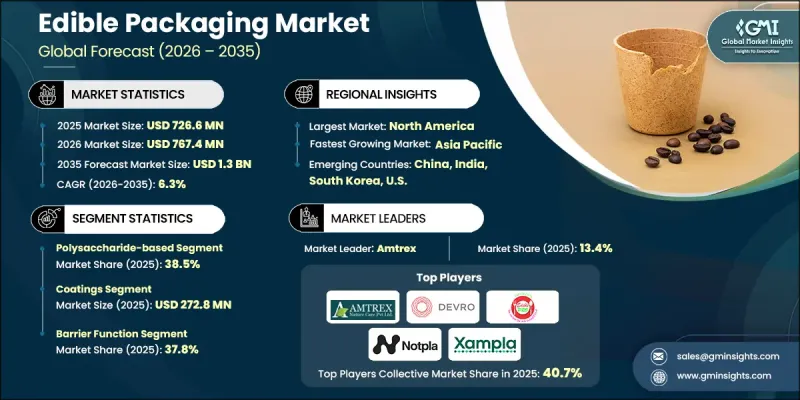
The market growth is supported by the increasing shift toward sustainable and biodegradable packaging solutions, along with the rapid expansion of the ready-to-eat and on-the-go food segment. Continuous innovation in edible films, coatings, and water-soluble wrapping technologies is also strengthening adoption across multiple food applications. In parallel, stricter global regulations aimed at reducing single-use plastic consumption are accelerating the transition toward eco-friendly packaging alternatives. Growing awareness among consumers regarding environmental impact is further encouraging brands to adopt plant-based edible materials as substitutes for conventional plastics. The market is also benefiting from advancements in material science, which are improving barrier performance, texture stability, and shelf-life protection in edible formats. Rising demand from foodservice providers, packaged food manufacturers, and quick-service restaurants is reinforcing commercial deployment. Overall, the market is evolving steadily as sustainability-driven packaging innovation becomes a central focus for global food supply chains and regulatory frameworks.
| Market Scope | |
|---|---|
| Start Year | 2025 |
| Forecast Year | 2026-2035 |
| Start Value | $726.6 Million |
| Forecast Value | $1.3 Billion |
| CAGR | 6.3% |
The protein-based segment is expected to register strong growth at a CAGR of 8% during the forecast period. This expansion is supported by increasing utilization of whey, soy, and gelatin-derived materials in edible films and capsule systems, which provide enhanced mechanical strength, barrier efficiency, and functional performance. Ongoing formulation advancements are enabling the development of customized packaging solutions tailored for premium food products, functional foods, and convenience-based consumption formats, thereby accelerating adoption across global markets.
The barrier function segment held a 37.8% share in 2025. This segment is widely used across dairy products, bakery goods, confectionery items, and fresh produce applications due to its ability to provide protection against moisture, oxygen, and oil migration. These properties help extend product shelf life while maintaining food quality and safety. Strong demand from retail channels, foodservice operations, and online food delivery platforms continues to reinforce the dominance of this segment, especially as sustainability requirements and regulatory compliance standards become more stringent.
North America Edible Packaging Market accounted for a 46.2% share in 2025. Market growth in the region is driven by increasing regulatory pressure to reduce single-use plastic consumption, alongside rising corporate sustainability commitments targeting net-zero waste outcomes. The region is witnessing wider adoption of edible packaging formats across packaged snacks, condiments, takeaway meals, and online food delivery services. Government-backed initiatives and industry programs in the United States and Canada are also encouraging the adoption of biodegradable and non-plastic packaging alternatives, particularly within foodservice and grocery distribution channels. Growing investments in pilot projects and regulatory frameworks are further strengthening the regional transition toward sustainable packaging systems.
Key companies operating in the Global Edible Packaging Market include Sunpack, Mantrose, EdiblePro, Tsukioka, Notpla, Contibelt, Devro, Xampla, Evoware, Glanbia, Sorbos, Edible Cutlery, Perfetta, Incredible Eats, FlexSea, and Amtrex. Companies in the Edible Packaging Market are strengthening their market position through continuous investment in material innovation and product diversification aimed at improving functionality and scalability. Many players are focusing on advancing bio-based film technologies and enhancing barrier properties to improve performance across different food categories. Strategic collaborations with food manufacturers and quick-service restaurant chains are enabling faster commercialization and broader adoption of edible packaging solutions. Firms are also expanding research and development activities to improve taste neutrality, structural stability, and moisture resistance in edible materials. In addition, companies are investing in sustainable sourcing of raw materials and improving production efficiency to reduce overall costs.
Table of Contents
Chapter 1 Methodology and Scope
- 1.1 Market scope and definition
- 1.2 Research design
- 1.2.1 Research approach
- 1.2.2 Data collection methods
- 1.3 Data mining sources
- 1.3.1 Global
- 1.3.2 Regional/Country
- 1.4 Base estimates and calculations
- 1.4.1 Base year calculation
- 1.4.2 Key trends for market estimation
- 1.5 Primary research and validation
- 1.5.1 Primary sources
- 1.6 Forecast model
- 1.7 Research assumptions and limitations
Chapter 2 Executive Summary
- 2.1 Industry 360° synopsis, 2022 - 2035
- 2.2 Key market trends
- 2.2.1 Material type trends
- 2.2.2 Packaging format trends
- 2.2.3 Functionality trends
- 2.2.4 Processing technology trends
- 2.2.5 Application trends
- 2.2.6 End-user industry trends
- 2.2.7 Regional trends
- 2.3 TAM Analysis, 2026-2035
- 2.4 CXO perspectives: Strategic imperatives
Chapter 3 Industry Insights
- 3.1 Industry ecosystem analysis
- 3.1.1 Supplier Landscape
- 3.1.2 Profit Margin
- 3.1.3 Cost structure
- 3.1.4 Value addition at each stage
- 3.1.5 Factor affecting the value chain
- 3.1.6 Disruptions
- 3.2 Industry impact forces
- 3.2.1 Growth drivers
- 3.2.1.1 Rising demand for sustainable and biodegradable packaging solutions
- 3.2.1.2 Expansion of foodservice and on-the-go packaged food sectors
- 3.2.1.3 Regulatory push against single-use plastics in Europe and North America
- 3.2.1.4 Innovations in edible films, coatings, and water-soluble wraps
- 3.2.1.5 Growing consumer preference for eco-friendly and zero-waste products
- 3.2.2 Industry pitfalls and challenges
- 3.2.2.1 High production costs compared to conventional packaging
- 3.2.2.2 Limited shelf life affecting storage and distribution
- 3.2.3 Market opportunities
- 3.2.3.1 Incorporation of functional ingredients like vitamins or probiotics
- 3.2.3.2 Partnerships with fast-food and beverage chains for custom packaging
- 3.2.1 Growth drivers
- 3.3 Growth potential analysis
- 3.4 Regulatory landscape
- 3.4.1 North America
- 3.4.2 Europe
- 3.4.3 Asia Pacific
- 3.4.4 Latin America
- 3.4.5 Middle East & Africa
- 3.5 Porter's analysis
- 3.6 PESTEL analysis
- 3.7 Technology and Innovation landscape
- 3.7.1 Current technological trends
- 3.7.2 Emerging technologies
- 3.8 Price trends
- 3.8.1 By region
- 3.8.2 By product
- 3.9 Pricing Strategies
- 3.10 Emerging Business Models
- 3.11 Compliance Requirements
- 3.12 Patent and IP analysis
Chapter 4 Competitive Landscape, 2025
- 4.1 Introduction
- 4.2 Company market share analysis
- 4.2.1 By region
- 4.2.1.1 North America
- 4.2.1.2 Europe
- 4.2.1.3 Asia Pacific
- 4.2.1.4 Latin America
- 4.2.1.5 Middle East & Africa
- 4.2.2 Market concentration analysis
- 4.2.1 By region
- 4.3 Competitive benchmarking of key players
- 4.3.1 Financial performance comparison
- 4.3.1.1 Revenue
- 4.3.1.2 Profit margin
- 4.3.1.3 R&D
- 4.3.2 Product portfolio comparison
- 4.3.2.1 Product range breadth
- 4.3.2.2 Technology
- 4.3.2.3 Innovation
- 4.3.3 Geographic presence comparison
- 4.3.3.1 Global footprint analysis
- 4.3.3.2 Service network coverage
- 4.3.3.3 Market penetration by region
- 4.3.4 Competitive positioning matrix
- 4.3.4.1 Leaders
- 4.3.4.2 Challengers
- 4.3.4.3 Followers
- 4.3.4.4 Niche players
- 4.3.5 Strategic outlook matrix
- 4.3.1 Financial performance comparison
- 4.4 Key developments
- 4.4.1 Mergers and acquisitions
- 4.4.2 Partnerships and collaborations
- 4.4.3 Technological advancements
- 4.4.4 Expansion and investment strategies
- 4.4.5 Digital transformation initiatives
- 4.5 Emerging/ startup competitors landscape
Chapter 5 Market Estimates and Forecast, By Material Type, 2022 - 2035 (USD Million)
- 5.1 Key trends
- 5.2 Protein-based
- 5.3 Polysaccharide-based
- 5.4 Lipid-based
- 5.5 Composite materials
Chapter 6 Market Estimates and Forecast, By Packaging Format, 2022 - 2035 (USD Million)
- 6.1 Key trends
- 6.2 Films
- 6.3 Coatings
- 6.4 Capsules
- 6.5 Wraps & sheets
- 6.6 Others
Chapter 7 Market Estimates and Forecast, By Functionality, 2022 - 2035 (USD Million)
- 7.1 Key trends
- 7.2 Barrier function
- 7.3 Antimicrobial & preservation
- 7.4 Carrier & encapsulation
- 7.5 Structural & mechanical
- 7.6 Sensory & organoleptic
Chapter 8 Market Estimates and Forecast, By Processing Technology, 2022 - 2035 (USD Million)
- 8.1 Key trends
- 8.2 Casting
- 8.3 Extrusion
- 8.4 Spraying & atomization
- 8.5 Molding
- 8.6 3D printing & additive manufacturing
Chapter 9 Market Estimates and Forecast, By Application, 2022 - 2035 (USD Million)
- 9.1 Key trends
- 9.2 Food packaging
- 9.3 Encapsulated beverage delivery
- 9.4 Pharmaceutical applications
- 9.5 Nutraceuticals & dietary supplements
Chapter 10 Market Estimates and Forecast, By End-User Industry, 2022 - 2035 (USD Million)
- 10.1 Key trends
- 10.2 Food manufacturers
- 10.3 Beverage manufacturers
- 10.4 Pharmaceutical companies
- 10.5 Nutraceutical companies
- 10.6 Ingredient & formulation suppliers
- 10.7 Foodservice operators
- 10.8 Others
Chapter 11 Market Estimates and Forecast, By Region, 2022 - 2035 (USD Million)
- 11.1 Key trends
- 11.2 North America
- 11.2.1 U.S.
- 11.2.2 Canada
- 11.3 Europe
- 11.3.1 Germany
- 11.3.2 UK
- 11.3.3 France
- 11.3.4 Spain
- 11.3.5 Italy
- 11.3.6 Netherlands
- 11.4 Asia Pacific
- 11.4.1 China
- 11.4.2 India
- 11.4.3 Japan
- 11.4.4 Australia
- 11.4.5 South Korea
- 11.5 Latin America
- 11.5.1 Brazil
- 11.5.2 Mexico
- 11.5.3 Argentina
- 11.6 Middle East and Africa
- 11.6.1 South Africa
- 11.6.2 Saudi Arabia
- 11.6.3 UAE
Chapter 12 Company Profiles
- 12.1 Global Key Players
- 12.1.1 Devro
- 12.1.2 Glanbia
- 12.1.3 Mantrose
- 12.1.4 Notpla
- 12.1.5 Xampla
- 12.2 Regional key players
- 12.2.1 North America
- 12.2.1.1 Amtrex
- 12.2.1.2 Incredible Eats
- 12.2.1.3 EdiblePro
- 12.2.2 Asia Pacific
- 12.2.2.1 Evoware
- 12.2.2.2 Tsukioka
- 12.2.2.3 Sunpack
- 12.2.3 Europe
- 12.2.3.1 Contibelt
- 12.2.3.2 FlexSea
- 12.2.3.3 Sorbos
- 12.2.1 North America
- 12.3 Niche Players/Disruptors
- 12.3.1 Edible Cutlery
- 12.3.2 Perfetta

