PUBLISHER: Global Market Insights Inc. | PRODUCT CODE: 2027582

PUBLISHER: Global Market Insights Inc. | PRODUCT CODE: 2027582
Tempeh Market Opportunity, Growth Drivers, Industry Trend Analysis, and Forecast 2026 - 2035
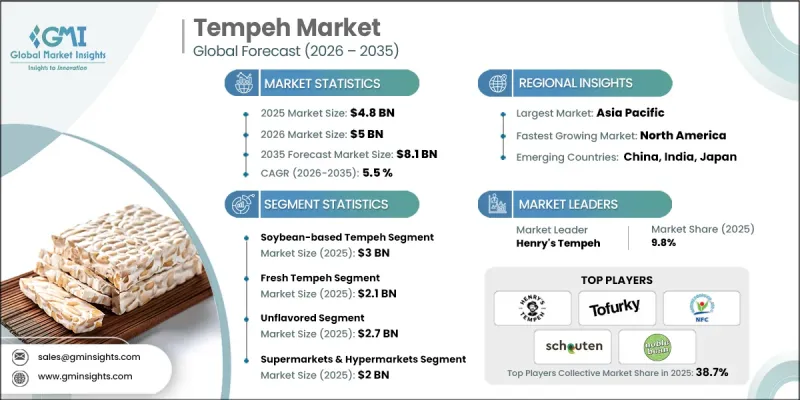
The Global Tempeh Market was valued at USD 4.8 billion in 2025 and is estimated to grow at a CAGR of 5.5% to reach USD 8.1 billion by 2035.
Tempeh, a traditional Indonesian fermented product, is created by fermenting whole soybeans with Rhizopus oligosporus culture, resulting in a protein-rich food with a dense texture and nutty flavor. It has gained traction among vegan, vegetarian, and flexitarian consumers due to its complete amino acid profile and high nutritional value. The product is rich in probiotics, B vitamins, and essential minerals, appealing to health-conscious individuals seeking digestive and overall wellness benefits. Its sustainable production, free from cholesterol and antibiotics, resonates with environmentally aware consumers. Modern manufacturing has advanced fermentation technology, controlled incubation, and innovative packaging methods, allowing producers to standardize texture and flavor while extending shelf life, catering to both traditional and global markets.
| Market Scope | |
|---|---|
| Start Year | 2025 |
| Forecast Year | 2026-2035 |
| Start Value | $4.8 Billion |
| Forecast Value | $8.1 Billion |
| CAGR | 5.5% |
The soybean-based tempeh segment captured USD 3 billion in 2025. Its dominance is rooted in traditional authenticity, optimal fermentation properties, and complete protein content. Manufacturers have increasingly adopted organic and non-GMO soybeans to meet rising demand for clean-label products. Multi-grain tempeh is also gaining popularity, offering nutritionally enriched variations with ancient grains and seeds, appealing to consumers seeking dietary diversity and enhanced health benefits.
The fresh tempeh segment reached USD 2.1 billion in 2025. Consumers favor fresh tempeh for authentic taste, maximum probiotic content, and superior texture. The frozen segment is expanding rapidly, supporting extended shelf life and distribution in non-traditional markets. Ready-to-eat tempeh is increasingly preferred by time-conscious consumers, providing pre-cooked, seasoned, and convenient protein options while retaining nutritional quality.
North America Tempeh Market is expected to witness significant growth from USD 1.2 billion in 2025 to USD 2 billion in 2035. The growth is fueled by the rising popularity of plant-based diets and health-conscious consumption habits among vegan, vegetarian, and flexitarian consumers. Organic and non-GMO ingredients are increasingly favored by producers, while local artisanal manufacturing facilities strengthen regional market presence. Rising awareness of fermented foods and sustainable protein alternatives continues to drive demand, particularly in urban and health-focused retail channels.
Key players in the Global Tempeh Market include Henry's Tempeh, Tofurky, Rhapsody Natural Foods, Schouten Food, Noble Bean, Nof Foods (Natural Oriental Fresh Foods), Tootie's Tempeh, Tofu Nagel (TOFU Manufaktur Christian Nagel), Gwen Tempeh, Impulse Tempeh, Nutrisoy, SoyBoy, Lightlife Foods, and Sweet Earth Foods. Companies in the Tempeh Market strengthen their position by investing in R&D to improve fermentation consistency, flavor, and texture. Expansion of product lines, including multi-grain, organic, and ready-to-eat formats, helps meet diverse consumer preferences. Strategic partnerships with retail chains and health-focused distributors enhance market reach, while marketing campaigns highlight sustainability, plant-based benefits, and digestive wellness. Firms also focus on local manufacturing facilities, clean-label certifications, and eco-friendly packaging to appeal to environmentally conscious consumers, enhancing brand credibility and loyalty while expanding their presence in emerging and mature markets.
Table of Contents
Chapter 1 Methodology & Scope
- 1.1 Market scope and definition
- 1.2 Research design
- 1.2.1 Research approach
- 1.2.2 Data collection methods
- 1.3 Data mining sources
- 1.3.1 Global
- 1.3.2 Regional/Country
- 1.4 Base estimates and calculations
- 1.4.1 Base year calculation
- 1.4.2 Key trends for market estimation
- 1.5 Primary research and validation
- 1.5.1 Primary sources
- 1.6 Forecast model
- 1.7 Research assumptions and limitations
Chapter 2 Executive Summary
- 2.1 Industry 360° synopsis
- 2.2 Key market trends
- 2.2.1 Source
- 2.2.2 Product Type
- 2.2.3 Flavor Type
- 2.2.4 Distribution Channel
- 2.2.5 Regional
- 2.3 TAM Analysis, 2026-2035
- 2.4 CXO perspectives: Strategic imperatives
Chapter 3 Industry Insights
- 3.1 Industry ecosystem analysis
- 3.1.1 Supplier landscape
- 3.1.2 Profit margin
- 3.1.3 Value addition at each stage
- 3.1.4 Factor affecting the value chain
- 3.1.5 Disruptions
- 3.2 Industry impact forces
- 3.2.1 Growth drivers
- 3.2.2 Industry pitfalls and challenges
- 3.2.3 Market opportunities
- 3.3 Growth potential analysis
- 3.4 Regulatory landscape
- 3.4.1 North America
- 3.4.2 Europe
- 3.4.3 Asia Pacific
- 3.4.4 Latin America
- 3.4.5 Middle East & Africa
- 3.5 Porter’s analysis
- 3.6 PESTEL analysis
- 3.7 Price trends
- 3.7.1 By region
- 3.7.2 By product
- 3.8 Future market trends
- 3.9 Technology and Innovation landscape
- 3.9.1 Current technological trends
- 3.9.2 Emerging technologies
- 3.10 Patent Landscape
- 3.11 Trade statistics (HS code)
- 3.11.1 Major importing countries
- 3.11.2 Major exporting countries
- 3.12 Sustainability and environmental aspects
- 3.12.1 Sustainable practices
- 3.12.2 Waste reduction strategies
- 3.12.3 Energy efficiency in production
- 3.12.4 Eco-friendly initiatives
- 3.13 Carbon footprint consideration
Chapter 4 Competitive Landscape, 2025
- 4.1 Introduction
- 4.2 Company market share analysis
- 4.2.1 By region
- 4.2.1.1 North America
- 4.2.1.2 Europe
- 4.2.1.3 Asia Pacific
- 4.2.1.4 LATAM
- 4.2.1.5 MEA
- 4.2.1 By region
- 4.3 Competitive analysis of major market players
- 4.4 Competitive positioning matrix
- 4.5 Key developments
- 4.5.1 Mergers & acquisitions
- 4.5.2 Partnerships & collaborations
- 4.5.3 New Product Launches
- 4.5.4 Expansion Plans
Chapter 5 Market Estimates and Forecast, By Source, 2022-2035 (USD Billion) (Kilo Tons)
- 5.1 Key trends
- 5.2 Soybean-based tempeh
- 5.3 Multi-grain tempeh
- 5.4 Chickpea-based tempeh
- 5.5 Other legume-based tempeh
Chapter 6 Market Estimates and Forecast, By Product Type, 2022-2035 (USD Billion) (Kilo Tons)
- 6.1 Key trends
- 6.2 Fresh Tempeh
- 6.3 Frozen Tempeh
- 6.4 Ready-to-Eat Tempeh
- 6.5 Others
Chapter 7 Market Estimates and Forecast, By Flavor, 2022-2035 (USD Billion) (Kilo Tons)
- 7.1 Key trends
- 7.2 Flavored
- 7.3 Unflavored
Chapter 8 Market Estimates and Forecast, By Distribution Channel,, 2022-2035 (USD Billion) (Kilo Tons)
- 8.1 Key trends
- 8.2 Supermarkets & hypermarkets
- 8.3 Specialty stores
- 8.4 Online retailers
- 8.5 Food service (restaurants & cafes)
- 8.6 Others
Chapter 9 Market Estimates and Forecast, By Region, 2022-2035 (USD Billion) (Kilo Tons)
- 9.1 Key trends
- 9.2 North America
- 9.2.1 U.S.
- 9.2.2 Canada
- 9.3 Europe
- 9.3.1 Germany
- 9.3.2 UK
- 9.3.3 France
- 9.3.4 Spain
- 9.3.5 Italy
- 9.3.6 Rest of Europe
- 9.4 Asia Pacific
- 9.4.1 China
- 9.4.2 India
- 9.4.3 Japan
- 9.4.4 Australia
- 9.4.5 South Korea
- 9.4.6 Rest of Asia Pacific
- 9.5 Latin America
- 9.5.1 Brazil
- 9.5.2 Mexico
- 9.5.3 Argentina
- 9.5.4 Rest of Latin America
- 9.6 Middle East and Africa
- 9.6.1 Saudi Arabia
- 9.6.2 South Africa
- 9.6.3 UAE
- 9.6.4 Rest of Middle East and Africa
Chapter 10 Company Profiles
- 10.1 Tofurky
- 10.2 Gwen Tempeh
- 10.3 Henry's Tempeh
- 10.4 Impulse
- 10.5 Nagel GmbH
- 10.6 Noffoods
- 10.7 Nutrisoy Pty Ltd
- 10.8 Rhapsody Natural Foods
- 10.9 Schouten
- 10.10 Tootie’s Tempeh

