
PUBLISHER: Global Market Insights Inc. | PRODUCT CODE: 2027592

PUBLISHER: Global Market Insights Inc. | PRODUCT CODE: 2027592
Fruit Infused Water Market Opportunity, Growth Drivers, Industry Trend Analysis, and Forecast 2026 - 2035
The Global Fruit Infused Water Market was valued at USD 17 billion in 2025 and is estimated to grow at a CAGR of 6.8% to reach USD 32.7 billion by 2035.
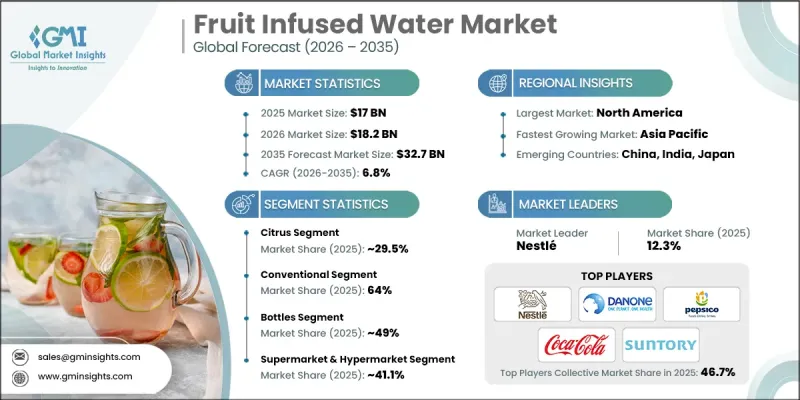
The fruit infused water industry has been expanding steadily as consumers increasingly gravitate toward healthier, naturally flavored hydration choices. Rising awareness of wellness and proper hydration habits is encouraging a shift away from sugar-loaded beverages toward cleaner alternatives. This category has become a key part of the functional beverage space, offering both refreshment and perceived health support. Fruit-infused water delivers a low-calorie option that aligns with modern dietary preferences focused on natural ingredients and transparency. Its composition supports clean-label expectations while eliminating the need for artificial additives. In addition to hydration, these beverages are associated with added nutritional value derived from infused ingredients, contributing to overall well-being and supporting active lifestyles. The growing appeal of convenient, ready-to-drink formats is further accelerating demand across multiple end-use sectors. As consumer priorities continue to evolve toward health-conscious consumption, the global fruit infused water market is expected to maintain strong growth momentum.
| Market Scope | |
|---|---|
| Start Year | 2025 |
| Forecast Year | 2026-2035 |
| Start Value | $17 Billion |
| Forecast Value | $32.7 Billion |
| CAGR | 6.8% |
In 2025, the citrus flavors segment accounted for 29.5% share and is projected to grow at a CAGR of 6.5% through 2035. This segment continues to lead due to its refreshing taste profile and strong consumer acceptance. Flavor trends within the market reflect a growing preference for natural and functional options that combine taste with perceived wellness benefits. Demand for fruit-based flavor profiles continues to rise as consumers seek variety and enhanced sensory experiences while maintaining a focus on healthier beverage choices.
The bottles segment held a share of 49% in 2025 and is expected to grow at a CAGR of 6.5% through 2035. Packaging innovation remains a key factor driving market expansion, as consumers prioritize convenience, portability, and sustainability. Bottles continue to dominate due to ease of use and widespread availability across retail channels. Lightweight and recyclable materials are gaining preference as environmental awareness increases. Alternative packaging formats are also evolving to meet diverse consumer needs, contributing to overall market development.
The supermarkets and hypermarkets segment accounted for 41.1% share in 2025 and is projected to grow at a CAGR of 7.1% through 2035. These retail channels remain the primary distribution platforms due to their broad reach and ability to offer extensive product selections. They play a critical role in enhancing brand visibility and enabling consumers to access a wide range of options in one location. Expanding retail networks and changing purchasing behaviors are further supporting growth in this segment.
North America Fruit Infused Water Market held a 33.5% share in 2025, driven by increasing demand for natural, low-calorie beverages and rising awareness of health and wellness. Consumers are actively seeking products that align with clean-label and sugar-free preferences. Innovation in flavor development and packaging design is helping brands strengthen their appeal. The growing trend of on-the-go consumption, supported by expanding retail and online distribution channels, continues to drive regional demand.
Key players operating in the Global Fruit Infused Water Market include PepsiCo, The Coca-Cola Company, Nestle, Danone, SUNTORY BEVERAGE & FOOD LIMITED, LaCroix Beverages, Inc., Hint Inc., Bai Brands, JUST Water, PATH Water, Flow Water, Primo Brands, Ozarka Water (BlueTriton Brands), Mountain Valley Spring Water, and Sanzo. Companies in the Fruit Infused Water Market are reinforcing their market position through innovation, branding, and strategic expansion. They are introducing new flavor profiles and clean-label formulations to meet evolving consumer preferences. Investments in sustainable packaging and environmentally responsible practices are helping companies align with growing eco-conscious demand. Strategic partnerships and distribution expansions are enabling broader market reach and improved product accessibility. Additionally, companies are strengthening their digital presence and leveraging e-commerce platforms to capture changing purchasing behaviors while focusing on product differentiation and premium positioning to enhance brand loyalty and competitiveness.
Table of Contents
Chapter 1 Methodology & Scope
- 1.1 Market scope and definition
- 1.2 Research design
- 1.2.1 Research approach
- 1.2.2 Data collection methods
- 1.3 Data mining sources
- 1.3.1 Global
- 1.3.2 Regional/Country
- 1.4 Base estimates and calculations
- 1.4.1 Base year calculation
- 1.4.2 Key trends for market estimation
- 1.5 Primary research and validation
- 1.5.1 Primary sources
- 1.6 Forecast model
- 1.7 Research assumptions and limitations
Chapter 2 Executive Summary
- 2.1 Industry 360° synopsis
- 2.2 Key market trends
- 2.2.1 Regional
- 2.2.2 Flavor type
- 2.2.3 Category
- 2.2.4 Packaging type
- 2.2.5 Distribution channel
- 2.3 TAM Analysis, 2026-2035
- 2.4 CXO perspectives: Strategic imperatives
- 2.4.1 Executive decision points
Chapter 3 Industry Insights
- 3.1 Industry ecosystem analysis
- 3.1.1 Supplier landscape
- 3.1.2 Profit margin
- 3.1.3 Value addition at each stage
- 3.1.4 Factor affecting the value chain
- 3.1.5 Disruptions
- 3.2 Industry impact forces
- 3.2.1 Growth drivers
- 3.2.2 Industry pitfalls and challenges
- 3.2.3 Market opportunities
- 3.3 Growth potential analysis
- 3.4 Regulatory landscape
- 3.4.1 North America
- 3.4.2 Europe
- 3.4.3 Asia Pacific
- 3.4.4 Latin America
- 3.4.5 Middle East & Africa
- 3.5 Porter's analysis
- 3.6 PESTEL analysis
- 3.7 Price trends
- 3.7.1 By region
- 3.7.2 By type
- 3.8 Future market trends
- 3.9 Technology and Innovation landscape
- 3.9.1 Current technological trends
- 3.9.2 Emerging technologies
- 3.10 Patent Landscape
- 3.11 Trade statistics (HS code)
- 3.11.1 Major importing countries
- 3.11.2 Major exporting countries
- 3.12 Sustainability and environmental aspects
- 3.12.1 Sustainable practices
- 3.12.2 Waste reduction strategies
- 3.12.3 Energy efficiency in production
- 3.12.4 Eco-friendly initiatives
- 3.13 Carbon footprint consideration
Chapter 4 Competitive Landscape, 2025
- 4.1 Introduction
- 4.2 Company market share analysis
- 4.2.1 By region
- 4.2.1.1 North America
- 4.2.1.2 Europe
- 4.2.1.3 Asia Pacific
- 4.2.1.4 LATAM
- 4.2.1.5 MEA
- 4.2.1 By region
- 4.3 Company matrix analysis
- 4.4 Competitive analysis of major market players
- 4.5 Competitive positioning matrix
- 4.6 Key developments
- 4.6.1 Mergers & acquisitions
- 4.6.2 Partnerships & collaborations
- 4.6.3 New Product Launches
- 4.6.4 Expansion Plans
Chapter 5 Market Estimates and Forecast, By Flavor Type, 2022-2035 (USD Billion) (Thousand Liters)
- 5.1 Key trends
- 5.2 Citrus
- 5.2.1 Lemon
- 5.2.2 Lime
- 5.2.3 Orange
- 5.2.4 Grapefruit
- 5.3 Berries
- 5.3.1 Strawberry
- 5.3.2 Blueberry
- 5.3.3 Raspberry
- 5.3.4 Blackberry
- 5.4 Tropical Fruits
- 5.4.1 Mango
- 5.4.2 Pineapple
- 5.4.3 Passion Fruit
- 5.4.4 Guava
- 5.5 Apples and Pears
- 5.6 Others
Chapter 6 Market Estimates and Forecast, By Category, 2022-2035 (USD Billion) (Thousand Liters)
- 6.1 Key trends
- 6.2 Organic
- 6.3 Conventional
Chapter 7 Market Estimates and Forecast, By Packaging Type, 2022-2035 (USD Billion) (Thousand Liters)
- 7.1 Key trends
- 7.2 Bottles
- 7.3 Cans
- 7.4 Jugs
- 7.5 Pouches
Chapter 8 Market Estimates and Forecast, By Distribution Channel, 2022-2035 (USD Billion) (Thousand Liters)
- 8.1 Key trends
- 8.2 Supermarkets and hypermarkets
- 8.3 Convenience stores
- 8.4 Online retail
- 8.5 Others (e.g., direct sales, vending machines)
Chapter 9 Market Estimates and Forecast, By Region, 2022-2035 (USD Billion) (Thousand Liters)
- 9.1 Key trends
- 9.2 North America
- 9.2.1 U.S.
- 9.2.2 Canada
- 9.3 Europe
- 9.3.1 Germany
- 9.3.2 UK
- 9.3.3 France
- 9.3.4 Spain
- 9.3.5 Italy
- 9.3.6 Rest of Europe
- 9.4 Asia Pacific
- 9.4.1 China
- 9.4.2 India
- 9.4.3 Japan
- 9.4.4 Australia
- 9.4.5 South Korea
- 9.4.6 Rest of Asia Pacific
- 9.5 Latin America
- 9.5.1 Brazil
- 9.5.2 Mexico
- 9.5.3 Argentina
- 9.5.4 Rest of Latin America
- 9.6 Middle East and Africa
- 9.6.1 Saudi Arabia
- 9.6.2 South Africa
- 9.6.3 UAE
- 9.6.4 Rest of Middle East and Africa
Chapter 10 Company Profiles
- 10.1 Bai Brands
- 10.2 Danone
- 10.3 Flow Water
- 10.4 Hint Inc.
- 10.5 JUST Water
- 10.6 LaCroix Beverages, Inc.
- 10.7 Mountain Valley Spring Water
- 10.8 Nestle
- 10.9 Ozarka Water (BlueTriton Brands)
- 10.10 PATH Water
- 10.11 PepsiCo
- 10.12 Primo Brands
- 10.13 Sanzo
- 10.14 SUNTORY BEVERAGE & FOOD LIMITED.
- 10.15 The Coca-Cola Company

