PUBLISHER: Global Market Insights Inc. | PRODUCT CODE: 2027593

PUBLISHER: Global Market Insights Inc. | PRODUCT CODE: 2027593
Tufting Machine Market Opportunity, Growth Drivers, Industry Trend Analysis, and Forecast 2026 - 2035
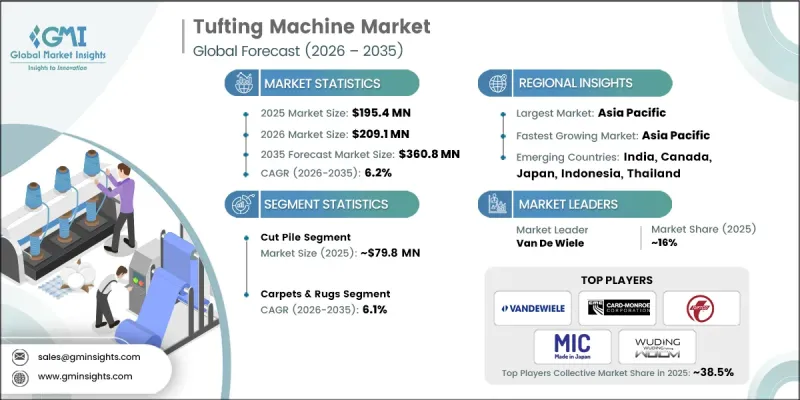
The Global Tufting Machine Market was valued at USD 195.4 million in 2025 and is estimated to grow at a CAGR of 6.2% to reach USD 360.8 million by 2035.
Market growth is fueled by the rising demand for home decor and interior design products, as more consumers prioritize visually appealing and comfortable living spaces. Tufting machines enable manufacturers to produce carpets, area rugs, and upholstered furniture that align with modern aesthetic trends. Commercial establishments, including hotels and office spaces, are also investing in decorative and durable flooring options. Advanced tufting technology allows manufacturers to achieve high-volume production while maintaining design flexibility and quality standards. The growing need for carpets and rugs in residential and commercial environments, along with rising urbanization and infrastructure investments, supports consistent market expansion. Tufting machines also provide cost-effective customization options, meeting the diverse requirements of contemporary interior design.
| Market Scope | |
|---|---|
| Start Year | 2025 |
| Forecast Year | 2026-2035 |
| Start Value | $195.4 Million |
| Forecast Value | $360.8 Million |
| CAGR | 6.2% |
The cut pile segment generated USD 79.8 million in 2025 and is expected to grow at a CAGR of 6.2% between 2026 and 2035. This segment leads the market due to its ability to create dense, soft, and visually appealing carpet surfaces. Cut pile carpets are formed by cutting yarn loops, delivering a plush texture widely preferred in both residential and commercial interiors. Rising demand for high-quality flooring, coupled with construction and renovation activities, drives adoption. The combination of durability, comfort, and design versatility strengthens the cut pile segment's market dominance.
The carpets and rugs segment accounted for 50.7% share in 2025 and is anticipated to grow at a CAGR of 6.1% through 2035. Tufting machines are primarily used for large-scale production of carpets and rugs, which remain essential for flooring, insulation, and aesthetic enhancement in homes, commercial facilities, and hospitality spaces. Urbanization, growing real estate investment, and demand for decorative flooring solutions support continued segment growth, while high-volume production capabilities reinforce its leadership in applications.
China Tufting Machine Market captured USD 39.5 million in 2025 and is projected to grow at a CAGR of 6.4% from 2026 to 2035. The market's growth is supported by demand from the textile, carpet, and artificial turf industries. Expansion of residential and commercial construction drives the need for high-speed tufting machines that enable mass production of carpets and rugs. China's well-established textile manufacturing base supports automation and multi-needle configurations, enhancing production efficiency and quality consistency. Advanced tufting machines equipped with computerized patterning and variable pile height features allow customization for decorative carpets, upholstery, and synthetic turf.
Key companies operating in the Global Tufting Machine Market include Guangdong Dayang, Card-Monroe Corporation (CMC), Yamaguchi Sangyo, Changzhou MTC Industry, Michishita Iron Works, Tuftco Corporation, Van De Wiele, Changzhou Wuding (WDCM), Wuxi Matale Industry & Tech, Haochuan Group, Yueqing Tufting Machine, Qingdao Shanzhong, KCMCO (Dongguan Kaichuang), and Zhengzhou Hento Machinery. To strengthen their market presence, leading tufting machine manufacturers focus on technological innovation, such as multi-needle systems, computer-controlled patterning, and variable pile height capabilities. Companies invest in automation to enhance production speed and consistency while reducing labor costs. Expanding global distribution networks and establishing regional service centers improve accessibility and customer support. Strategic collaborations, mergers, and partnerships enable access to new markets and client segments. Manufacturers also offer tailored solutions for residential, commercial, and industrial applications, while emphasizing after-sales support, training, and maintenance services.
Table of Contents
Chapter 1 Methodology & Scope
- 1.1 Market scope and definition
- 1.2 Research design
- 1.2.1 Research approach
- 1.2.2 Data collection methods
- 1.3 Data mining sources
- 1.3.1 Global
- 1.3.2 Regional/Country
- 1.4 Base estimates and calculations
- 1.4.1 Base year calculation
- 1.4.2 Key trends for market estimation
- 1.5 Primary research and validation
- 1.5.1 Primary sources
- 1.6 Forecast model
- 1.7 Research assumptions and limitations
Chapter 2 Executive Summary
- 2.1 Industry 360° synopsis
- 2.2 Key market trends
- 2.2.1 Regional
- 2.2.2 Product type
- 2.2.3 Operation mode
- 2.2.4 Application
- 2.2.5 End use
- 2.2.6 Distribution channel
Chapter 3 Industry Insights
- 3.1 Industry ecosystem analysis
- 3.1.1 Supplier landscape
- 3.1.2 Profit margin
- 3.1.3 Value addition at each stage
- 3.1.4 Factor affecting the value chain
- 3.2 Industry impact forces
- 3.2.1 Growth drivers
- 3.2.1.1 Expansion of the home decor and interior design sector
- 3.2.1.2 Growing demand for carpets and rugs in residential and commercial spaces
- 3.2.1.3 Rising textile exports in key producing countries
- 3.2.2 Pitfalls & Challenges
- 3.2.2.1 High capital investment for advanced tufting machinery
- 3.2.2.2 Requirement for skilled operators and technical expertise
- 3.2.3 Opportunities
- 3.2.3.1 Development of eco-friendly and energy-efficient tufting machines
- 3.2.3.2 Increasing demand for automated and digitally controlled tufting systems
- 3.2.1 Growth drivers
- 3.3 Growth potential analysis
- 3.4 Future market trends
- 3.5 Technology and innovation landscape
- 3.5.1 Current technological trends
- 3.5.2 Emerging technologies
- 3.6 Regulatory landscape
- 3.6.1 Standards and compliance requirements
- 3.6.2 Regional regulatory frameworks
- 3.6.3 Certification standards
- 3.7 Porter’s analysis
- 3.8 PESTEL analysis
- 3.9 Pricing analysis (driven by primary research)
- 3.9.1 Historical price trend analysis (driven by primary research)
- 3.9.2 Pricing strategy by player type (premium / value / cost-plus) (driven by primary research)
- 3.9.3 Regional price variations
- 3.9.4 Component cost structure & impact on final pricing
- 3.10 Trade data analysis (HS code 8447.9) (driven by paid database)
- 3.10.1 Import/export volume & value trends (driven by paid database)
- 3.10.2 Key trade corridors & tariff impact (driven by paid database)
- 3.10.3 Major importing & exporting countries
- 3.10.4 HS code classification & trade statistics
- 3.11 Capacity & production landscape (driven by primary research)
- 3.11.1 Installed capacity by region & key producer (driven by primary research)
- 3.11.2 Capacity utilization rates & expansion pipelines (driven by primary research)
Chapter 4 Competitive Landscape, 2025
- 4.1 Introduction
- 4.2 Company market share analysis
- 4.2.1 By Region
- 4.2.1.1 North America
- 4.2.1.2 Europe
- 4.2.1.3 Asia Pacific
- 4.2.1.4 Latin America
- 4.2.1.5 Middle East & Africa
- 4.2.1 By Region
- 4.3 Company matrix analysis
- 4.4 Competitive analysis of major market players
- 4.5 Competitive positioning matrix
- 4.6 Key developments
- 4.6.1 Mergers & acquisitions
- 4.6.2 Partnerships & collaborations
- 4.6.3 New product launches
- 4.6.4 Expansion plans
Chapter 5 Market Estimates & Forecast, By Product Type, 2022 - 2035, (USD Million) (Thousand Units)
- 5.1 Key trends
- 5.2 Cut pile
- 5.3 Loop pile
- 5.4 Cut loop
- 5.5 Multi-level loop
- 5.6 Others
Chapter 6 Market Estimates & Forecast, By Operation Mode, 2022 - 2035, (USD Million) (Thousand Units)
- 6.1 Key trends
- 6.2 Electric
- 6.3 Hydraulic
- 6.4 Pneumatic
Chapter 7 Market Estimates & Forecast, By Application, 2022 - 2035, (USD Million) (Thousand Units)
- 7.1 Key trends
- 7.2 Carpets & rugs
- 7.3 Automotive interiors
- 7.4 Artificial turf
- 7.5 Textile wall coverings
- 7.6 Others
Chapter 8 Market Estimates & Forecast, By End Use, 2022 - 2035, (USD Million) (Thousand Units)
- 8.1 Key trends
- 8.2 Residential
- 8.3 Commercial
- 8.4 Industrial
Chapter 9 Market Estimates & Forecast, By Distribution Channel, 2022 - 2035, (USD Million) (Thousand Units)
- 9.1 Key trends
- 9.2 Direct
- 9.3 Indirect
Chapter 10 Market Estimates & Forecast, By Region, 2022 - 2035, (USD Million) (Thousand Units)
- 10.1 Key trends
- 10.2 North America
- 10.2.1 U.S.
- 10.2.2 Canada
- 10.3 Europe
- 10.3.1 Germany
- 10.3.2 UK
- 10.3.3 France
- 10.3.4 Italy
- 10.3.5 Spain
- 10.4 Asia Pacific
- 10.4.1 China
- 10.4.2 India
- 10.4.3 Japan
- 10.4.4 South Korea
- 10.4.5 Australia
- 10.5 Latin America
- 10.5.1 Brazil
- 10.5.2 Mexico
- 10.5.3 Argentina
- 10.6 MEA
- 10.6.1 Saudi Arabia
- 10.6.2 UAE
- 10.6.3 South Africa
Chapter 11 Company Profiles
- 11.1 Card-Monroe Corporation (CMC)
- 11.2 Tuftco Corporation
- 11.3 Van De Wiele
- 11.4 Weihai Tesite Machinery
- 11.5 Wuxi Matale Industry & Tech
- 11.6 Changzhou Wuding (WDCM)
- 11.7 Changzhou MTC Industry
- 11.8 Michishita Iron Works
- 11.9 Guangdong Dayang
- 11.10 Yueqing Tufting Machine
- 11.11 Haochuan Group
- 11.12 Qingdao Shanzhong
- 11.13 KCMCO
- 11.14 Yamaguchi Sangyo
- 11.15 Zhengzhou Hento Machinery

