PUBLISHER: Global Market Insights Inc. | PRODUCT CODE: 2027604

PUBLISHER: Global Market Insights Inc. | PRODUCT CODE: 2027604
Luxury Furniture Market Opportunity, Growth Drivers, Industry Trend Analysis, and Forecast 2026 - 2035
The Global Luxury Furniture Market was valued at USD 33.2 billion in 2025 and is estimated to grow at a CAGR of 4.6% to reach USD 51.8 billion by 2035.
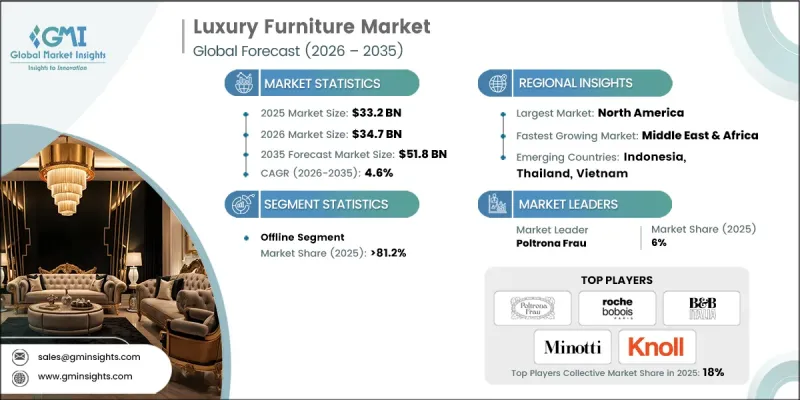
Market momentum is strongly influenced by the spending behavior of ultra-high-net-worth individuals, who view furniture purchases as a blend of lifestyle enhancement and long-term value creation. High-end furnishings are no longer limited to functionality, as buyers increasingly consider design heritage, craftsmanship, and exclusivity when making purchasing decisions. The market is further shaped by demand across multiple ownership environments, reflecting evolving lifestyle preferences. In developing regions, a growing affluent population is fueling demand for premium interiors that symbolize personal success and refined taste. Consumers are increasingly prioritizing durable, high-quality products over mass-produced alternatives, aligning with a broader shift toward mindful consumption. The growing emphasis on customization and sustainability is also redefining product development strategies, as buyers seek unique, environmentally responsible designs. Rising discretionary income levels, combined with increasing exposure to global design standards, are strengthening the adoption of luxury furniture, positioning the market for steady expansion across both established and emerging economies.
| Market Scope | |
|---|---|
| Start Year | 2025 |
| Forecast Year | 2026-2035 |
| Start Value | $33.2 Billion |
| Forecast Value | $51.8 Billion |
| CAGR | 4.6% |
The seating furniture segment held the largest share in 2025. This segment plays a central role in luxury interiors by combining functionality with strong visual appeal. It includes a wide spectrum of products designed to enhance both comfort and aesthetics across different living environments. Demand is driven by the need for refined craftsmanship, premium materials, and design sophistication. The category continues to evolve with a focus on ergonomic performance, aesthetic detailing, and customization, reinforcing its importance within the broader luxury furniture landscape.
The offline distribution channel accounted for 81.2% share in 2025, maintaining its dominant position. Physical retail continues to play a critical role in luxury furniture sales, as customers prefer to evaluate product quality, materials, and design in person before making high-value purchases. Showrooms operated by premium brands serve as experiential spaces that showcase complete collections and deliver personalized customer service. These locations also function as brand-building platforms, supporting marketing initiatives and strengthening customer engagement. Strategic placement in high-end retail districts enhances visibility and accessibility, further supporting offline channel dominance.
Asia Pacific Luxury Furniture Market is projected to grow at a CAGR of 5.1% through 2035. Growth across the region is driven by expanding affluent populations, rapid urban development, and increasing investment in premium residential and hospitality projects. Consumers are becoming more exposed to global design trends, which is elevating demand for high-quality furnishings. At the same time, improvements in local manufacturing capabilities are enabling regional brands to compete effectively in the luxury segment. These combined factors are positioning Asia Pacific as a key hub for both consumption and innovation in the global luxury furniture market.
Key companies operating in the Global Luxury Furniture Market include Arhaus, B&B Italia, Baker Furniture, Cassina, Ethan Allen, Fendi Casa, Flexform, Herman Miller, King Living, Knoll, KUKA, Ligne Roset, Man Wah Holdings Limited, Markor International Home Furnishings, Minotti, Natuzzi, Poltrona Frau, Restoration Hardware (RH), Roche Bobois, and Rolf Benz. Companies in the Luxury Furniture Market are strengthening their competitive position by investing in design innovation, premium materials, and customization capabilities. Many players focus on enhancing brand identity through exclusive collections, collaborations, and limited-edition offerings that appeal to affluent consumers. Expansion of flagship showrooms in prime locations supports immersive brand experiences and customer engagement. Businesses are also prioritizing sustainable sourcing and environmentally responsible manufacturing processes to align with evolving consumer expectations. Digital transformation, including online visualization tools and personalized design services, is improving customer interaction. Additionally, strategic global expansion, partnerships, and supply chain optimization are enabling companies to scale operations while maintaining product quality and brand exclusivity.
Table of Contents
Chapter 1 Methodology and Scope
- 1.1 Market scope and definition
- 1.2 Research design
- 1.2.1 Research approach
- 1.2.2 Data collection methods
- 1.3 Data mining sources
- 1.3.1 Global
- 1.3.2 Regional/Country
- 1.4 Base estimates and calculations
- 1.4.1 Base year calculation
- 1.4.2 Key trends for market estimation
- 1.5 Primary research and validation
- 1.5.1 Primary sources
- 1.6 Forecast model
- 1.7 Research assumptions and limitations
Chapter 2 Executive Summary
- 2.1 Industry 360° synopsis
- 2.2 Key market trends
- 2.2.1 Regional
- 2.2.2 Product type
- 2.2.3 Material
- 2.2.4 Price range
- 2.2.5 Application
- 2.2.6 Distribution channel
Chapter 3 Industry Insights
- 3.1 Industry ecosystem analysis
- 3.1.1 Supplier landscape
- 3.1.2 Profit margin
- 3.1.3 Value addition at each stage
- 3.1.4 Factor affecting the value chain
- 3.2 Industry impact forces
- 3.2.1 Growth drivers
- 3.2.1.1 Increasing brand awareness & aspiration for international luxury brands
- 3.2.1.2 E-commerce penetration & digital shopping convenience
- 3.2.1.3 Expansion of luxury hotels, restaurants & commercial spaces globally
- 3.2.2 Industry pitfalls & challenges
- 3.2.2.1 Supply chain disruptions & material shortages
- 3.2.2.2 Currency volatility impacting international sales
- 3.2.3 Opportunities
- 3.2.3.1 Luxury furniture rental & subscription models
- 3.2.3.2 Heritage brand premiumization & storytelling
- 3.2.1 Growth drivers
- 3.3 Growth potential analysis
- 3.4 Future market trends
- 3.5 Technology and innovation landscape
- 3.5.1 Current technological trends
- 3.5.2 Emerging technologies
- 3.6 Pricing analysis (driven by primary research)
- 3.6.1 Historical price trend analysis
- 3.6.2 Price elasticity of demand in luxury segment
- 3.6.3 Currency fluctuation impact on import pricing
- 3.7 Regulatory framework
- 3.8 Porter’s analysis
- 3.9 PESTEL analysis
- 3.10 Trade data analysis (HS Code: 9401-seats) (driven by paid data base)
- 3.10.1 Import/export volume & value trends
- 3.10.2 Key trade corridors & tariff impact
- 3.10.3 Major exporting & importing countries
- 3.10.4 Trade flow analysis by region
- 3.11 Impact of AI & generative AI on the market
- 3.11.1 AI-driven disruption of existing business models
- 3.11.2 GenAI use cases & adoption roadmap by segment
- 3.11.3 Personalized design & customization engines
- 3.11.4 AI-powered interior design consultation
- 3.11.5 Predictive demand analytics & inventory management
- 3.11.6 Virtual showrooms & immersive shopping experiences
- 3.12 Consumer buying behavior analysis
- 3.12.1 Purchasing patterns
- 3.12.2 Preference analysis
- 3.12.3 Regional variations in consumer behavior
- 3.12.4 Impact of e-commerce on buying decisions
Chapter 4 Competitive Landscape, 2025
- 4.1 Introduction
- 4.2 Company market share analysis
- 4.3 Competitive analysis of major market players
- 4.4 Competitive positioning matrix
- 4.5 Key developments
- 4.5.1 Mergers & acquisitions
- 4.5.2 Partnerships & collaborations
- 4.5.3 New product launches
- 4.5.4 Expansion plans
Chapter 5 Market Estimates and Forecast, By Product Type, 2022 - 2035 (USD Billion) (Thousand Units)
- 5.1 Key trends
- 5.2 Tables
- 5.3 Chairs
- 5.4 Sofas & lounges
- 5.5 Kitchen
- 5.6 Lighting
- 5.7 Interior accessories
- 5.8 Beds
- 5.9 Others
Chapter 6 Market Estimates and Forecast, By Material, 2022 - 2035 (USD Billion) (Thousand Units)
- 6.1 Key trends
- 6.2 Wood
- 6.3 Metal
- 6.4 Upholstery
- 6.5 Glass & crystal
- 6.6 Composite & others
Chapter 7 Market Estimates and Forecast, By Price, 2022 - 2035 (USD Billion) (Thousand Units)
- 7.1 Key trends
- 7.2 Ultra-luxury (>$10,000 per piece)
- 7.3 Premium luxury ($5,000-$10,000 per piece)
- 7.4 Accessible luxury ($2,000-$5,000 per piece)
Chapter 8 Market Estimates and Forecast, By End-Use, 2022 - 2035 (USD Billion) (Thousand Units)
- 8.1 Key trends
- 8.2 Residential
- 8.3 Commercial
- 8.3.1 Hotels & resorts
- 8.3.2 Restaurants & cafes
- 8.3.3 Corporate offices
- 8.3.4 Others
Chapter 9 Market Estimates and Forecast, By Distribution Channel, 2022 - 2035 (USD Billion) (Thousand Units)
- 9.1 Key trends
- 9.2 Online
- 9.2.1 E-commerce
- 9.2.2 Company websites
- 9.3 Offline
- 9.3.1 Mega retail stores & home improvement centers
- 9.3.2 Specialty stores
- 9.3.3 Others
Chapter 10 Market Estimates and Forecast, By Region, 2022 - 2035 (USD Billion) (Thousand Units)
- 10.1 Key trends
- 10.2 North America
- 10.2.1 U.S.
- 10.2.2 Canada
- 10.3 Europe
- 10.3.1 UK
- 10.3.2 Germany
- 10.3.3 France
- 10.3.4 Italy
- 10.3.5 Spain
- 10.4 Asia Pacific
- 10.4.1 China
- 10.4.2 India
- 10.4.3 Japan
- 10.4.4 South Korea
- 10.4.5 Australia
- 10.5 Latin America
- 10.5.1 Brazil
- 10.5.2 Mexico
- 10.5.3 Argentina
- 10.6 MEA
- 10.6.1 UAE
- 10.6.2 Saudi Arabia
- 10.6.3 South Africa
Chapter 11 Company Profiles
- 11.1 Arhaus
- 11.2 B&B Italia
- 11.3 Baker Furniture
- 11.4 Cassina
- 11.5 Ethan Allen
- 11.6 Fendi Casa
- 11.7 Flexform
- 11.8 Herman Miller
- 11.9 King Living
- 11.10 Knoll
- 11.11 KUKA
- 11.12 Ligne Roset
- 11.13 Man Wah Holdings Limited
- 11.14 Markor International Home Furnishings
- 11.15 Minotti
- 11.16 Natuzzi
- 11.17 Poltrona Frau
- 11.18 Restoration Hardware (RH)
- 11.19 Roche Bobois
- 11.20 Rolf Benz

