PUBLISHER: Global Market Insights Inc. | PRODUCT CODE: 2027609

PUBLISHER: Global Market Insights Inc. | PRODUCT CODE: 2027609
Chocolate Market Opportunity, Growth Drivers, Industry Trend Analysis, and Forecast 2026 - 2035
The Global Chocolate Market was valued at USD 129.6 billion in 2025 and is estimated to grow at a CAGR of 3% to reach USD 175.7 billion by 2035.
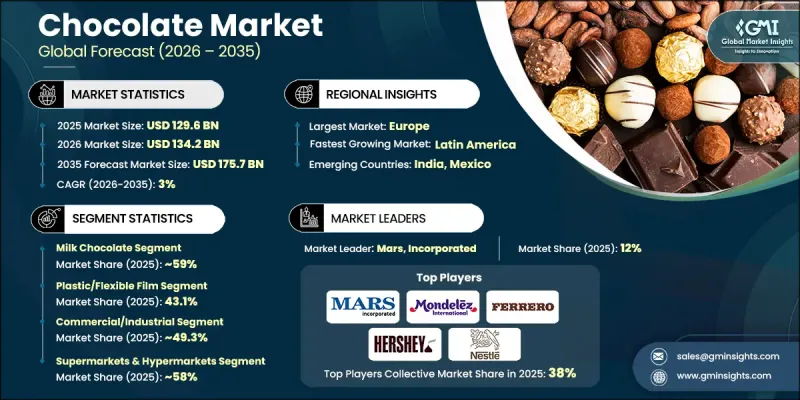
The global chocolate industry continues to evolve steadily as shifting consumer preferences shape demand toward premium quality, unique flavor profiles, and responsibly sourced ingredients. Chocolate manufacturers are increasingly aligning product development strategies with changing lifestyles, where consumers prioritize indulgence, convenience, and sensory appeal alongside transparency in sourcing and production. The market is also benefiting from the rising popularity of artisanal and premium chocolate varieties, along with growing interest in products that offer distinctive taste experiences and cleaner ingredient labels. Companies are strengthening their portfolios by introducing innovative formulations, improved processing methods, and enhanced texture stability to meet evolving expectations. The inclusion of functional ingredients and diversified product concepts is further supporting market expansion by catering to health-conscious and experience-driven consumers. In addition, digital transformation across production and distribution networks is improving supply chain efficiency, enabling better demand forecasting and consumer insight generation. This allows manufacturers to respond more effectively to seasonal demand fluctuations and emerging consumption trends, reinforcing long-term industry growth.
| Market Scope | |
|---|---|
| Start Year | 2025 |
| Forecast Year | 2026-2035 |
| Start Value | $129.6 Billion |
| Forecast Value | $175.7 Billion |
| CAGR | 3% |
The milk chocolate segment accounted for USD 129.6 billion in 2025 and held a 59% share, and it is projected to grow at a CAGR of 2.9% through 2035. This segment continues to lead due to its widely preferred smooth taste profile and balanced sweetness, which appeals to consumers across all age groups. It remains a core product category for manufacturers, serving as a foundation for product diversification and flavor innovation across multiple chocolate offerings.
The plastic and flexible film packaging segment held a 43.1% share in 2025 and is expected to grow at a CAGR of 2.3% from 2026 to 2035. This packaging format remains highly preferred due to its cost efficiency, versatility, and ability to preserve product freshness for extended periods. Its lightweight structure supports efficient large-scale distribution and aligns with growing demand for individually portioned packs and convenient on-the-go consumption formats.
North America Chocolate Market held a 29% share in 2025. The region benefits from strong demand for premium chocolate products, evolving taste preferences, and a highly developed retail ecosystem. Consumer interest in product transparency, ingredient quality, and innovative flavor experiences is further driving market expansion. Continuous product innovation and advanced manufacturing capabilities also support the rapid adoption of differentiated chocolate offerings across the region.
Key companies operating in the Global Chocolate Market include Mars, Incorporated, Nestle S.A., Mondelez International, Inc., Ferrero Group, The Hershey Company, Lindt & Sprungli AG, Ezaki Glico Co., Ltd., Ritter Sport, Fazer Group, Ghirardelli Chocolate Company, Arcor Group, Hu Kitchen, and Tony's Chocolonely. Companies in the Chocolate Market are focusing on multiple strategic initiatives to strengthen their competitive position and expand market reach. A major focus is product innovation, with manufacturers investing in new flavor development, premium offerings, and functional chocolate varieties that align with evolving consumer preferences. Firms are increasingly emphasizing sustainable sourcing practices, particularly in cocoa procurement, to meet rising demand for ethical and environmentally responsible products. Expansion of premium and artisanal product lines is also helping brands differentiate themselves in a highly competitive landscape. Companies are strengthening digital capabilities across marketing, sales, and supply chain operations to improve consumer engagement and demand forecasting accuracy. Strategic partnerships with retailers and foodservice providers are enhancing product visibility and distribution efficiency.
Table of Contents
Chapter 1 Methodology & Scope
- 1.1 Market scope and definition
- 1.2 Research design
- 1.2.1 Research approach
- 1.2.2 Data collection methods
- 1.3 Data mining sources
- 1.3.1 Global
- 1.3.2 Regional/Country
- 1.4 Base estimates and calculations
- 1.4.1 Base year calculation
- 1.4.2 Key trends for market estimation
- 1.5 Primary research and validation
- 1.5.1 Primary sources
- 1.6 Forecast model
- 1.7 Research assumptions and limitations
Chapter 2 Executive Summary
- 2.1 Industry 360° synopsis
- 2.2 Key market trends
- 2.2.1 Regional
- 2.2.2 Chemistry Type
- 2.2.3 Application
- 2.2.4 Vessel/Structure Type
- 2.2.5 Performance Characteristics
- 2.2.6 End-Use
- 2.3 TAM Analysis, 2026-2035
- 2.4 CXO perspectives: Strategic imperatives
- 2.4.1 Executive decision points
- 2.4.2 Critical success factors
- 2.5 Future Outlook and Strategic Recommendations
Chapter 3 Industry Insights
- 3.1 Industry ecosystem analysis
- 3.1.1 Supplier landscape
- 3.1.2 Profit margin
- 3.1.3 Value addition at each stage
- 3.1.4 Factor affecting the value chain
- 3.1.5 Disruptions
- 3.2 Industry impact forces
- 3.2.1 Growth drivers
- 3.2.1.1 Changing consumer preferences
- 3.2.1.2 Expanding chocolate consumption in emerging markets
- 3.2.1.3 Innovative product developments
- 3.2.2 Industry pitfalls and challenges
- 3.2.2.1 Fluctuating cocoa bean prices
- 3.2.2.2 Health concerns
- 3.2.3 Market opportunities
- 3.2.3.1 Growing demand for organic & fair-trade certified chocolate
- 3.2.3.2 Expansion of E-commerce & direct-to-consumer channels
- 3.2.1 Growth drivers
- 3.3 Growth potential analysis
- 3.4 Regulatory landscape
- 3.4.1 North America
- 3.4.2 Europe
- 3.4.3 Asia Pacific
- 3.4.4 Latin America
- 3.4.5 Middle East & Africa
- 3.5 Porter’s analysis
- 3.6 PESTEL analysis
- 3.7 Price trends
- 3.7.1 By region
- 3.7.2 By type
- 3.8 Future market trends
- 3.9 Technology and Innovation landscape
- 3.9.1 Current technological trends
- 3.9.2 Emerging technologies
- 3.10 Patent Landscape
- 3.11 Trade statistics (HS code)
- 3.11.1 Major importing countries
- 3.11.2 Major exporting countries
- 3.12 Sustainability and environmental aspects
- 3.12.1 Sustainable practices
- 3.12.2 Waste reduction strategies
- 3.12.3 Energy efficiency in production
- 3.12.4 Eco-friendly initiatives
- 3.13 Carbon footprint consideration
Chapter 4 Competitive Landscape, 2025
- 4.1 Introduction
- 4.2 Company market share analysis
- 4.2.1 By region
- 4.2.1.1 North America
- 4.2.1.2 Europe
- 4.2.1.3 Asia Pacific
- 4.2.1.4 LATAM
- 4.2.1.5 MEA
- 4.2.1 By region
- 4.3 Company matrix analysis
- 4.4 Competitive analysis of major market players
- 4.5 Competitive positioning matrix
- 4.6 Key developments
- 4.6.1 Mergers & acquisitions
- 4.6.2 Partnerships & collaborations
- 4.6.3 New Product Launches
- 4.6.4 Expansion Plans
Chapter 5 Market Estimates and Forecast, By Type, 2022-2035 (USD Billion) (Kilo Tons)
- 5.1 Key trends
- 5.2 Milk chocolate
- 5.3 Dark chocolate
- 5.4 White chocolate
- 5.5 Others
Chapter 6 Market Estimates and Forecast, By Packaging, 2022-2035 (USD Billion) (Kilo Tons)
- 6.1 Key trends
- 6.2 Plastic/Flexible Film
- 6.3 Cartons/Paperboard
- 6.4 Foil/Aluminum
- 6.5 Metal Tins
- 6.6 Glass Jars
- 6.7 Others
Chapter 7 Market Estimates and Forecast, By Application, 2022-2035 (USD Billion) (Kilo Tons)
- 7.1 Key trends
- 7.2 Household/Personal Consumption
- 7.3 Commercial/Industrial
- 7.4 Others
Chapter 8 Market Estimates and Forecast, By Distribution Channel, 2022-2035 (USD Billion) (Kilo Tons)
- 8.1 Key trends
- 8.2 Supermarkets & Hypermarkets
- 8.3 Convenience Stores
- 8.4 Specialty Chocolate Stores
- 8.5 Online Retail
- 8.6 Others
Chapter 9 Market Estimates and Forecast, By Region, 2022-2035 (USD Billion) (Kilo Tons)
- 9.1 Key trends
- 9.2 North America
- 9.2.1 U.S.
- 9.2.2 Canada
- 9.3 Europe
- 9.3.1 Germany
- 9.3.2 UK
- 9.3.3 France
- 9.3.4 Spain
- 9.3.5 Italy
- 9.3.6 Rest of Europe
- 9.4 Asia Pacific
- 9.4.1 China
- 9.4.2 India
- 9.4.3 Japan
- 9.4.4 Australia
- 9.4.5 South Korea
- 9.4.6 Rest of Asia Pacific
- 9.5 Latin America
- 9.5.1 Brazil
- 9.5.2 Mexico
- 9.5.3 Argentina
- 9.5.4 Rest of Latin America
- 9.6 Middle East and Africa
- 9.6.1 Saudi Arabia
- 9.6.2 South Africa
- 9.6.3 UAE
- 9.6.4 Rest of Middle East and Africa
Chapter 10 Company Profiles
- 10.1 Nestle S.A.
- 10.2 Mars, Incorporated
- 10.3 Mondelez International, Inc.
- 10.4 The Hershey Company
- 10.5 Ferrero Group
- 10.6 Lindt & Sprungli AG
- 10.7 Ezaki Glico Co., Ltd.
- 10.8 Ritter Sport
- 10.9 Fazer Group
- 10.10 Ghirardelli Chocolate Company
- 10.11 Arcor Group
- 10.12 Hu Kitchen
- 10.13 Tony's Chocolonely

