PUBLISHER: Global Market Insights Inc. | PRODUCT CODE: 2027616

PUBLISHER: Global Market Insights Inc. | PRODUCT CODE: 2027616
Sorting and Grading Machines Market Opportunity, Growth Drivers, Industry Trend Analysis, and Forecast 2026 - 2035
The Global Sorting and Grading Machines Market was valued at USD 5.9 billion in 2025 and is estimated to grow at a CAGR of 7.2% to reach USD 11.8 billion by 2035.
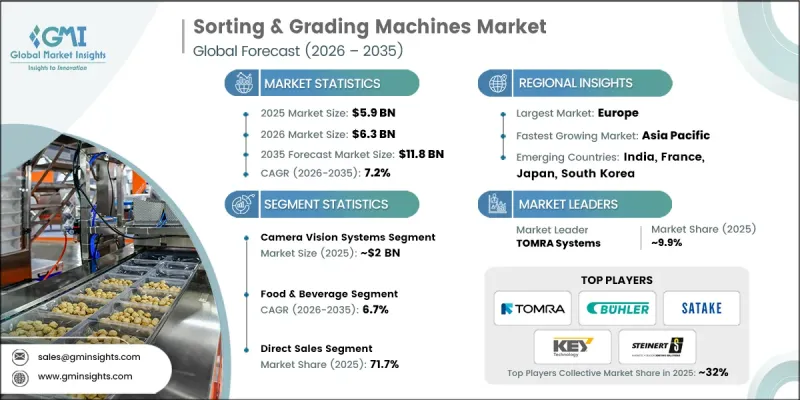
The market is expanding due to rising demand for automation across both agricultural and food processing sectors. Producers are increasingly adopting automated systems to enhance operational efficiency, reduce labor costs, and maintain consistent product quality. These machines allow precise categorization of agricultural produce, such as fruits, vegetables, and grains, while supporting compliance with strict regulatory standards in food manufacturing. Mechanized sorting minimizes errors linked to manual processes, boosting overall productivity. Advancements in mechanical sorting technology are making it easier for manufacturers to handle diverse products. Growth in agricultural output and export-oriented farming is further propelling market activity, as producers focus on post-harvest handling to minimize losses and adhere to international grading standards.
| Market Scope | |
|---|---|
| Start Year | 2025 |
| Forecast Year | 2026-2035 |
| Start Value | $5.9 Billion |
| Forecast Value | $11.8 Billion |
| CAGR | 7.2% |
In 2025, the camera vision systems segment generated USD 2 billion and is expected to grow at a CAGR of 8.4% through 2035. These systems dominate the market due to their ability to deliver high-speed, accurate, and automated inspections. Utilizing sophisticated imaging technology and algorithm-based analysis, camera vision systems assess size, shape, color, and defects, ensuring uniformity and quality. This automation reduces reliance on manual labor while improving efficiency. The rising trend toward industrial automation and consistent quality control further strengthens the position of camera vision systems within the global sorting and grading machines market.
The food & beverage segment held a 35% share in 2025 and is projected to grow at a CAGR of 6.7% from 2026 to 2035. This segment dominates because quality control is critical for fruits, vegetables, nuts, baked goods, and packaged items. Automated sorting systems equipped with vision-based inspection ensure uniform size, color consistency, and defect-free products. Increasing consumer demand for high-quality, visually appealing goods, along with stringent food safety regulations, drives adoption in this sector. Operational efficiency combined with product consistency reinforces the food and beverage segment's market leadership.
Germany Sorting and Grading Machines Market captured USD 521.4 million in 2025, and is expected to grow at a CAGR of 5.9% from 2026 to 2035. Growth is fueled by a robust food processing industry and an advanced manufacturing sector. Industries processing fruits, vegetables, grains, and packaged foods rely on precision sorting systems to meet quality standards and regulatory compliance. Adoption of optical sorting, sensor-based grading, and AI-powered defect detection enhances accuracy while reducing manual intervention. Manufacturers emphasize automation, energy efficiency, and Industry 4.0 integration for real-time monitoring and data-driven optimization. Export-focused food processors invest in high-capacity machines to satisfy global quality expectations.
Key players in the Global Sorting and Grading Machines Market include Advanced Sorting Machines, BINDER, Buhler AG, Cimbria A/S, Daewon GSI Co., Ltd., FOSS Analytical A/S, GREEFA, Key Technology, Inc., Meyer Optoelectronic, Newtec A/S, Raytec Vision S.p.A., Satake Corporation, Sesotec GmbH, STEINERT, and TOMRA Systems. Companies in the Sorting and Grading Machines Market strengthen their market presence through innovation in high-speed, AI-enabled vision systems and enhanced mechanical sorting technologies. Strategic partnerships with agricultural and food processing firms help expand customer reach. Manufacturers invest in product customization for diverse crop and produce types while focusing on energy-efficient, compact, and scalable solutions. Expanding after-sales service networks, providing remote diagnostics, and integrating Industry 4.0 monitoring systems enhance operational reliability for clients. Participation in global trade exhibitions, targeted marketing campaigns, and regional sales offices bolsters brand recognition and market penetration, while research and development investments ensure continuous technological advancement and competitiveness.
Table of Contents
Chapter 1 Methodology & Scope
- 1.1 Market scope and definition
- 1.2 Research design
- 1.2.1 Research approach
- 1.2.2 Data collection methods
- 1.3 Data mining sources
- 1.3.1 Global
- 1.3.2 Regional/Country
- 1.4 Base estimates and calculations
- 1.4.1 Base year calculation
- 1.4.2 Key trends for market estimation
- 1.5 Primary research and validation
- 1.5.1 Primary sources
- 1.6 Forecast model
- 1.7 Research assumptions and limitations
Chapter 2 Executive Summary
- 2.1 Industry 360° synopsis
- 2.2 Key market trends
- 2.2.1 Regional
- 2.2.2 By Type
- 2.2.3 By Machine Type
- 2.2.4 By Application
- 2.2.5 By Machine Capacity
- 2.2.6 Distribution channel
Chapter 3 Industry Insights
- 3.1 Industry ecosystem analysis
- 3.1.1 Supplier landscape
- 3.1.2 Profit margin
- 3.1.3 Value addition at each stage
- 3.1.4 Factor affecting the value chain
- 3.2 Industry impact forces
- 3.2.1 Growth drivers
- 3.2.1.1 Increasing demand for automation in food processing and agricultural industries
- 3.2.1.2 Growth of global agricultural production and exports
- 3.2.1.3 Expansion of packaging and processing industries
- 3.2.2 Pitfalls & Challenges
- 3.2.2.1 High initial investment in advanced sorting and grading machines
- 3.2.2.2 Complex operation and need for skilled technical workforce
- 3.2.3 Opportunities
- 3.2.3.1 Growing demand for smart and connected sorting systems with real-time monitoring
- 3.2.3.2 Expansion of food safety regulations and export quality standards
- 3.2.1 Growth drivers
- 3.3 Growth potential analysis
- 3.4 Future market trends
- 3.5 Technology and innovation landscape
- 3.5.1 Current technological trends
- 3.5.2 Emerging technologies
- 3.6 Regulatory landscape
- 3.6.1 Standards and compliance requirements
- 3.6.2 Regional regulatory frameworks
- 3.6.3 Certification standards
- 3.7 Porter's analysis
- 3.8 PESTEL analysis
- 3.9 Pricing analysis (driven by primary research)
- 3.9.1 Historical price trend analysis (driven by primary research)
- 3.9.2 Pricing strategy by player type (premium / value / cost-plus) (driven by primary research)
- 3.9.3 Price variation by technology type
- 3.9.4 Price variation by machine capacity
- 3.9.5 Regional price benchmarking
- 3.10 Trade data analysis (driven by paid database)
- 3.10.1 Import/export volume & value trends (driven by paid database)
- 3.10.2 Key trade corridors & tariff impact (driven by paid database)
- 3.10.3 Top exporting countries
- 3.10.4 Top importing countries
- 3.10.5 HS code classification & trade flow analysis
- 3.11 Impact of AI & generative AI on the market
- 3.11.1 AI-driven disruption of existing business models
- 3.11.2 GenAI use cases & adoption roadmap by segment
- 3.11.3 Predictive maintenance & diagnostics
- 3.11.4 Real-time quality control optimization
- 3.11.5 Automated sorting algorithm development
- 3.11.6 Investment trends in AI-enabled sorting solutions
- 3.12 Capacity & production landscape (driven by primary research)
- 3.12.1 Installed capacity by region & key producer (driven by primary research)
- 3.12.2 Capacity utilization rates & expansion pipelines (driven by primary research)
Chapter 4 Competitive Landscape, 2025
- 4.1 Introduction
- 4.2 Company market share analysis
- 4.2.1 By Region
- 4.2.1.1 North America
- 4.2.1.2 Europe
- 4.2.1.3 Asia Pacific
- 4.2.1.4 Latin America
- 4.2.1.5 Middle East & Africa
- 4.2.1 By Region
- 4.3 Company matrix analysis
- 4.4 Competitive analysis of major market players
- 4.5 Competitive positioning matrix
- 4.6 Key developments
- 4.6.1 Mergers & acquisitions
- 4.6.2 Partnerships & collaborations
- 4.6.3 New product launches
- 4.6.4 Expansion plans
Chapter 5 Market Estimates & Forecast, By Type, 2022 - 2035, (USD Billion) (Thousand Units)
- 5.1 Key trends
- 5.2 Camera vision systems
- 5.3 Near-infrared systems (NIR)
- 5.4 X-ray sorting machines
- 5.5 Mechanical sorting machines
- 5.6 Laser sorting machines
- 5.7 Others
Chapter 6 Market Estimates & Forecast, By Machine Type, 2022 - 2035, (USD Billion) (Thousand Units)
- 6.1 Key trends
- 6.2 Quality Defect Detection Sorters
- 6.3 Color Sorters
- 6.4 Size Sorters
- 6.5 Weight Sorters
- 6.6 Shape Sorters
- 6.7 Others
Chapter 7 Market Estimates & Forecast, By Application, 2022 - 2035, (USD Billion) (Thousand Units)
- 7.1 Key trends
- 7.2 Food & Beverage
- 7.3 Agriculture
- 7.4 Recycling
- 7.5 Mining
- 7.6 Pharmaceuticals
- 7.7 Others
Chapter 8 Market Estimates & Forecast, By Machine Capacity, 2022 - 2035, (USD Billion) (Thousand Units)
- 8.1 Key trends
- 8.2 Small
- 8.3 Medium
- 8.4 Large
Chapter 9 Market Estimates & Forecast, By Distribution Channel, 2022 - 2035, (USD Billion) (Thousand Units)
- 9.1 Key trends
- 9.2 Direct Sales
- 9.3 Indirect Sales
Chapter 10 Market Estimates & Forecast, By Region, 2022 - 2035, (USD Billion) (Thousand Units)
- 10.1 Key trends
- 10.2 North America
- 10.2.1 U.S.
- 10.2.2 Canada
- 10.3 Europe
- 10.3.1 Germany
- 10.3.2 UK
- 10.3.3 France
- 10.3.4 Italy
- 10.3.5 Spain
- 10.4 Asia Pacific
- 10.4.1 China
- 10.4.2 India
- 10.4.3 Japan
- 10.4.4 South Korea
- 10.4.5 Australia
- 10.5 Latin America
- 10.5.1 Brazil
- 10.5.2 Mexico
- 10.5.3 Argentina
- 10.6 MEA
- 10.6.1 Saudi Arabia
- 10.6.2 UAE
- 10.6.3 South Africa
Chapter 11 Company Profiles
- 11.1 Advanced Sorting Machines
- 11.2 BINDER
- 11.3 Buhler AG
- 11.4 Cimbria A/S
- 11.5 Daewon GSI Co., Ltd.
- 11.6 FOSS Analytical A/S
- 11.7 GREEFA
- 11.8 Key Technology, Inc.
- 11.9 Meyer Optoelectronic
- 11.10 Newtec A/S
- 11.11 Raytec Vision S.p.A.
- 11.12 Satake Corporation
- 11.13 Sesotec GmbH
- 11.14 STEINERT
- 11.15 TOMRA Systems

