PUBLISHER: Global Market Insights Inc. | PRODUCT CODE: 2027618

PUBLISHER: Global Market Insights Inc. | PRODUCT CODE: 2027618
Toy Market Opportunity, Growth Drivers, Industry Trend Analysis, and Forecast 2026 - 2035
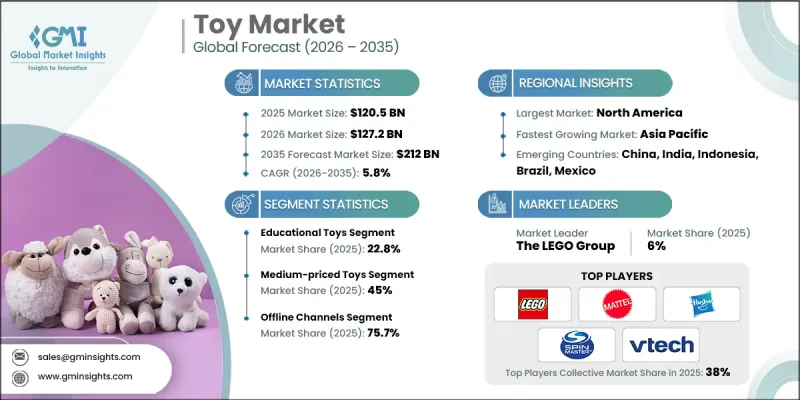
The Global Toy Market was valued at USD 120.5 billion in 2025 and is estimated to grow at a CAGR of 5.8% to reach USD 212 billion by 2035.
The industry is reshaped by advances in technology and evolving consumer expectations. Toys are no longer just for entertainment; they now combine learning, engagement, and play. Modern consumers seek products that offer educational value while keeping children entertained. Connected and smart toys, often paired with mobile applications, allow parents to monitor playtime, set limits, and track developmental progress. Digital integration, such as Bluetooth-enabled toys, voice prompts, and feedback-based learning, enhances the play experience. Physical play now blends with digital interaction, creating immersive experiences that appeal to tech-savvy children. Manufacturers are responding with innovative products that support cognitive development, creativity, and interactive learning while aligning with parental expectations for safe and beneficial play.
| Market Scope | |
|---|---|
| Start Year | 2025 |
| Forecast Year | 2026-2035 |
| Start Value | $120.5 Billion |
| Forecast Value | $212 Billion |
| CAGR | 5.8% |
The educational toys segment accounted for USD 27.52 billion in 2025, representing 22.8% share, and is projected to grow at a CAGR of 6.6% through 2035. This segment thrives due to a growing parental focus on early childhood education and school preparedness. Smart educational toys with app connectivity, adaptive learning, and progress tracking are particularly popular for enhancing cognitive and problem-solving skills.
The medium-priced toys segment held a 45% share in 2025, generating USD 54.79 billion with an expected CAGR of 6.1% through 2035. These products balance quality, features, and affordability, appealing to mainstream consumers while offering satisfactory play experiences. Budget-friendly toys target cost-conscious buyers, while premium offerings include advanced construction sets, collectibles, and technology-driven toys for affluent customers.
U.S. Toy Market held a 79% share, generating USD 25.27 billion in 2025 and is expected to grow at 6% CAGR through 2035. Market growth is driven by high consumer spending power, established retail networks, and strong brand loyalty. Licensed toys linked to popular entertainment franchises remain highly sought-after. Regulatory frameworks ensure safety, enhancing consumer confidence. The Canadian market follows similar trends with additional demand for bilingual and educational products that support English and French learning.
Key players operating in the Global Toy Market include Hasbro, Inc., Mattel, Inc., Bandai Namco Holdings Inc., MGA Entertainment, Inc., The LEGO Group, Spin Master Corp., Ravensburger AG, VTech Holdings Ltd., Schleich GmbH, Moose Toys, Playmobil, JAKKS Pacific, Inc., Jazwares, LLC, Tomy Company, Ltd., and Basic Fun, Inc. Companies in the Toy Market are implementing diverse strategies to strengthen their presence and expand market share. They focus on product innovation by integrating smart technology, app connectivity, and adaptive learning features to enhance educational value and engagement. Strategic partnerships with licensors and entertainment franchises extend brand appeal and attract fans. Expanding digital and offline retail networks ensures broad market accessibility, while targeted marketing campaigns, influencer collaborations, and seasonal promotions drive sales. Companies also emphasize regulatory compliance, safety certifications, and sustainability initiatives to build consumer trust.
Table of Contents
Chapter 1 Methodology and Scope
- 1.1 Market scope and definition
- 1.2 Research design
- 1.2.1 Research approach
- 1.2.2 Data collection methods
- 1.3 Data mining sources
- 1.3.1 Global
- 1.3.2 Regional/Country
- 1.4 Base estimates and calculations
- 1.4.1 Base year calculation
- 1.4.2 Key trends for market estimation
- 1.5 Primary research and validation
- 1.5.1 Primary sources
- 1.6 Forecast model
- 1.7 Research assumptions and limitations
Chapter 2 Executive Summary
- 2.1 Industry 360° synopsis
- 2.2 Key market trends
- 2.2.1 Regional
- 2.2.2 Product Type
- 2.2.3 Price Range
- 2.2.4 Age Group
- 2.2.5 Material
- 2.2.6 End User
- 2.2.7 Distribution channel
- 2.3 CXO perspectives: Strategic imperatives
- 2.3.1 Key decision points for industry executives
- 2.3.2 Critical success factors for market players
- 2.4 Future outlook and strategic recommendations
Chapter 3 Industry Insights
- 3.1 Industry ecosystem analysis
- 3.1.1 Supplier landscape
- 3.1.2 Profit margin
- 3.1.3 Value addition at each stage
- 3.1.4 Factor affecting the value chain
- 3.2 Industry impact forces
- 3.2.1 Growth drivers
- 3.2.1.1 Rising demand for educational and STEM toys
- 3.2.1.2 Integration of smart technology and connectivity
- 3.2.1.3 Growing focus on sustainability
- 3.2.2 Industry pitfalls & challenges
- 3.2.2.1 Price sensitivity in emerging markets
- 3.2.2.2 Rapid product lifecycle and trend changes
- 3.2.3 Opportunities
- 3.2.3.1 Growth of e-commerce and direct-to-consumer sales
- 3.2.3.2 Emerging markets expansion
- 3.2.1 Growth drivers
- 3.3 Growth potential analysis
- 3.4 Future market trends
- 3.5 Technology and innovation landscape
- 3.5.1 Current technological trends
- 3.5.2 Emerging technologies
- 3.6 Price trends
- 3.6.1 Historical Price Trend Analysis (Driven by Primary Research) (2019-2024)
- 3.6.2 Pricing Strategy by Player Type (Premium/Value/Budget) (Driven by Primary Research)
- 3.6.3 Regional Price Variation & Purchasing Power Parity (Driven by Primary Research)
- 3.6.4 Impact of Material Costs on Retail Pricing (Driven by Primary Research)
- 3.7 Regulatory landscape
- 3.7.1 Standards and compliance requirements
- 3.7.2 Regional regulatory frameworks
- 3.7.3 Certification standards
- 3.8 Porter's analysis
- 3.9 PESTEL analysis
- 3.10 Trade Data Analysis (Driven by Primary Research)
- 3.10.1 Import/Export Volume & Value Trends by HS Code (Driven by Primary Research)
- 3.10.2 Key Trade Corridors & Tariff Impact (Driven by Primary Research)
- 3.10.3 Major Exporting Countries (China, Vietnam, Thailand) (Driven by Primary Research)
- 3.10.4 Major Importing Countries (US, UK, Germany, Australia) (Driven by Primary Research)
- 3.11 Impact of AI & Generative AI on the Market
- 3.11.1 AI-Driven Disruption of Traditional Toy Design & Development
- 3.11.2 GenAI Use Cases (Personalized Toys, Voice-Interactive Learning, Adaptive Play)
- 3.11.3 Adoption Roadmap by Product Segment (Educational vs. Entertainment Toys)
- 3.11.4 Risks, Limitations & Regulatory Considerations (Data Privacy, Screen Time Concerns)
- 3.12 Distribution Infrastructure & Channel Penetration Landscape (Driven by Primary Research)
- 3.12.1 Channel Coverage by Region & Format (Modern Trade vs. Traditional Retail) (Driven by Primary Research)
- 3.12.2 Last-Mile Infrastructure Gaps & Emerging Channel Shifts (D2C, Social Commerce) (Driven by Primary Research)
Chapter 4 Competitive Landscape, 2025
- 4.1 Introduction
- 4.2 Company market share analysis
- 4.2.1 By region
- 4.2.1.1 North America
- 4.2.1.2 Europe
- 4.2.1.3 Asia Pacific
- 4.2.1.4 Latin America
- 4.2.1.5 Middle East and Africa
- 4.2.1 By region
- 4.3 Company matrix analysis
- 4.4 Competitive analysis of major market players
- 4.5 Competitive positioning matrix
- 4.6 Key developments
- 4.6.1 Mergers & acquisitions
- 4.6.2 Partnerships & collaborations
- 4.6.3 New product launches
- 4.6.4 Expansion plans
Chapter 5 Market Estimates & Forecast, By Product Type, 2022 - 2035 (USD Billion) (Thousand Units)
- 5.1 Key trends
- 5.2 Educational Toy
- 5.3 Construction Toy
- 5.4 Musical Toy
- 5.5 Game Toy
- 5.6 Doll & Miniature
- 5.7 Automotive Toy
- 5.8 Pretended Play Toy
- 5.9 Others (Art and Craft Toys, Musical Instruments etc.)
Chapter 6 Market Estimates & Forecast, By Price Range, 2022 - 2035 (USD Billion) (Thousand Units)
- 6.1 Key trends
- 6.2 Low
- 6.3 Medium
- 6.4 High
Chapter 7 Market Estimates & Forecast, By Age Group, 2022 - 2035 (USD Billion) (Thousand Units)
- 7.1 Key trends
- 7.2 Below 1 Yrs.
- 7.3 Age 1- 3
- 7.4 Age 3- 5
- 7.5 Age 5- 12
- 7.6 Age 12+
Chapter 8 Market Estimates & Forecast, By Material, 2022 - 2035 (USD Billion) (Thousand Units)
- 8.1 Key trends
- 8.2 Plastic
- 8.3 Wooden
- 8.4 Metal
- 8.5 Fabric
- 8.6 Biodegradable/Organic Materials
Chapter 9 Market Estimates & Forecast, By End-use, 2022 - 2035 (USD Billion) (Thousand Units)
- 9.1 Key trends
- 9.2 Individual
- 9.3 Commercial
Chapter 10 Market Estimates & Forecast, By Distribution Channel, 2022 - 2035 (USD Billion) (Thousand Units)
- 10.1 Key trends
- 10.2 Online
- 10.2.1 E-Commerce Website
- 10.2.2 Company Owned Website
- 10.3 Offline
- 10.3.1 Hypermarket/Supermarket
- 10.3.2 Departmental Stores
- 10.3.3 Specialized Stores
- 10.3.4 Other Retail Stores
Chapter 11 Market Estimates and Forecast, By Region, 2022 - 2035 (USD Billion) (Thousand Units)
- 11.1 Key trends
- 11.2 North America
- 11.2.1 U.S.
- 11.2.2 Canada
- 11.3 Europe
- 11.3.1 Germany
- 11.3.2 UK
- 11.3.3 France
- 11.3.4 Italy
- 11.3.5 Spain
- 11.4 Asia Pacific
- 11.4.1 China
- 11.4.2 Japan
- 11.4.3 India
- 11.4.4 Australia
- 11.4.5 South Korea
- 11.5 Latin America
- 11.5.1 Brazil
- 11.5.2 Mexico
- 11.5.3 Argentina
- 11.6 Middle East and Africa
- 11.6.1 South Africa
- 11.6.2 Saudi Arabia
- 11.6.3 UAE
Chapter 12 Company Profiles
- 12.1 Bandai Namco Holdings Inc.
- 12.2 Basic Fun, Inc.
- 12.3 Hasbro, Inc.
- 12.4 JAKKS Pacific, Inc.
- 12.5 Jazwares, LLC
- 12.6 Mattel, Inc.
- 12.7 MGA Entertainment, Inc.
- 12.8 Moose Toys
- 12.9 Playmobil
- 12.10 Ravensburger AG
- 12.11 Schleich GmbH
- 12.12 Spin Master Corp.
- 12.13 The LEGO Group
- 12.14 Tomy Company, Ltd.
- 12.15 VTech Holdings Ltd.

