PUBLISHER: Global Market Insights Inc. | PRODUCT CODE: 2027619

PUBLISHER: Global Market Insights Inc. | PRODUCT CODE: 2027619
Line Printer Market Opportunity, Growth Drivers, Industry Trend Analysis, and Forecast 2026 - 2035
The Global Line Printer Market was valued at USD 1.3 billion in 2025 and is estimated to grow at a CAGR of 4.8% to reach USD 2.1 billion by 2035.
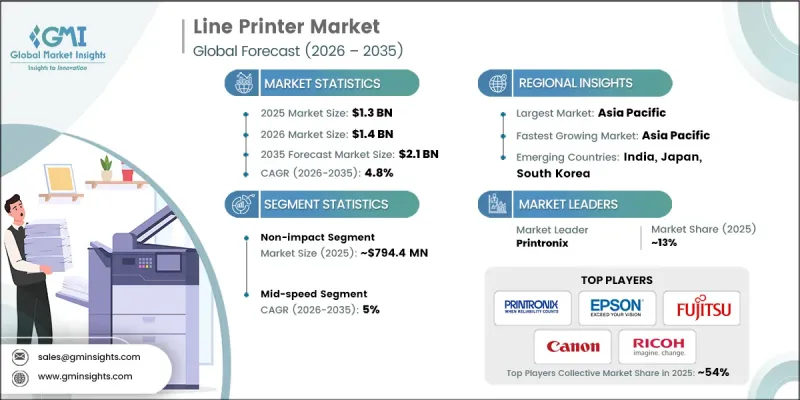
Market growth is driven by the rising need for high-speed printing solutions across large-scale data processing environments. Organizations handling extensive transactional data require dependable systems capable of delivering consistent and uninterrupted output. High-volume operations across enterprise systems and data-intensive environments demand robust printing equipment designed for durability and continuous performance. Line printers are increasingly preferred due to their ability to handle substantial workloads with minimal downtime, making them essential for maintaining operational efficiency. Their long service life and heavy-duty construction further enhance their value in demanding applications. Businesses are prioritizing solutions that enable seamless data processing and reporting while minimizing disruptions. The growing reliance on high-speed printing technologies to manage bulk workloads is strengthening overall productivity, positioning the line printer market as a stable and essential component within enterprise infrastructure.
| Market Scope | |
|---|---|
| Start Year | 2025 |
| Forecast Year | 2026-2035 |
| Start Value | $1.3 Billion |
| Forecast Value | $2.1 Billion |
| CAGR | 4.8% |
Rising adoption across financial institutions and public sector organizations is creating additional growth opportunities for the line printer industry. These entities manage large volumes of transactional documentation that require reliable and continuous output. The need for uninterrupted printing to support daily operational workflows is reinforcing demand for high-performance systems. Reliable print infrastructure remains critical for maintaining efficiency in documentation-heavy environments.
The non-impact segment generated USD 794.4 million in 2025 and is expected to grow at a CAGR of 4.6% through 2035. This segment leads the line printer market due to its efficiency, consistent output quality, and lower operational noise compared to traditional impact systems. Non-impact technologies operate without direct physical contact during printing, which reduces wear and maintenance requirements while ensuring stable performance. Their suitability for high-volume applications continues to support widespread adoption.
The mid-speed segment accounted for 45.3% share in 2025 and is projected to grow at a CAGR of 5% from 2026 to 2035. This segment dominates due to its balanced offering of performance, affordability, and operational reliability. Mid-speed printers provide sufficient output capacity for most industrial and enterprise requirements without the complexity or cost associated with higher-speed systems. Their efficiency and cost-effectiveness make them a preferred choice for organizations seeking dependable performance.
China Line Printer Market captured USD 126 million in 2025 with an anticipated CAGR of 5.9% through 2035. Market growth is supported by increasing demand from industrial and commercial sectors that rely on high-speed, large-volume printing solutions. Expanding operations in logistics, retail, and financial services are driving the adoption of durable and efficient printing systems. Manufacturers are focusing on enhancing product reliability, reducing maintenance needs, and improving integration with enterprise systems to meet evolving business requirements.
Key companies operating in the Global Line Printer Market include Canon Inc., Epson, Fujitsu Limited, Hewlett-Packard Development Company (HP), Ricoh Company, Ltd., Xerox Corporation, Toshiba Tec Corporation, OKI Data Corporation, Printronix, Bixolon Co., Ltd., Citizen Systems Japan Co., Ltd., DASCOM, Jolimark Holdings Limited, Microplex GmbH, and Star Micronics Co., Ltd. Companies in the Line Printer Market are strengthening their market presence through continuous product innovation and performance optimization. Manufacturers are investing in advanced technologies to enhance printing speed, durability, and operational efficiency. Expanding product portfolios to address diverse industrial requirements is a key focus area. Strategic collaborations and distribution network expansion are enabling broader market reach. Companies are also prioritizing energy efficiency and reduced maintenance to improve overall value for customers. Additionally, integration with modern enterprise systems and improved connectivity features are helping businesses streamline operations, while after-sales support and service capabilities are enhancing long-term customer relationships.
Table of Contents
Chapter 1 Methodology & Scope
- 1.1 Market scope and definition
- 1.2 Research design
- 1.2.1 Research approach
- 1.2.2 Data collection methods
- 1.3 Data mining sources
- 1.3.1 Global
- 1.3.2 Regional/Country
- 1.4 Base estimates and calculations
- 1.4.1 Base year calculation
- 1.4.2 Key trends for market estimation
- 1.5 Primary research and validation
- 1.5.1 Primary sources
- 1.6 Forecast model
- 1.7 Research assumptions and limitations
Chapter 2 Executive Summary
- 2.1 Industry 360° synopsis
- 2.2 Key market trends
- 2.2.1 Regional
- 2.2.2 Product type
- 2.2.3 Print speed
- 2.2.4 Application
- 2.2.5 End use
- 2.2.6 Distribution channel
Chapter 3 Industry Insights
- 3.1 Industry ecosystem analysis
- 3.1.1 Supplier landscape
- 3.1.2 Profit margin
- 3.1.3 Value addition at each stage
- 3.1.4 Factor affecting the value chain
- 3.2 Industry impact forces
- 3.2.1 Growth drivers
- 3.2.1.1 Continued demand for high-speed printing in large-scale data processing environments
- 3.2.1.2 Adoption in banking, financial services, and government institutions
- 3.2.1.3 Durability and long operational life of impact printing technologies
- 3.2.2 Pitfalls & Challenges
- 3.2.2.1 Declining demand due to digital documentation and paperless workflows
- 3.2.2.2 Competition from modern laser and high-speed inkjet printers
- 3.2.3 Opportunities
- 3.2.3.1 Sustained demand in legacy enterprise systems and mainframe environments
- 3.2.3.2 Development of compact and energy-efficient line printer models
- 3.2.1 Growth drivers
- 3.3 Growth potential analysis
- 3.4 Future market trends
- 3.5 Technology and innovation landscape
- 3.5.1 Current technological trends
- 3.5.2 Emerging technologies
- 3.6 Regulatory landscape
- 3.6.1 Standards and compliance requirements
- 3.6.2 Regional regulatory frameworks
- 3.6.3 Certification standards
- 3.7 Porter's analysis
- 3.8 PESTEL analysis
- 3.9 Pricing analysis (driven by primary research)
- 3.9.1 Historical price trend analysis (driven by primary research) (2019-2024)
- 3.9.2 Pricing strategy by player type (premium / value / cost-plus) (driven by primary research)
- 3.10 Trade data analysis (driven by paid data base)
- 3.10.1 Import/export volume & value trends by HS code (driven by paid data base)
- 3.10.2 Key trade corridors & tariff impact analysis (driven by paid data base)
- 3.11 Impact of AI & generative AI on the market
- 3.11.1 AI-driven disruption of existing business models
- 3.11.2 GenAI use cases & adoption roadmap by segment
- 3.11.3 Risks, limitations & regulatory considerations
- 3.12 Capacity & production landscape (driven by primary research)
- 3.12.1 Installed capacity by region & key producer (driven by primary research)
- 3.12.2 Capacity utilization rates & expansion pipelines (driven by primary research)
Chapter 4 Competitive Landscape, 2025
- 4.1 Introduction
- 4.2 Company market share analysis
- 4.2.1 By Region
- 4.2.1.1 North America
- 4.2.1.2 Europe
- 4.2.1.3 Asia Pacific
- 4.2.1.4 Latin America
- 4.2.1.5 Middle East & Africa
- 4.2.1 By Region
- 4.3 Company matrix analysis
- 4.4 Competitive analysis of major market players
- 4.5 Competitive positioning matrix
- 4.6 Key developments
- 4.6.1 Mergers & acquisitions
- 4.6.2 Partnerships & collaborations
- 4.6.3 New product launches
- 4.6.4 Expansion plans
Chapter 5 Market Estimates & Forecast, By Product Type, 2022 - 2035, (USD Million) (Thousand Units)
- 5.1 Key trends
- 5.2 Impact line printers
- 5.2.1 Drum printers
- 5.2.2 Chain printers
- 5.2.3 Band printers
- 5.2.4 Dot matrix printers
- 5.3 Non-impact line printers
- 5.3.1 Thermal line printers
- 5.3.2 Electrostatic printers
Chapter 6 Market Estimates & Forecast, By Print Speed, 2022 - 2035, (USD Million) (Thousand Units)
- 6.1 Key trends
- 6.2 Low
- 6.3 Mid
- 6.4 High
Chapter 7 Market Estimates & Forecast, By Application, 2022 - 2035, (USD Million) (Thousand Units)
- 7.1 Key trends
- 7.2 Transaction printouts
- 7.3 Report printing
- 7.4 Barcode and label printing
- 7.5 Document printing
- 7.6 Others
Chapter 8 Market Estimates & Forecast, By End-use, 2022 - 2035, (USD Million) (Thousand Units)
- 8.1 Key trends
- 8.2 Manufacturing and industrial sector
- 8.3 Retail and logistics
- 8.4 Banking and financial services
- 8.5 Healthcare
- 8.6 Government and public sector
- 8.7 Telecommunication and IT
- 8.8 Others
Chapter 9 Market Estimates & Forecast, By Distribution Channel, 2022 - 2035, (USD Million) (Thousand Units)
- 9.1 Key trends
- 9.2 Direct
- 9.3 Indirect
Chapter 10 Market Estimates & Forecast, By Region, 2022 - 2035, (USD Million) (Thousand Units)
- 10.1 Key trends
- 10.2 North America
- 10.2.1 U.S.
- 10.2.2 Canada
- 10.3 Europe
- 10.3.1 Germany
- 10.3.2 UK
- 10.3.3 France
- 10.3.4 Italy
- 10.3.5 Spain
- 10.4 Asia Pacific
- 10.4.1 China
- 10.4.2 India
- 10.4.3 Japan
- 10.4.4 South Korea
- 10.4.5 Australia
- 10.5 Latin America
- 10.5.1 Brazil
- 10.5.2 Mexico
- 10.5.3 Argentina
- 10.6 MEA
- 10.6.1 Saudi Arabia
- 10.6.2 UAE
- 10.6.3 South Africa
Chapter 11 Company Profiles
- 11.1 Bixolon Co., Ltd.
- 11.2 Canon Inc.
- 11.3 Citizen Systems Japan Co., Ltd.
- 11.4 DASCOM
- 11.5 Epson
- 11.6 Fujitsu Limited
- 11.7 Hewlett-Packard Development Company (HP)
- 11.8 Jolimark Holdings Limited
- 11.9 Microplex GmbH
- 11.10 OKI Data Corporation
- 11.11 Printronix
- 11.12 Ricoh Company, Ltd.
- 11.13 Star Micronics Co., Ltd.
- 11.14 Toshiba Tec Corporation
- 11.15 Xerox Corporation

