PUBLISHER: Global Market Insights Inc. | PRODUCT CODE: 2027621

PUBLISHER: Global Market Insights Inc. | PRODUCT CODE: 2027621
Casters Market Opportunity, Growth Drivers, Industry Trend Analysis, and Forecast 2026 - 2035
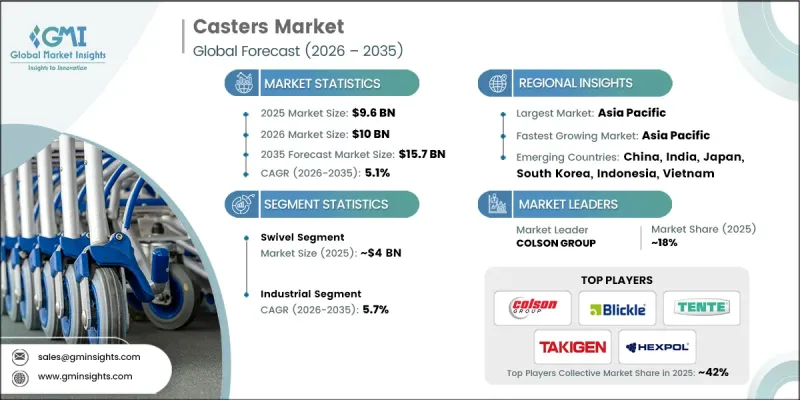
The Global Casters Market was valued at USD 9.6 billion in 2025 and is estimated to grow at a CAGR of 5.1% to reach USD 15.7 billion by 2035.
Market growth is fueled by the rapid expansion of logistics networks, material handling systems, and industrial infrastructure across global economies. Increasing demand for efficient movement of goods within warehouses, production facilities, and distribution hubs is significantly boosting the adoption of caster-based mobility solutions. The continued rise of e-commerce is accelerating the development of fulfillment centers, where mobile equipment plays a crucial role in operational efficiency. Businesses are increasingly prioritizing durable and high-performance mobility components that can handle heavy loads and continuous usage. At the same time, manufacturing environments are evolving toward flexible and modular production systems, driving the use of mobile workstations and equipment. This shift is encouraging the integration of robust and long-lasting casters into industrial setups. Additionally, the growing emphasis on reducing manual labor and improving workflow efficiency is further strengthening demand, positioning the casters market as a vital component of modern industrial and logistics ecosystems.
| Market Scope | |
|---|---|
| Start Year | 2025 |
| Forecast Year | 2026-2035 |
| Start Value | $9.6 Billion |
| Forecast Value | $15.7 Billion |
| CAGR | 5.1% |
The swivel segment generated USD 4 billion in 2025 and is expected to grow at a CAGR of 5.8% through 2035. This segment leads the casters market due to its high level of flexibility and ease of movement across diverse applications. Swivel casters enable full rotational movement, allowing equipment to be maneuvered smoothly in multiple directions with minimal effort. Their adaptability makes them suitable for a wide range of uses where precision and mobility are essential. Increasing demand for ergonomic equipment and efficient handling solutions continues to support segment growth, reinforcing its strong market position.
The industrial segment accounted for 41.6% share in 2025 and is projected to grow at a CAGR of 5.7% between 2026 and 2035. This segment dominates due to the need for heavy-duty mobility solutions in demanding operational environments. Industrial casters are engineered to support substantial loads, endure harsh conditions, and maintain performance over extended periods. Their durability, resistance to wear, and ability to function across different surfaces make them essential in large-scale operations. Ongoing industrialization, warehouse automation, and infrastructure expansion continue to drive strong demand in this segment.
China Casters Market captured USD 1.2 billion in 2025 and is anticipated to grow at a CAGR of 6.4% through 2035, supported by rapid growth in manufacturing, logistics, and large-scale distribution systems. Increasing reliance on efficient material handling solutions is encouraging widespread adoption of high-performance casters across industrial and commercial environments. Domestic production capabilities are also strengthening, with a focus on developing durable and application-specific products that meet evolving operational requirements. Growth in organized retail, healthcare infrastructure, and logistics facilities further contributes to rising demand.
Key companies operating in the Global Casters Market include Blickle, Colson Group, TENTE, Hamilton Caster, RWM Casters, Takigen, Tellure, Regal Castors, Payson Casters, TrioPines, ZONWE, Er Wagner, Hexpol, Flywheel Metalwork, and Cebora. Companies in the casters market are focusing on innovation, durability, and customization to strengthen their competitive position. Manufacturers are investing in advanced materials and engineering techniques to improve load capacity, wear resistance, and overall product lifespan. Expanding product portfolios to cater to specialized industrial requirements is also a key priority. Strategic partnerships and distribution expansion are helping companies enhance market reach and customer accessibility. Firms are increasingly emphasizing ergonomic design and safety features to align with workplace efficiency standards. Additionally, integration with automated systems and smart manufacturing environments is becoming a focal point, enabling companies to stay competitive in a rapidly evolving industrial landscape.
Table of Contents
Chapter 1 Methodology & Scope
- 1.1 Market scope and definition
- 1.2 Research design
- 1.2.1 Research approach
- 1.2.2 Data collection methods
- 1.3 Data mining sources
- 1.3.1 Global
- 1.3.2 Regional/Country
- 1.4 Base estimates and calculations
- 1.4.1 Base year calculation
- 1.4.2 Key trends for market estimation
- 1.5 Primary research and validation
- 1.5.1 Primary sources
- 1.6 Forecast model
- 1.7 Research assumptions and limitations
Chapter 2 Executive Summary
- 2.1 Industry 360° synopsis
- 2.2 Key market trends
- 2.2.1 Regional
- 2.2.2 Type
- 2.2.3 Material
- 2.2.4 Load capacity
- 2.2.5 Mounting
- 2.2.6 Application
- 2.2.7 End use
- 2.2.8 Distribution channel
Chapter 3 Industry Insights
- 3.1 Industry ecosystem analysis
- 3.1.1 Supplier landscape
- 3.1.2 Profit margin
- 3.1.3 Value addition at each stage
- 3.1.4 Factor affecting the value chain
- 3.2 Industry impact forces
- 3.2.1 Growth drivers
- 3.2.1.1 Expansion of material handling and logistics operations
- 3.2.1.2 Rising adoption of automation and mobile equipment in manufacturing facilities
- 3.2.1.3 Growth of healthcare infrastructure and medical equipment usage
- 3.2.2 Pitfalls & Challenges
- 3.2.2.1 High wear and tear in heavy-duty industrial environments
- 3.2.2.2 Intense price competition among global and regional manufacturers
- 3.2.3 Opportunities
- 3.2.3.1 Growing demand for ergonomic and low-noise mobility solutions
- 3.2.3.2 Development of smart casters with tracking and load monitoring capabilities
- 3.2.1 Growth drivers
- 3.3 Growth potential analysis
- 3.4 Future market trends
- 3.5 Technology and innovation landscape
- 3.5.1 Current technological trends
- 3.5.2 Emerging technologies
- 3.6 Regulatory landscape
- 3.6.1 Standards and compliance requirements
- 3.6.2 Regional regulatory frameworks
- 3.6.3 Certification standards
- 3.7 Porter's analysis
- 3.8 PESTEL analysis
- 3.9 Pricing analysis (driven by primary research)
- 3.9.1 Historical price trend analysis (driven by primary research)
- 3.9.2 Pricing strategy by player type (premium / value / cost-plus) (driven by primary research)
- 3.9.3 Regional price variations
- 3.10 Trade data analysis (driven by paid database)
- 3.10.1 Import/export volume & value trends (driven by primary research)
- 3.10.2 Key trade corridors & tariff impact (driven by primary research)
- 3.10.3 Major importing & exporting countries
Chapter 4 Competitive Landscape, 2025
- 4.1 Introduction
- 4.2 Company market share analysis
- 4.2.1 By Region
- 4.2.1.1 North America
- 4.2.1.2 Europe
- 4.2.1.3 Asia Pacific
- 4.2.1.4 Latin America
- 4.2.1.5 Middle East & Africa
- 4.2.1 By Region
- 4.3 Company matrix analysis
- 4.4 Competitive analysis of major market players
- 4.5 Competitive positioning matrix
- 4.6 Key developments
- 4.6.1 Mergers & acquisitions
- 4.6.2 Partnerships & collaborations
- 4.6.3 New product launches
- 4.6.4 Expansion plans
Chapter 5 Market Estimates & Forecast, By Type, 2022 - 2035, (USD Billion) (Thousand Units)
- 5.1 Key trends
- 5.2 Swivel
- 5.3 Rigid/ Fixed
- 5.4 Ball bearing
- 5.5 Kingpin
Chapter 6 Market Estimates & Forecast, By Material, 2022 - 2035, (USD Billion) (Thousand Units)
- 6.1 Key trends
- 6.2 Metal
- 6.3 Rubber
- 6.4 Plastic
- 6.5 Polyurethane
Chapter 7 Market Estimates & Forecast, By Load Capacity, 2022 - 2035, (USD Billion) (Thousand Units)
- 7.1 Key trends
- 7.2 Light-duty
- 7.3 Medium-duty
- 7.4 Heavy-duty
Chapter 8 Market Estimates & Forecast, By Mounting, 2022 - 2035, (USD Billion) (Thousand Units)
- 8.1 Key trends
- 8.2 Plate
- 8.3 Stem
Chapter 9 Market Estimates & Forecast, By Application, 2022 - 2035, (USD Billion) (Thousand Units)
- 9.1 Key trends
- 9.2 Industrial
- 9.3 Commercial
- 9.4 Healthcare
- 9.5 Residential
Chapter 10 Market Estimates & Forecast, By End Use, 2022 - 2035, (USD Billion) (Thousand Units)
- 10.1 Key trends
- 10.2 Automotive
- 10.3 Aerospace
- 10.4 Food Industry
- 10.5 Medical
- 10.6 Textile industry
- 10.7 Other end-users
Chapter 11 Market Estimates & Forecast, By Distribution Channel, 2022 - 2035, (USD Billion) (Thousand Units)
- 11.1 Key trends
- 11.2 Direct
- 11.3 Indirect
Chapter 12 Market Estimates & Forecast, By Region, 2022 - 2035, (USD Billion) (Thousand Units)
- 12.1 Key trends
- 12.2 North America
- 12.2.1 U.S.
- 12.2.2 Canada
- 12.3 Europe
- 12.3.1 Germany
- 12.3.2 UK
- 12.3.3 France
- 12.3.4 Italy
- 12.3.5 Spain
- 12.4 Asia Pacific
- 12.4.1 China
- 12.4.2 India
- 12.4.3 Japan
- 12.4.4 South Korea
- 12.4.5 Australia
- 12.5 Latin America
- 12.5.1 Brazil
- 12.5.2 Mexico
- 12.5.3 Argentina
- 12.6 MEA
- 12.6.1 Saudi Arabia
- 12.6.2 UAE
- 12.6.3 South Africa
Chapter 13 Company Profiles
- 13.1 Blickle
- 13.2 Cebora
- 13.3 COLSON GROUP
- 13.4 Er Wagner
- 13.5 Flywheel Metalwork
- 13.6 Hamilton Caster
- 13.7 Hexpol
- 13.8 Payson Casters
- 13.9 Regal Castors
- 13.10 RWM Casters
- 13.11 Takigen
- 13.12 Tellure
- 13.13 TENTE
- 13.14 TrioPines
- 13.15 ZONWE

