PUBLISHER: Global Market Insights Inc. | PRODUCT CODE: 2027623

PUBLISHER: Global Market Insights Inc. | PRODUCT CODE: 2027623
Rice Derivative Market Opportunity, Growth Drivers, Industry Trend Analysis, and Forecast 2026 - 2035
The Global Rice Derivative Market was valued at USD 20.2 billion in 2025 and is estimated to grow at a CAGR of 5.9% to reach USD 35.5 billion by 2035.
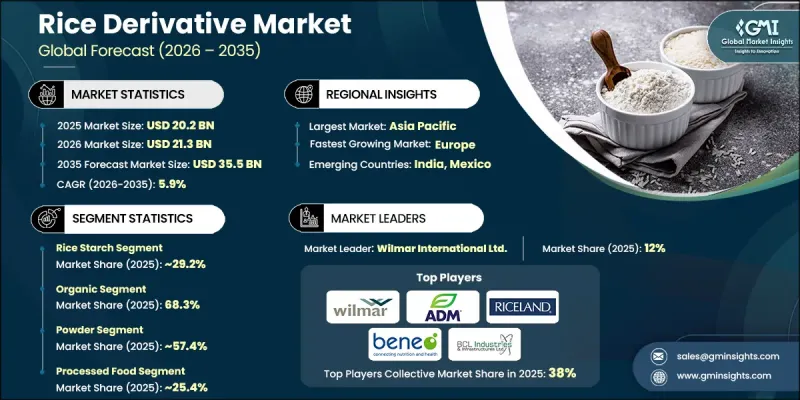
Market growth is driven by rising demand across the food and beverage, pharmaceutical, cosmetic, and nutritional supplement industries. Consumers are increasingly shifting toward rice-based ingredients due to their multifunctional benefits, allergen-friendly nature, and naturally gluten-free composition. These derivatives are gaining strong traction as plant-based and sustainable alternatives to synthetic and animal-derived ingredients, aligning with evolving health and wellness trends. Their ability to enhance texture, improve product stability, and boost nutritional value makes them highly valuable in a wide range of applications, supporting the development of functional and specialty products. Ongoing investments in research and development are accelerating innovation, enabling manufacturers to introduce advanced formulations that meet changing consumer preferences. Growing awareness regarding the health benefits of organic rice derivatives, along with rising demand for clean-label and fortified products, is further supporting market expansion. In addition, advancements in processing technologies are allowing companies to diversify their offerings and better cater to various end-user requirements.
| Market Scope | |
|---|---|
| Start Year | 2025 |
| Forecast Year | 2026-2035 |
| Start Value | $20.2 Billion |
| Forecast Value | $35.5 Billion |
| CAGR | 5.9% |
The rice starch segment accounted for 29.2% share in 2025 and is expected to grow at a CAGR of 4.9% through 2035. This segment continues to perform strongly due to its versatility and wide applicability across multiple industries. Its functional properties, including stabilization, texture enhancement, and hypoallergenic characteristics, make it a preferred ingredient in various formulations. Its role in improving consistency and product quality further strengthens its position in the market.
The organic segment held a 68.3% share in 2025 and is anticipated to grow at a CAGR of 5.7% from 2026 to 2035. Increasing consumer preference for naturally processed, sustainable, and clean-label products is driving demand within this segment. Organic rice derivatives are widely utilized in premium product categories, supported by regulatory compliance and growing emphasis on transparency in sourcing and production practices.
North America Rice Derivative Market accounted for 32.5% share in 2025, reflecting strong regional growth. The region benefits from advanced processing infrastructure, well-established supply chains, and strict quality standards, which encourage the adoption of high-value rice-based ingredients across multiple industries. Continued innovation and demand for health-oriented products are further strengthening market expansion in this region.
Key companies operating in the Global Rice Derivative Market include Archer Daniels Midland Company, Wilmar International Ltd., Riceland Foods Inc., Axiom Foods, RiceBran Technologies, BENEO GmbH, PGP International, Golden Grain Group Limited, Agro Tech Foods Ltd., BCL Industries & Infrastructure Ltd., A.P. Refinery Pvt. Ltd., Maharashtra Solvent Extraction (P) Ltd., Panjin Hetian Food Co., Ltd., and Shafi Gluco Chem. Companies in the Rice Derivative Market are strengthening their competitive position by focusing on innovation, product diversification, and expansion into high-growth regions. Many players are investing in advanced processing technologies to improve product quality, functionality, and efficiency. Strategic partnerships and collaborations are being used to enhance distribution networks and expand market reach. Firms are also aligning their offerings with clean-label and organic trends to meet evolving consumer expectations. Additionally, companies are increasing their presence in emerging markets while optimizing supply chain operations to ensure consistent product availability. Emphasis on research and development, along with customized solutions for different industries, is helping companies build long-term customer relationships and sustain market growth.
Table of Contents
Chapter 1 Methodology & Scope
- 1.1 Market scope and definition
- 1.2 Research design
- 1.2.1 Research approach
- 1.2.2 Data collection methods
- 1.3 Data mining sources
- 1.3.1 Global
- 1.3.2 Regional/Country
- 1.4 Base estimates and calculations
- 1.4.1 Base year calculation
- 1.4.2 Key trends for market estimation
- 1.5 Primary research and validation
- 1.5.1 Primary sources
- 1.6 Forecast model
- 1.7 Research assumptions and limitations
Chapter 2 Executive Summary
- 2.1 Industry 360° synopsis
- 2.2 Key market trends
- 2.2.1 Regional
- 2.2.2 Ingredient Type
- 2.2.3 Nature
- 2.2.4 Form
- 2.2.5 Application
- 2.3 TAM Analysis, 2026-2035
- 2.4 CXO perspectives: Strategic imperatives
- 2.4.1 Executive decision points
- 2.4.2 Critical success factors
- 2.5 Future Outlook and Strategic Recommendations
Chapter 3 Industry Insights
- 3.1 Industry ecosystem analysis
- 3.1.1 Supplier landscape
- 3.1.2 Profit margin
- 3.1.3 Value addition at each stage
- 3.1.4 Factor affecting the value chain
- 3.1.5 Disruptions
- 3.2 Industry impact forces
- 3.2.1 Growth drivers
- 3.2.1.1 Gluten-free & allergen-free food demand
- 3.2.1.2 Growth of plant-based food & beverage sector
- 3.2.1.3 Nutraceutical & functional food expansion
- 3.2.2 Industry pitfalls and challenges
- 3.2.2.1 Raw material price volatility
- 3.2.2.2 Competition from soy, pea & oat derivatives
- 3.2.3 Market opportunities
- 3.2.3.1 Advanced rice protein formulations
- 3.2.3.2 Sustainable & organic production
- 3.2.1 Growth drivers
- 3.3 Growth potential analysis
- 3.4 Regulatory landscape
- 3.4.1 North America
- 3.4.2 Europe
- 3.4.3 Asia Pacific
- 3.4.4 Latin America
- 3.4.5 Middle East & Africa
- 3.5 Porter’s analysis
- 3.6 PESTEL analysis
- 3.7 Price trends
- 3.7.1 By region
- 3.7.2 By ingredient type
- 3.8 Future market trends
- 3.9 Technology and Innovation landscape
- 3.9.1 Current technological trends
- 3.9.2 Emerging technologies
- 3.10 Patent Landscape
- 3.11 Trade statistics (HS code)
- 3.11.1 Major importing countries
- 3.11.2 Major exporting countries
- 3.12 Sustainability and environmental aspects
- 3.12.1 Sustainable practices
- 3.12.2 Waste reduction strategies
- 3.12.3 Energy efficiency in production
- 3.12.4 Eco-friendly initiatives
- 3.13 Carbon footprint consideration
Chapter 4 Competitive Landscape, 2025
- 4.1 Introduction
- 4.2 Company market share analysis
- 4.2.1 By region
- 4.2.1.1 North America
- 4.2.1.2 Europe
- 4.2.1.3 Asia Pacific
- 4.2.1.4 LATAM
- 4.2.1.5 MEA
- 4.2.1 By region
- 4.3 Company matrix analysis
- 4.4 Competitive analysis of major market players
- 4.5 Competitive positioning matrix
- 4.6 Key developments
- 4.6.1 Mergers & acquisitions
- 4.6.2 Partnerships & collaborations
- 4.6.3 New Product Launches
- 4.6.4 Expansion Plans
Chapter 5 Market Estimates and Forecast, By Ingredient Type, 2022-2035 (USD Billion) (Kilo Tons)
- 5.1 Key trends
- 5.2 Rice Starch
- 5.3 Rice Bran
- 5.4 Rice Germ
- 5.5 Rice Oil
- 5.6 Rice Protein
- 5.7 Rice Fats
- 5.8 Rice Flour
- 5.9 Others
Chapter 6 Market Estimates and Forecast, By Nature, 2022-2035 (USD Billion) (Kilo Tons)
- 6.1 Key trends
- 6.2 Organic
- 6.3 Conventional
Chapter 7 Market Estimates and Forecast, By Form, 2022-2035 (USD Billion) (Kilo Tons)
- 7.1 Key trends
- 7.2 Powder
- 7.3 Liquid
- 7.4 Granular / Pellet
- 7.5 Others
Chapter 8 Market Estimates and Forecast, By Application, 2022-2035 (USD Billion) (Kilo Tons)
- 8.1 Key trends
- 8.2 Bakery
- 8.3 Processed Food
- 8.4 Beverages
- 8.5 Infant Food
- 8.6 Nutritional Products
- 8.7 Pharmaceutical
- 8.8 Cosmetic
- 8.9 Others
Chapter 9 Market Estimates and Forecast, By Region, 2022-2035 (USD Billion) (Kilo Tons)
- 9.1 Key trends
- 9.2 North America
- 9.2.1 U.S.
- 9.2.2 Canada
- 9.3 Europe
- 9.3.1 Germany
- 9.3.2 UK
- 9.3.3 France
- 9.3.4 Spain
- 9.3.5 Italy
- 9.3.6 Rest of Europe
- 9.4 Asia Pacific
- 9.4.1 China
- 9.4.2 India
- 9.4.3 Japan
- 9.4.4 Australia
- 9.4.5 South Korea
- 9.4.6 Rest of Asia Pacific
- 9.5 Latin America
- 9.5.1 Brazil
- 9.5.2 Mexico
- 9.5.3 Argentina
- 9.5.4 Rest of Latin America
- 9.6 Middle East and Africa
- 9.6.1 Saudi Arabia
- 9.6.2 South Africa
- 9.6.3 UAE
- 9.6.4 Rest of Middle East and Africa
Chapter 10 Company Profiles
- 10.1 Axiom Foods
- 10.2 Riceland Foods Inc.
- 10.3 Wilmar International Ltd.
- 10.4 Archer Daniels Midland Company
- 10.5 RiceBran Technologies
- 10.6 BENEO GmbH
- 10.7 Golden Grain Group Limited
- 10.8 PGP International
- 10.9 Agro Tech Foods Ltd.
- 10.10 BCL Industries & Infrastructure Ltd.
- 10.11 A.P. Refinery Pvt. Ltd.
- 10.12 Maharashtra Solvent Extraction (P) Ltd.
- 10.13 Panjin Hetian Food Co., Ltd.
- 10.14 Shafi Gluco Chem

