PUBLISHER: Global Market Insights Inc. | PRODUCT CODE: 2027625

PUBLISHER: Global Market Insights Inc. | PRODUCT CODE: 2027625
Digital Biomarkers Market Opportunity, Growth Drivers, Industry Trend Analysis, and Forecast 2026 - 2035
The Global Digital Biomarkers Market was valued at USD 4.8 billion in 2025 and is estimated to grow at a CAGR of 29.2% to reach USD 60.6 billion by 2035.
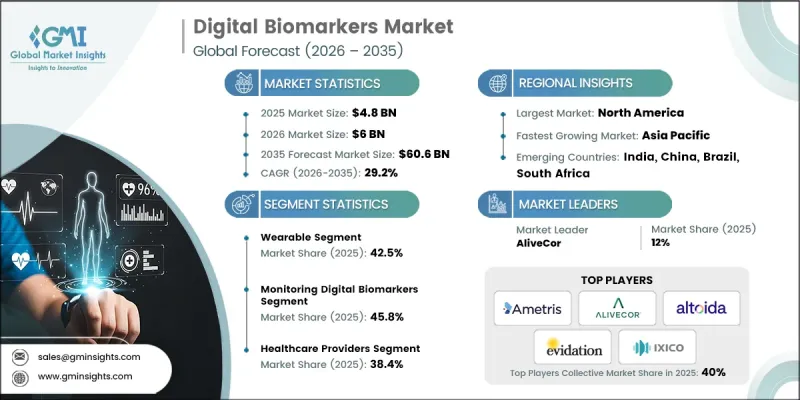
Market growth is fueled by advancements in sensor technologies, rising adoption of remote patient monitoring solutions, and the growing integration of AI-powered analytics into clinical research and healthcare delivery. The digital biomarkers market is gaining significant momentum as technology providers, pharmaceutical companies, and research organizations intensify investments in next-generation health monitoring tools. These stakeholders are advancing research and development efforts to introduce reliable and validated digital endpoints that enhance clinical trial efficiency and improve patient outcomes. Digital biomarkers refer to physiological, behavioral, and environmental data captured through connected devices such as wearables and sensor-enabled platforms. These data points enable continuous health assessment, disease progression tracking, and treatment evaluation. Increasing emphasis on precision medicine and personalized healthcare is further strengthening the adoption of digital biomarkers, positioning the global digital biomarkers market as a transformative force in modern healthcare systems.
| Market Scope | |
|---|---|
| Start Year | 2025 |
| Forecast Year | 2026-2035 |
| Start Value | $4.8 Billion |
| Forecast Value | $60.6 Billion |
| CAGR | 29.2% |
The digital biomarkers market is advancing rapidly as organizations prioritize innovation and expand capabilities in data-centric healthcare technologies. Increased investment in research initiatives is driving the development of highly accurate and validated digital measurement tools. Continuous progress in analytical capabilities is enabling improved interpretation of complex health data, supporting more effective clinical decision-making and patient monitoring. The ability to generate actionable insights from continuous data streams is enhancing both research outcomes and healthcare delivery efficiency.
The wearable segment accounted for 42.5% share in 2025, making it the leading category. Wearable devices enable continuous tracking of key physiological and behavioral indicators, providing a more comprehensive data set compared to periodic clinical assessments. This constant monitoring supports early detection of health variations and allows timely medical intervention. In addition, wearables offer a more convenient and non-invasive approach to health monitoring, which increases user acceptance and encourages broader adoption. The combination of accessibility, comfort, and real-time data collection continues to drive growth within this segment.
The cardiovascular and metabolic disorders segment held a 22.6% share in 2025. This segment reflects the growing use of digital biomarkers in monitoring and managing chronic health conditions. Continuous tracking of physiological parameters enables healthcare providers to understand disease progression better and make informed treatment decisions. Advanced monitoring solutions support early identification of irregular health patterns, improving preventive care and long-term disease management. The increasing need for effective monitoring of chronic conditions is reinforcing demand within this segment.
North America Digital Biomarkers Market captured a notable share in 2025, supported by advanced healthcare infrastructure, widespread adoption of connected devices, and early implementation of AI-enabled analytics in clinical workflows. The region benefits from established regulatory frameworks that are increasingly supportive of digital health technologies and remote monitoring solutions. These regulatory advancements are accelerating the validation and adoption of digital biomarkers in both research and clinical environments. Additionally, the high prevalence of chronic conditions is driving demand for continuous and real-time health monitoring, further strengthening market growth across North America.
Key companies operating in the Global Digital Biomarkers Market include Ametris, AliveCor, Altoida, Amgen Inc., Adherium Limited, Aural Analytic, Brainomix, Biogen, Clario, Empatica Inc., Evidation Health Inc., IXICO plc, Koneksa, Sonde Health, Inc., and Vivo Sense. Companies in the Digital Biomarkers Market are adopting strategic initiatives to enhance their competitive position and expand their global footprint. A primary focus is placed on advancing research and development to create highly accurate, validated, and scalable digital health solutions. Organizations are increasingly integrating artificial intelligence and advanced analytics to improve data interpretation and clinical relevance. Strategic collaborations with healthcare providers, research institutions, and technology firms are enabling faster innovation and broader adoption. Companies are also investing in regulatory compliance and validation processes to strengthen credibility and accelerate market entry. Expanding product portfolios and enhancing platform capabilities are helping businesses address diverse healthcare needs. Additionally, improving user experience through intuitive interfaces and seamless device integration supports higher adoption rates and long-term customer engagement.
Table of Contents
Chapter 1 Research Methodology
- 1.1 Research approach
- 1.2 Quality commitments
- 1.2.1 GMI AI policy & data integrity commitment
- 1.2.1.1 Source consistency protocol
- 1.2.1 GMI AI policy & data integrity commitment
- 1.3 Research trail & confidence scoring
- 1.3.1 Research trail components
- 1.3.2 Scoring components
- 1.4 Data collection
- 1.4.1 Partial list of primary sources
- 1.5 Data mining sources
- 1.5.1 Paid sources
- 1.5.1.1 Sources, by region
- 1.5.1 Paid sources
- 1.6 Base estimates and calculations
- 1.6.1 Base year calculation for any one approach
- 1.7 Forecast model
- 1.7.1 Quantified market impact analysis
- 1.7.1.1 Mathematical impact of growth parameters on forecast
- 1.7.1 Quantified market impact analysis
- 1.8 Research transparency addendum
- 1.8.1 Source attribution framework
- 1.8.2 Quality assurance metrics
- 1.8.3 Our commitment to trust
Chapter 2 Executive Summary
- 2.1 Industry 360° synopsis
- 2.2 Key market trends
- 2.3 Type trends
- 2.4 Clinical practice trends
- 2.5 Therapeutic area trends
- 2.6 End use trends
- 2.7 CXO perspectives: Strategic imperatives
Chapter 3 Industry Insights
- 3.1 Industry ecosystem analysis
- 3.2 Industry impact forces
- 3.2.1 Growth drivers
- 3.2.1.1 Rising prevalence of chronic diseases
- 3.2.1.2 Advancements in AI and machine learning
- 3.2.1.3 Adoption of wearable devices
- 3.2.1.4 Growing focus on remote monitoring
- 3.2.2 Industry pitfalls and challenges
- 3.2.2.1 High costs of advanced devices
- 3.2.2.2 Lack of skilled professionals
- 3.2.3 Market opportunity
- 3.2.3.1 Growing opportunity in brain health monitoring through passive, continuous digital biomarkers
- 3.2.1 Growth drivers
- 3.3 Growth potential analysis
- 3.4 Regulatory landscape
- 3.4.1 North America
- 3.4.2 Europe
- 3.4.3 Asia Pacific
- 3.4.4 Latin America
- 3.4.5 Middle East and Africa
- 3.5 Technological landscape (Driven by Primary Research)
- 3.5.1 Current technologies
- 3.5.1.1 ECG based cardiac biomarker systems
- 3.5.1.2 Ambient sensor-based digital biomarkers for early detection of heart failure decompensation
- 3.5.2 Emerging technologies
- 3.5.2.1 AI assisted detection of biomarkers using sensors and biosensors
- 3.5.2.2 Development of digital voice biomarkers for early Alzheimer's detection
- 3.5.1 Current technologies
- 3.6 Future market trends (Driven by Primary Research)
- 3.7 Impact of AI and Generative AI on the market (Driven by Primary Research)
- 3.8 Patent analysis (Driven by Primary Research)
- 3.9 Porter's analysis
- 3.10 PESTEL analysis
Chapter 4 Competitive Landscape, 2025
- 4.1 Introduction
- 4.2 Company market share analysis
- 4.2.1 North America
- 4.2.2 Europe
- 4.2.3 Asia Pacific
- 4.3 Company matrix analysis
- 4.4 Competitive analysis of major market players
- 4.5 Competitive positioning matrix
- 4.6 Key developments
- 4.6.1 Merger and acquisition
- 4.6.2 Partnership and collaboration
- 4.6.3 New product launches
- 4.6.4 Expansion plans
Chapter 5 Market Estimates and Forecast, By Type, 2022-2035 ($ Mn)
- 5.1 Key trends
- 5.2 Wearable
- 5.3 Mobile-based applications
- 5.4 Sensors
- 5.5 Other types
Chapter 6 Market Estimates and Forecast, By Clinical Practice, 2022-2035 ($ Mn)
- 6.1 Key trends
- 6.2 Diagnostic digital biomarkers
- 6.3 Monitoring digital biomarkers
- 6.4 Predictive and prognostic digital biomarkers
- 6.5 Other clinical practices
Chapter 7 Market Estimates and Forecast, By Therapeutic Area, 2022-2035 ($ Mn)
- 7.1 Key trends
- 7.2 Cardiovascular and metabolic disorders (CVMD)
- 7.3 Diabetes
- 7.4 Respiratory disorders
- 7.5 Psychiatric disorders
- 7.6 Sleep and movement diseases
- 7.7 Neurological disorders
- 7.8 Musculoskeletal disorders
- 7.9 Other therapeutic areas
Chapter 8 Market Estimates and Forecast, By End Use, 2022-2035 ($ Mn)
- 8.1 Key trends
- 8.2 Healthcare providers
- 8.3 Payers
- 8.4 Pharmaceutical and biotechnology companies
- 8.5 Academic and research institutions
Chapter 9 Market Estimates and Forecast, By Region, 2022-2035 ($ Mn)
- 9.1 Key trends
- 9.2 North America
- 9.2.1 U.S.
- 9.2.2 Canada
- 9.3 Europe
- 9.3.1 Germany
- 9.3.2 UK
- 9.3.3 France
- 9.3.4 Spain
- 9.3.5 Italy
- 9.3.6 Netherlands
- 9.4 Asia Pacific
- 9.4.1 China
- 9.4.2 Japan
- 9.4.3 India
- 9.4.4 Australia
- 9.4.5 South Korea
- 9.5 Latin America
- 9.5.1 Brazil
- 9.5.2 Mexico
- 9.5.3 Argentina
- 9.6 Middle East and Africa
- 9.6.1 South Africa
- 9.6.2 Saudi Arabia
- 9.6.3 UAE
Chapter 10 Company Profiles
- 10.1 Ametris
- 10.2 AliveCor
- 10.3 Altoida
- 10.4 Amgen Inc.
- 10.5 Adherium Limited
- 10.6 Aural Analytic
- 10.7 Brainomix
- 10.8 Biogen
- 10.9 Clario
- 10.10 Empatica Inc.
- 10.11 Evidation Health Inc.
- 10.12 IXICO plc
- 10.13 Koneksa
- 10.14 Sonde Health, Inc.
- 10.15 Vivo Sense

