PUBLISHER: Global Market Insights Inc. | PRODUCT CODE: 2027626

PUBLISHER: Global Market Insights Inc. | PRODUCT CODE: 2027626
Nano Metal Oxide Market Opportunity, Growth Drivers, Industry Trend Analysis, and Forecast 2026 - 2035
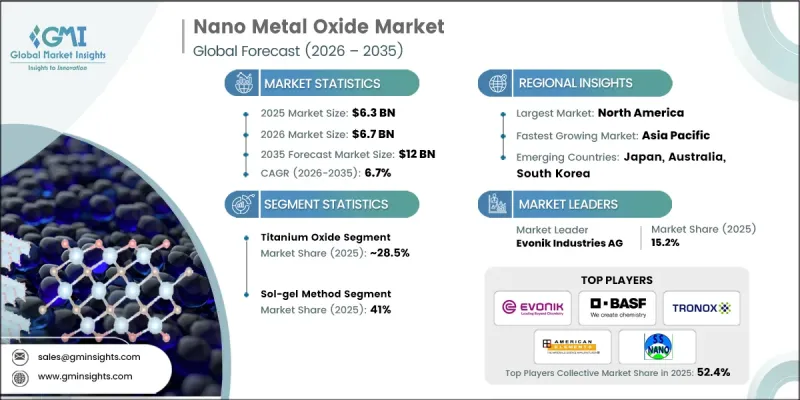
The Global Nano Metal Oxide Market was valued at USD 6.3 billion in 2025 and is estimated to grow at a CAGR of 6.7% to reach USD 12 billion by 2035.
Nano metal oxides, with particle sizes ranging from 1 to 100 nanometers, exhibit unique characteristics that differentiate them from their bulk counterparts, including increased surface area, enhanced chemical reactivity, superior mechanical strength, improved electrical conductivity, and advanced optical properties. These materials have found wide-ranging applications across electronics, healthcare, energy, cosmetics, and environmental remediation. In electronics, nano metal oxides are used for conductive coatings, semiconductors, and sensor technologies due to their exceptional conductivity and catalytic behavior. In the medical sector, they support targeted drug delivery, biomedical imaging, and cancer therapies due to their biocompatibility and precision delivery capabilities. Their use in energy applications, including solar cells, fuel cells, and catalytic processes, leverages their optical and catalytic efficiency to improve energy conversion and storage, supporting the advancement of renewable energy technologies worldwide.
| Market Scope | |
|---|---|
| Start Year | 2025 |
| Forecast Year | 2026-2035 |
| Start Value | $6.3 Billion |
| Forecast Value | $12 Billion |
| CAGR | 6.7% |
The titanium oxide segment held 28.5% in 2025 and is expected to grow at a CAGR of 5.9% through 2035. Titanium oxide maintains a strong market presence due to its extensive utilization across electronics, healthcare, and energy industries, including semiconductor fabrication and solar energy applications. Its chemical stability, optical clarity, and electrical properties make it a preferred choice for high-performance applications, driving continuous adoption in multiple sectors.
The sol-gel method accounted for 41% share in 2025. This technique allows manufacturers to produce nano metal oxides with precise particle sizes, shapes, and uniformity. The process involves hydrolysis and condensation of metal alkoxides to form a sol, followed by gelation and thermal treatment, resulting in high-quality oxide nanoparticles. The ability to control morphological and structural features through sol-gel synthesis ensures consistent performance across applications, which has solidified its dominance in nano metal oxide production.
North America Nano Metal Oxide Market was valued at USD 1.3 billion in 2025 and is expected to grow at a CAGR of 6.4% from 2026 to 2035. North America's growth is driven by advanced electronics, healthcare, and energy storage sectors, supported by a robust innovation ecosystem and a stringent regulatory framework for nanomaterials. The U.S. leads the region due to significant research and development investments, while Canada contributes through environmental and industrial nanotechnology research initiatives. This strong technological foundation enables the region to maintain a competitive edge in commercial production and application of nanometal oxides.
Key players operating in the Global Nano Metal Oxide Market include American Elements, SkySpring Nanomaterials Inc., Inframat Advanced Materials LLC, Advanced Nano Products Co. Ltd., Nanostructured & Amorphous Materials Inc., BASF SE, Tronox Holdings plc, Meliorum Technologies Inc., Sakai Chemical Industry Co., Ltd., Evonik Industries AG, NanoComposix Inc., Tayca Corporation, Reinste Nano Ventures Pvt. Ltd., PlasmaChem GmbH, Umicore, Hongwu International Group Ltd., and US Research Nanomaterials Inc. Companies in the Nano Metal Oxide Market are implementing strategies to strengthen their market presence through investment in high-precision manufacturing technologies that ensure particle size consistency, purity, and optimized functional performance. They are expanding regional operations via joint ventures, strategic partnerships, and mergers to access new end-use sectors. R&D efforts are prioritized to develop application-specific formulations for electronics, healthcare, and energy solutions. Firms are also focusing on sustainability by creating eco-friendly production processes and enhancing the recycling of nanomaterials. Supply chain optimization, intellectual property development, and collaboration with research institutions further support market competitiveness, while providing technical services and customized solutions help secure long-term client relationships and maintain a leading position in the global market.
Table of Contents
Chapter 1 Methodology & Scope
- 1.1 Market scope and definition
- 1.2 Research design
- 1.2.1 Research approach
- 1.2.2 Data collection methods
- 1.3 Data mining sources
- 1.3.1 Global
- 1.3.2 Regional/Country
- 1.4 Base estimates and calculations
- 1.4.1 Base year calculation
- 1.4.2 Key trends for market estimation
- 1.5 Primary research and validation
- 1.5.1 Primary sources
- 1.6 Forecast model
- 1.7 Research assumptions and limitations
Chapter 2 Executive Summary
- 2.1 Industry 360° synopsis
- 2.2 Key market trends
- 2.2.1 Regional
- 2.2.2 Grade
- 2.2.3 Form
- 2.2.4 Application
- 2.2.5 End use industry
- 2.2.6 Distribution channel
- 2.3 TAM Analysis, 2026-2035
- 2.4 CXO perspectives: Strategic imperatives
Chapter 3 Industry Insights
- 3.1 Industry ecosystem analysis
- 3.1.1 Supplier landscape
- 3.1.2 Profit margin
- 3.1.3 Value addition at each stage
- 3.1.4 Factor affecting the value chain
- 3.1.5 Disruptions
- 3.2 Industry impact forces
- 3.2.1 Growth drivers
- 3.2.1.1 Growing demand for advanced electronics & semiconductors
- 3.2.1.2 Expansion of energy storage & battery technologies
- 3.2.1.3 Increasing focus on environmental remediation
- 3.2.2 Industry pitfalls and challenges
- 3.2.2.1 High production costs & complex manufacturing processes
- 3.2.2.2 Health & safety concerns related to nanomaterial exposure
- 3.2.3 Market opportunities
- 3.2.3.1 Development of sustainable & green synthesis methods
- 3.2.3.2 Growth potential in cosmetics & personal care sector
- 3.2.1 Growth drivers
- 3.3 Growth potential analysis
- 3.4 Regulatory landscape
- 3.4.1 North America
- 3.4.2 Europe
- 3.4.3 Asia Pacific
- 3.4.4 Latin America
- 3.4.5 Middle East & Africa
- 3.5 Porter's analysis
- 3.6 PESTEL analysis
- 3.7 Price trends
- 3.7.1 By region
- 3.7.2 By product type
- 3.8 Future market trends
- 3.9 Technology and innovation landscape
- 3.9.1 Current technological trends
- 3.9.2 Emerging technologies
- 3.10 Patent Landscape
- 3.11 Trade statistics (HS code)
- 3.11.1 Major importing countries
- 3.11.2 Major exporting countries
- 3.12 Sustainability and environmental aspects
- 3.12.1 Sustainable practices
- 3.12.2 Waste reduction strategies
- 3.12.3 Energy efficiency in production
- 3.12.4 Eco-friendly initiatives
- 3.13 Carbon footprint consideration
Chapter 4 Competitive Landscape, 2025
- 4.1 Introduction
- 4.2 Company market share analysis
- 4.2.1 By region
- 4.2.1.1 North America
- 4.2.1.2 Europe
- 4.2.1.3 Asia Pacific
- 4.2.1.4 LATAM
- 4.2.1.5 MEA
- 4.2.1 By region
- 4.3 Competitive analysis of major market players
- 4.4 Competitive positioning matrix
- 4.5 Key developments
- 4.5.1 Mergers & acquisitions
- 4.5.2 Partnerships & collaborations
- 4.5.3 New Product Launches
- 4.5.4 Expansion Plans
Chapter 5 Market Estimates and Forecast, By Product Type, 2022-2035 (USD Billion) (Kilo Tons)
- 5.1 Key trends
- 5.2 Titanium oxide
- 5.3 Zinc oxide
- 5.4 Aluminum oxide
- 5.5 Copper oxide
- 5.6 Iron oxide
- 5.7 Chromium oxide
- 5.8 Other
Chapter 6 Market Estimates and Forecast, By Production Method, 2022-2035 (USD Billion) (Kilo Tons)
- 6.1 Key trends
- 6.2 Sol-gel method
- 6.3 Hydrothermal method
- 6.4 Precipitation method
- 6.4.1 Co-precipitation
- 6.4.2 Direct precipitation
- 6.5 Chemical vapor deposition (CVD)
- 6.6 Others
Chapter 7 Market Estimates and Forecast, By Particle Size, 2022-2035 (USD Billion) (Kilo Tons)
- 7.1 Key trends
- 7.2 Nanoparticles
- 7.3 Nanorods
- 7.4 Nanotubes
- 7.5 Nanowires
- 7.6 Others
Chapter 8 Market Estimates and Forecast, By Application, 2022-2035 (USD Billion) (Kilo Tons)
- 8.1 Key trends
- 8.2 Electronics & electrical
- 8.2.1 Semiconductors
- 8.2.2 Sensors
- 8.2.3 Display technologies
- 8.2.4 Conductive films
- 8.3 Energy storage & conversion
- 8.3.1 Batteries (li-ion, solid-state)
- 8.3.2 Supercapacitors
- 8.3.3 Solar cells
- 8.3.4 Fuel cells
- 8.4 Catalysis
- 8.5 Healthcare
- 8.6 Cosmetics & personal care
- 8.6.1 Sunscreens
- 8.6.2 Anti-aging products
- 8.6.3 Color cosmetics
- 8.7 Construction
- 8.8 Others
Chapter 9 Market Estimates and Forecast, By Region, 2022-2035 (USD Billion) (Kilo Tons)
- 9.1 Key trends
- 9.2 North America
- 9.2.1 U.S.
- 9.2.2 Canada
- 9.3 Europe
- 9.3.1 Germany
- 9.3.2 UK
- 9.3.3 France
- 9.3.4 Spain
- 9.3.5 Italy
- 9.3.6 Rest of Europe
- 9.4 Asia Pacific
- 9.4.1 China
- 9.4.2 India
- 9.4.3 Japan
- 9.4.4 Australia
- 9.4.5 South Korea
- 9.4.6 Rest of Asia Pacific
- 9.5 Latin America
- 9.5.1 Brazil
- 9.5.2 Mexico
- 9.5.3 Argentina
- 9.5.4 Rest of Latin America
- 9.6 Middle East and Africa
- 9.6.1 Saudi Arabia
- 9.6.2 South Africa
- 9.6.3 UAE
- 9.6.4 Rest of Middle East and Africa
Chapter 10 Company Profiles
- 10.1 Advanced Nano Products Co. Ltd.
- 10.2 American Elements
- 10.3 BASF SE
- 10.4 Evonik Industries AG
- 10.5 Hongwu International Group Ltd.
- 10.6 Inframat Advanced Materials LLC
- 10.7 Meliorum Technologies Inc.
- 10.8 nanoComposix Inc.
- 10.9 Nanophase Technologies Corporation
- 10.10 Nanostructured & Amorphous Materials Inc.
- 10.11 PlasmaChem GmbH
- 10.12 Reinste Nano Ventures Pvt. Ltd.
- 10.13 Sakai Chemical Industry Co., Ltd.
- 10.14 SkySpring Nanomaterials Inc.
- 10.15 Tayca Corporation
- 10.16 Tronox Holdings plc
- 10.17 Umicore
- 10.18 US Research Nanomaterials Inc.

