PUBLISHER: Global Market Insights Inc. | PRODUCT CODE: 2027627

PUBLISHER: Global Market Insights Inc. | PRODUCT CODE: 2027627
Ceramic 3D Printing Market Opportunity, Growth Drivers, Industry Trend Analysis, and Forecast 2026 - 2035
The Global Ceramic 3D Printing Market was valued at USD 295.9 million in 2025 and is estimated to grow at a CAGR of 13.7% to reach USD 1.1 billion by 2035.
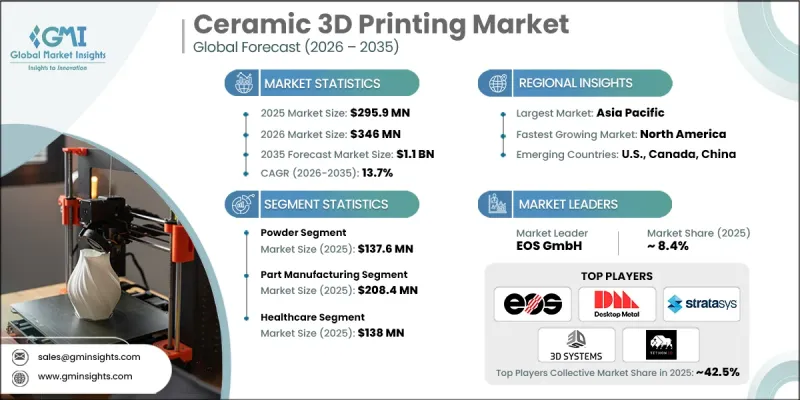
The growth is fueled by the ongoing advancement of additive manufacturing technologies, which enable producers to fabricate ceramic parts with intricate and precise designs previously unattainable. Improved resolution, accuracy, and operational reliability allow manufacturers to explore new applications across industries. Rising demand for high-performance ceramic materials in industrial production drives the market further, while the healthcare sector is adopting patient-specific solutions for dental and medical applications. Customized implants, crowns, and prosthetics are increasingly required, promoting materials that meet biocompatibility standards. Aerospace applications are also expanding, leveraging ceramic components for weight reduction and extreme temperature resistance. Overall, investments in production capacity, research, and technological development are accelerating market expansion while supporting broader adoption across industrial, healthcare, and aerospace segments.
| Market Scope | |
|---|---|
| Start Year | 2025 |
| Forecast Year | 2026-2035 |
| Start Value | $295.9 Million |
| Forecast Value | $1.1 Billion |
| CAGR | 13.7% |
The powder-based materials segment reached USD 137.6 million in 2025. This segment benefits from compatibility with binder jetting and powder bed technologies, which deliver precise results and scalable production. Powder remains the preferred choice as it aligns with performance requirements across applications and provides consistent quality in complex manufacturing processes.
The part manufacturing segment accounted for USD 208.4 million in 2025, driven by advancements in material properties and printing accuracy. Industries such as aerospace, electronics, and medical manufacturing are adopting ceramic additive manufacturing to produce durable, complex parts tailored to specific operational needs. Innovations in materials and specialized applications continue to generate new product developments, driving wider market acceptance.
North America Ceramic 3D Printing Market captured USD 92.6 million in 2025. The region benefits from technological advancements, early adoption of additive manufacturing, and collaboration across aerospace, defense, and medical sectors. Market expansion is fueled by continuous innovation funding, the increasing use of ceramic materials for thermal and structural applications, and manufacturing processes that enhance sustainability and operational efficiency.
Key players in the Ceramic 3D Printing Industry include Lithoz GmbH, EOS GmbH, 3D Systems Corporation, Desktop Metal, Stratasys, 3DCeram Sinto, Voxeljet AG, Admatec Europe BV, Tethon 3D, Kyocera Corporation, Saint-Gobain Weber, Nanoe (Zetamix), StoneFlower3D, Jiangsu Sanzer New Materials Technology Co., Ltd., and 3D Potter. Companies in the Ceramic 3D Printing Market are expanding their presence by investing in R&D to improve material formulations, printing precision, and operational scalability. Strategic collaborations with aerospace, medical, and electronics manufacturers are fostering new applications and increasing adoption. Firms are optimizing production processes, including powder handling and binder technologies, to enhance efficiency and part quality. Market participants are also exploring customized solutions for patient-specific medical devices and lightweight aerospace components. Investments in regional manufacturing hubs and supply chain infrastructure strengthen distribution networks, while continuous innovation in design software and post-processing techniques differentiates their offerings and maintains competitive advantages.
Table of Contents
Chapter 1 Methodology & Scope
- 1.1 Market scope and definition
- 1.2 Research design
- 1.2.1 Research approach
- 1.2.2 Data collection methods
- 1.3 Data mining sources
- 1.3.1 Global
- 1.3.2 Regional/Country
- 1.4 Base estimates and calculations
- 1.4.1 Base year calculation
- 1.4.2 Key trends for market estimation
- 1.5 Primary research and validation
- 1.5.1 Primary sources
- 1.6 Forecast model
- 1.7 Research assumptions and limitations
Chapter 2 Executive Summary
- 2.1 Industry 360° synopsis
- 2.2 Key market trends
- 2.2.1 Regional
- 2.2.2 Form
- 2.2.3 Application
- 2.2.4 End Use
- 2.3 TAM Analysis, 2026-2035
- 2.4 CXO perspectives: Strategic imperatives
- 2.4.1 Executive decision points
- 2.4.2 Critical success factors
- 2.5 Future Outlook and Strategic Recommendations
Chapter 3 Industry Insights
- 3.1 Industry ecosystem analysis
- 3.1.1 Supplier Landscape
- 3.1.2 Profit Margin
- 3.1.3 Value addition at each stage
- 3.1.4 Factor affecting the value chain
- 3.1.5 Disruptions
- 3.2 Industry impact forces
- 3.2.1 Growth drivers
- 3.2.1.1 Advancements in am technology enabling complex geometries
- 3.2.1.2 Rising demand for customized medical & dental solutions
- 3.2.1.3 Aerospace lightweighting & thermal management requirements
- 3.2.2 Industry pitfalls and challenges
- 3.2.2.1 High equipment & material costs limiting adoption
- 3.2.2.2 Quality assurance & defect detection complexities
- 3.2.3 Market opportunities
- 3.2.3.1 Expansion in electronics and energy application
- 3.2.3.2 Advancement in multi-material and hybrid manufacturing
- 3.2.1 Growth drivers
- 3.3 Growth potential analysis
- 3.4 Regulatory landscape
- 3.4.1 North America
- 3.4.2 Europe
- 3.4.3 Asia Pacific
- 3.4.4 Latin America
- 3.4.5 Middle East & Africa
- 3.5 Porter's analysis
- 3.6 PESTEL analysis
- 3.7 Price trends
- 3.7.1 By region
- 3.7.2 Form
- 3.8 Future market trends
- 3.9 Technology and Innovation Landscape
- 3.9.1 Current technological trends
- 3.9.2 Emerging technologies
- 3.10 Patent Landscape
- 3.11 Trade statistics (HS code)
- 3.11.1 Major importing countries
- 3.11.2 Major exporting countries
- 3.12 Sustainability and environmental aspects
- 3.12.1 Sustainable practices
- 3.12.2 Waste reduction strategies
- 3.12.3 Energy efficiency in production
- 3.12.4 Eco-friendly initiatives
Chapter 4 Competitive Landscape, 2025
- 4.1 Introduction
- 4.2 Company market share analysis
- 4.2.1 By region
- 4.2.1.1 North America
- 4.2.1.2 Europe
- 4.2.1.3 Asia Pacific
- 4.2.1.4 LATAM
- 4.2.1.5 MEA
- 4.2.1 By region
- 4.3 Company matrix analysis
- 4.4 Competitive analysis of major market players
- 4.5 Competitive positioning matrix
- 4.6 Key developments
- 4.6.1 Mergers & acquisitions
- 4.6.2 Partnerships & collaborations
- 4.6.3 New product launches
- 4.6.4 Expansion plans
Chapter 5 Market Estimates and Forecast, By Form, 2022 - 2035 (USD Million) (Tons)
- 5.1 Key trends
- 5.2 Powder
- 5.3 Resin
- 5.4 Filament
- 5.5 Others
Chapter 6 Market Estimates and Forecast, By Application, 2022 - 2035 (USD Million) (Tons)
- 6.1 Key trends
- 6.2 Rapid prototyping
- 6.3 Tooling
- 6.4 Part manufacturing
- 6.5 Others
Chapter 7 Market Estimates and Forecast, By End Use Industry, 2022 - 2035 (USD Million) (Tons)
- 7.1 Key trends
- 7.2 Healthcare
- 7.3 Aerospace & defense
- 7.4 Automotive
- 7.5 Others
Chapter 8 Market Estimates and Forecast, By Region, 2022 - 2035 (USD Million) (Tons)
- 8.1 Key trends
- 8.2 North America
- 8.2.1 U.S.
- 8.2.2 Canada
- 8.3 Europe
- 8.3.1 Germany
- 8.3.2 UK
- 8.3.3 France
- 8.3.4 Spain
- 8.3.5 Italy
- 8.3.6 Rest of Europe
- 8.4 Asia Pacific
- 8.4.1 China
- 8.4.2 India
- 8.4.3 Japan
- 8.4.4 Australia
- 8.4.5 South Korea
- 8.4.6 Rest of Asia Pacific
- 8.5 Latin America
- 8.5.1 Brazil
- 8.5.2 Mexico
- 8.5.3 Rest of Latin America
- 8.6 Middle East and Africa
- 8.6.1 Saudi Arabia
- 8.6.2 South Africa
- 8.6.3 UAE
- 8.6.4 Rest of Middle East and Africa
Chapter 9 Company Profiles
- 9.1 3DCeram Sinto
- 9.2 Lithoz GmbH
- 9.3 Admatec Europe BV
- 9.4 Voxeljet AG
- 9.5 EOS GmbH
- 9.6 StoneFlower3D
- 9.7 3D Potter
- 9.8 Tethon 3D
- 9.9 Nanoe (Zetamix)
- 9.10 Jiangsu Sanzer New Materials Technology Co., Ltd.
- 9.11 Kyocera Corporation
- 9.12 Saint-Gobain Weber
- 9.13 3D Systems Corporation
- 9.14 Desktop Metal
- 9.15 Stratasys

