PUBLISHER: Global Market Insights Inc. | PRODUCT CODE: 2027629

PUBLISHER: Global Market Insights Inc. | PRODUCT CODE: 2027629
Sand Tile Saw Market Opportunity, Growth Drivers, Industry Trend Analysis, and Forecast 2026 - 2035
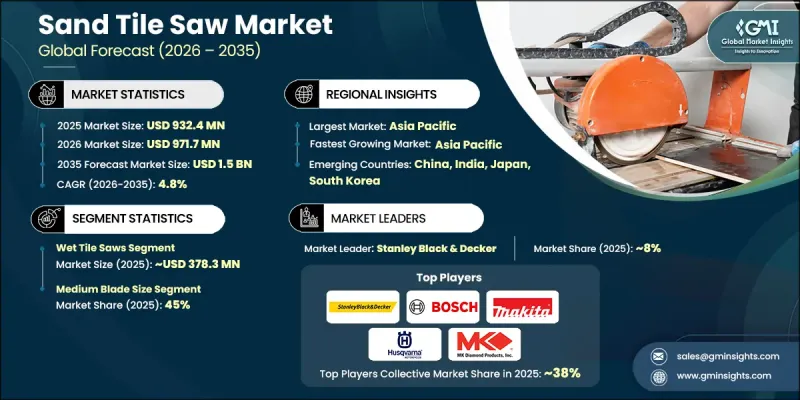
The Global Sand Tile Saw Market was valued at USD 932.4 million in 2025 and is estimated to grow at a CAGR of 4.8% to reach USD 1.5 billion in 2035.
Rapidly increasing rates of urbanization, along with the increasing rate of growth of the residential construction industry, are creating a demand for sand tile saws globally. The increasing rates of urbanization are creating a constant need to find new spaces to build homes, apartments, and offices, where tile work is an essential part of interior design. People are investing in tile work for floors, backsplashes, bathroom remodelling, etc. Sand tile saws help make precise, clean cuts in ceramic, porcelain, and even stone. The increasing number of people in the middle class in developing countries means a rise in investment in home remodelling and renovation. The modern way of constructing buildings focuses on quality finishes, which require professional tile work. The increasing rate of home remodeling, along with the rise of the DIY movement, encourages people to buy tile saws for their own purposes. The increasing rate of real estate construction in developing countries provides a constant demand for tile saws. People require strong, efficient tile saws to get the work done with minimal waste.
| Market Scope | |
|---|---|
| Start Year | 2025 |
| Forecast Year | 2026-2035 |
| Start Value | $932.4 Million |
| Forecast Value | $1.5 Billion |
| CAGR | 4.8% |
The wet tile saws segment accounted for USD 378.3 million in 2025 and is anticipated to grow at a CAGR of 5.1% from 2026 to 2035. The wet tile saws segment dominates the market due to superior cutting performance, dust suppression, and blade cooling capabilities. Wet tile saws use water to lubricate the blade and remove cutting debris, resulting in cleaner cuts and longer blade life. Professional contractors prefer wet saws for precision cutting of porcelain, ceramic, and natural stone tiles. Water cooling prevents blade overheating and enables continuous cutting operations on demanding materials. Dust suppression benefits improve workplace safety and comply with health regulations regarding silica exposure. Growing commercial construction, professional tile installation demand, and emphasis on cutting quality drive the adoption of wet tile saws. The technology's advantages in precision, safety, and productivity position wet tile saws as the leading segment in the market
The medium blade size segment held 45% share in 2025 and is anticipated to grow at a CAGR of 4.9% from 2026 to 2035. The medium blade size segment leads the market due to versatility across residential and commercial tile cutting applications. Blades ranging from 10 to 14 inches accommodate most standard tile sizes while maintaining portability and manageable equipment weight. Professional contractors value medium-sized saws that balance cutting capacity with jobsite mobility. The blade size range handles ceramic, porcelain, and natural stone tiles commonly used in residential and commercial installations. Medium saws provide sufficient cutting depth for standard flooring and wall tile applications. Growing demand for versatile equipment that serves multiple project types drives preference for medium blade sizes. The combination of cutting capacity, portability, and broad application suitability positions medium blade saws as the dominant segment in the market.
United States Sand Tile Saw Market reached USD 217.4 million in 2025 and is expected to grow at a CAGR of 5.2% through 2035. Market expansion in the region is supported by strong construction activity, increased renovation spending, and growing interest in home improvement solutions. The presence of well-established distribution channels and a strong preference for advanced tools continue to drive demand, while both professional users and individual consumers contribute to sustained market growth.
Key companies operating in the Global Sand Tile Saw Market include Makita, Husqvarna, Bosch, Rubi Tools, QEP, MK Diamond, RIDGID, Stanley Black & Decker, Skil, WEN, Dremel, Metabo, Lackmond Products, Felker (Target brand), and DeWalt. Companies in the Sand Tile Saw Market are enhancing their competitive position by focusing on innovation, product efficiency, and strategic expansion. Manufacturers are introducing advanced cutting technologies that improve precision, durability, and user safety. Many players are investing in lightweight and portable designs to meet evolving customer preferences. Expanding distribution networks, including online and offline channels, is helping companies improve accessibility and reach a broader customer base. Strategic partnerships and collaborations are also being adopted to strengthen market presence. Additionally, companies are emphasizing after-sales support, training services, and product customization to build long-term relationships with users. Competitive pricing strategies and continuous product upgrades further enable companies to maintain strong positioning in a highly competitive market landscape.
Table of Contents
Chapter 1 Methodology & Scope
- 1.1 Market scope and definition
- 1.2 Research design
- 1.2.1 Research approach
- 1.2.2 Data collection methods
- 1.3 Data mining sources
- 1.3.1 Global
- 1.3.2 Regional/Country
- 1.4 Base estimates and calculations
- 1.4.1 Base year calculation
- 1.4.2 Key trends for market estimation
- 1.5 Primary research and validation
- 1.5.1 Primary sources
- 1.6 Forecast model
- 1.7 Research assumptions and limitations
Chapter 2 Executive Summary
- 2.1 Industry 360° synopsis
- 2.2 Key market trends
- 2.2.1 Type
- 2.2.2 Blade size
- 2.2.3 Power
- 2.2.4 Power source
- 2.2.5 End user
- 2.2.6 Distribution channel
Chapter 3 Industry Insights
- 3.1 Industry ecosystem analysis
- 3.1.1 Supplier landscape
- 3.1.2 Profit margin
- 3.1.3 Value addition at each stage
- 3.1.4 Factor affecting the value chain
- 3.2 Industry impact forces
- 3.2.1 Growth drivers
- 3.2.1.1 Rapid urbanization and residential construction growth
- 3.2.1.2 Commercial construction and infrastructure development
- 3.2.1.3 Growing DIY home improvement and renovation trends
- 3.2.2 Pitfalls & Challenges
- 3.2.2.1 Competition from alternative cutting technologies
- 3.2.2.2 Economic sensitivity and construction cycle volatility
- 3.2.3 Opportunities
- 3.2.3.1 Technological innovation in cordless and portable systems
- 3.2.3.2 Growing demand for sustainable and eco-friendly building materials
- 3.2.1 Growth drivers
- 3.3 Growth potential analysis
- 3.4 Future market trends
- 3.5 Technology and innovation landscape
- 3.5.1 Current technological trends
- 3.5.2 Emerging technologies
- 3.6 Pricing analysis (driven by primary research)
- 3.6.1 Pricing analysis (driven by primary research)
- 3.6.2 Historical price trend analysis (driven by primary research)
- 3.6.3 Price Variation by material type & application
- 3.7 Regulatory landscape
- 3.7.1 Standards and compliance requirements
- 3.7.2 Regional regulatory frameworks
- 3.7.3 Certification standards
- 3.8 Porter's analysis
- 3.9 PESTEL analysis
- 3.10 Trade data analysis (driven by paid database)
- 3.10.1 Import/export volume & value trends
- 3.10.2 Key trade corridors & tariff impact
- 3.10.3 Regional trade dynamics & cross-border flow
- 3.11 Impact of AI & generative AI on the market
- 3.11.1 AI-driven disruption of manufacturing processes
- 3.11.2 GenAI uses cases (design optimization, predictive maintenance)
- 3.11.3 Risks, limitations & regulatory considerations
Chapter 4 Competitive Landscape, 2025
- 4.1 Introduction
- 4.2 Company market share analysis
- 4.2.1 By Region
- 4.2.1.1 North America
- 4.2.1.2 Europe
- 4.2.1.3 Asia Pacific
- 4.2.1.4 Latin America
- 4.2.1.5 Middle East & Africa
- 4.2.1 By Region
- 4.3 Company matrix analysis
- 4.4 Competitive analysis of major market players
- 4.5 Competitive positioning matrix
- 4.6 Key developments
- 4.6.1 Mergers & acquisitions
- 4.6.2 Partnerships & collaborations
- 4.6.3 New product launches
- 4.6.4 Expansion plans
Chapter 5 Market Estimates & Forecast, By Type, 2022 - 2035, (USD Million) (Thousand Units)
- 5.1 Key trends
- 5.2 Wet tile saws
- 5.3 Dry tile saws
- 5.4 Portable tile saws
- 5.5 Stationary tile saws
Chapter 6 Market Estimates & Forecast, By Blade Size, 2022 - 2035, (USD Million) (Thousand Units)
- 6.1 Key trends
- 6.2 Small (up to 10 inches)
- 6.3 Medium (10 to 14 inches)
- 6.4 Large (over 14 inches)
Chapter 7 Market Estimates & Forecast, By Power, 2022 - 2035, (USD Million) (Thousand Units)
- 7.1 Key trends
- 7.2 Upto 2 HP
- 7.3 2-5HP
- 7.4 Above 5 HP
Chapter 8 Market Estimates & Forecast, By Power Source, 2022 - 2035, (USD Million) (Thousand Units)
- 8.1 Key trends
- 8.2 Electric
- 8.3 Battery operated
- 8.4 Gas operated
Chapter 9 Market Estimates & Forecast, By End-use, 2022 - 2035, (USD Million) (Thousand Units)
- 9.1 Key trends
- 9.2 Residential
- 9.3 Commercial
- 9.4 Industrial
Chapter 10 Market Estimates & Forecast, By Distribution Channel, 2022 - 2035, (USD Million) (Thousand Units)
- 10.1 Key trends
- 10.2 Direct
- 10.3 Indirect
Chapter 11 Market Estimates & Forecast, By Region, 2022 - 2035, (USD Million) (Thousand Units)
- 11.1 Key trends
- 11.2 North America
- 11.2.1 U.S.
- 11.2.2 Canada
- 11.3 Europe
- 11.3.1 Germany
- 11.3.2 UK
- 11.3.3 France
- 11.3.4 Italy
- 11.3.5 Spain
- 11.4 Asia Pacific
- 11.4.1 China
- 11.4.2 India
- 11.4.3 Japan
- 11.4.4 South Korea
- 11.4.5 Australia
- 11.5 Latin America
- 11.5.1 Brazil
- 11.5.2 Mexico
- 11.5.3 Argentina
- 11.6 MEA
- 11.6.1 Saudi Arabia
- 11.6.2 UAE
- 11.6.3 South Africa
Chapter 12 Company Profiles
- 12.1 Bosch
- 12.2 DeWalt
- 12.3 Dremel
- 12.4 Felker (Target brand)
- 12.5 Husqvarna
- 12.6 Lackmond Products
- 12.7 Makita
- 12.8 Metabo
- 12.9 MK Diamond
- 12.10 QEP
- 12.11 RIDGID
- 12.12 Rubi Tools
- 12.13 Skil
- 12.14 Stanley Black & Decker
- 12.15 WEN

